Category Archives: Popular culture

Don’t judge too quickly (clever ads from extinct company)

A friend shared with me these video ads that have apparently been making their way, in a viral form, across the Internet. First time I had seen them, though, and I enjoyed them enough to pass them on to you.

Ironically, the service it advertises — Ameriquest Mortgage — ceased to operate under that name two years ago. So I guess cleverness isn’t everything.

Before we move on, could you (briefly) explain the Jacko thing to me?

My first thought glancing over the news today is, OK, after today can we move on? No more Michael Jackson this, Michael Jackson that, wherever I turn?

But then my second thought was, While I don’t want to delay the moving-on thing, could someone explain to me what everybody is worked up about?

I don’t get it, and I never will. It’s related, I think, to the phenomenon on reality shows in which the audience screams constantly — not when something remarkable happens on the stage, or someone shouts “fire!” — but at everything that happens, everything that is said. It drives me nuts, and my wife and daughters get tired of me complaining about it when they’re watching their dancing shows, but it still bugs me because I don’t get it. Why is it that exciting?

As for Michael Jackson — well, I don’t want to speak ill of the dead; I just look forward to when we’re not speaking about him at all. What I think about him now is what I thought four years back:

Tuesday, 14 June 2005

What’s WITH these people?

Celebrity worship is a mystery to me. This puzzlement is deepened by the case of Michael Jackson.

OK, I can sort of understand how someone might have become a fan of his at one point. In the early ’80s, he was a remarkably talented young black man. But now that he is no longer young, or black, or manly in any way you’d notice, and hasn’t put forth any striking evidence of talent lately, about all he’s got left is being remarkable. And not in a good way.

I’m not saying this to be mean or anything like that. I just don’t see how, beyond memories of some catchy tunes and dancing that seemed to defy physical laws, anybody would feel any sort of emotional involvement in anything that Mr. Jackson does, or anything that happens to him or doesn’t happen to him.

And yet there are people who really, really cared what happened in his trial. Michael_jackson_fans They were willing to put their whole lives in suspense over whether he was found “guilty” or “not guilty.” They made it their business to be there at the courthouse, as close to his side as possible. They were ecstatic at the verdict.

What I want to know is, Why? It seems to me that even a cursory examination of the stipulated facts regarding Mr. Jackson would give any sensible person considerable pause. I mean, I can seeing pitying a man who lives in a fantasy world and sleeps with young boys to whom he is not related (even innocently), and has obsessively done bizarre things to his own body. But I can’t see how anyone would admire him, or hitch one’s own happiness to his fate.

I’d appreciate any insight that anyone out there has into this phenomenon. If I could understand this, maybe I could understand the whole celebrity culture.

Anyway, before we move on, does anyone have an explanation for me? Preferably, a brief one?

That settles it: Miss SC says Sanford should stay

I posted this on Twitter this morning, but I didn’t want y’all to be left out of the loop. The Spartanburg paper reports that the newly-crowned Miss South Carolina says our governor should stay, even though she was “a little shocked” by his recent confessions:

Newly crowned Miss South Carolina Kelly Sloan said in an interview Sunday that the embattled governor of the state she’s now the public face of should be allowed to finish his second and final term…

“People make mistakes,” Sloan said. “I was a little shocked, to tell you the truth. But as a governor, he’s done his job. I do not think he should resign. He’s asked for forgiveness, and I think forgiveness is something we should all have for one another.”

One wonders what she means by “He’s done his job,” but hey, who’s quibbling? Could I win a beauty contest? I don’t think so. Then I should ne’er presume to second-guess her. As Theodoric of York would say, “Who’s the barber here?”

No word yet on what Her Majesty thinks about the abdication of former beauty queen Sarah Palin, or the all-important, burning issue of Michael Jackson still being dead.

Speaking of which, did you see that TV networks plan to anchor the news from his memorial service? In a world in which priorities are that far out of whack, I suppose it’s not out of line at all to ask a beauty queen about who should govern us…

Just look down at your shoes and walk away, gov

Last night while channel-surfing and finding nothing good, I stopped for a moment on an old “Roseanne” episode. The plot was about as tacky as you can imagine: Roseanne was concerned about her daughter’s sex life, of all things, and was nagging her husband (John Goodman) to talk to the daughter’s husband about it (at least, I hope he was her husband).

Goodman, of course, refused. Under the Guy Code, that was not a permissible topic. Sports, cars, whatever, but not personal relationships. Roseanne was disgusted with him, but he was adamant.

Next scene, Goodman is in the breakroom at work, and another guy (I’m gathering he was Roseanne’s sister’s husband) starts trying to get a conversation going about relationships and sex. Finally, he’s so obvious about it that the daughter’s husband storms out, realizing the topic is his own sex life. Goodman reproaches the guy who brought up the topic, saying he knew Roseanne had put him up to it.

This causes an argument in which the other guy reveals something intimate that he knows about Goodman and his wife, and Goodman counters with something equally personal and inappropriate. Then he stops, shocked, and says something like “We know way too much.” A shocked pause, then he says (more or less), “There’s nothing to do now except to look down at our shoes and quickly walk away.”

Both men simultaneously break eye contact, jerking their heads downward to look at their feet, and walk quickly from the room via separate doors.

Which is what any man with any self respect would do. And it’s what Mark Sanford should have done some time ago — certainly before that bizarre interview that came out yesterday.

Netflix guilt

Like I don’t have enough things to worry about, now I’m coping with Netflix Guilt.

It goes like this:

Once, a year or so ago, I put “Bloody Sunday” onto my list, figuring I should take more interest in how the Troubles started. Somehow it wriggles its way to the top of the queue, and comes to my house. I watch a bit of it. It’s shot in a documentary style. I can pick out, early on, characters who are Not Going to Make It. They are, of course, sympathetic characters. I know they represent real people, not fiction. I know there’s nothing I can do the inevitable slide toward this brief orgy of violence. It takes me about five tries to get almost all the way through the movie, and I still haven’t accomplished it, weeks later. I feel like I don’t care enough about violence in Ireland if I don’t watch it to the end, so I haven’t sent it back.

Trying to turn away from “Bloody Sunday,” I order “The Wrestler,” which has gotten all sorts of good reviews. I start watching it. I can see why it got good reviews. Have to wonder, does Mickey Rourke’s body actually look like that, or is that fake. Can see that this character’s “arc” is not upward. Quickly get tired of the seediness, and the character’s sadness, despite early glimpses of Marisa Tomei nearly nude. Feel like I have to watch it to the end, because this is a Serious Movie.

But I don’t want to.

Hence, Netflix Guilt.

I also have “Defiance.” Should I start watching it instead, if I actually get time for movie watching tonight? And… he asks with trepidation — will I like it any better? Will it be any better than the second James Bond movie he did? And if it isn’t, will I still feel like I have to watch it because it’s about a serious historical subject? Probably.

Der Führer pans the new “Star Trek”

Saw this video spoof earlier in the week and meant to share it. Since I hadn’t posted anything all day, I might as well post it now.

Think of the creative energy it takes to produce something like that on YouTube, and the site is just full of stuff like that.

This was brought to my attention by my high school classmate Burl Burlingame, who blogs out of Honolulu. He works for the Star-Bulletin. Aside from the fact that he still has his job, he and I have been on parallel tracks lately. He also just fell into the twin traps of Facebook and Twitter, so we have commiserated this week.

Burl and I graduated from Radford High School in 1971. You may recall I wrote something about those days in my column last fall, “Barack Like Me.” Burl got into journalism earlier than I did; he published an underground newspaper at Radford. The one thing I remember clearly about that was that he used to refer to our principal, who was virtually never seen by the students (I never saw him that whole senior year, although I knew people who said they’d met him), as “the Ghost Who Walks.” The principal’s name was Yamamoto. Not the admiral who planned the Pearl Harbor attack; another Yamamoto. (Actually, come to think of it, he could have been the admiral for all we knew, since we never saw him.)

It’s particularly meaningful to me that Burl posted something making fun of Nazis. You may have noted that the lede story in The State today was about a high school prank. A particularly nasty, destructive high school prank, but still a senior prank. Our senior prank at Radford back in 71 was less destructive, but more creative.

About a dozen of us staged a revolution to take over the school. Or rather, in guerrilla fashion, we took over a classroom at a time and quickly moved on. We wielded water guns, and wore rather elaborate paramilitary costumes. Most of us had recently seen Woody Allen’s “Bananas,” and were largely inspired by that, only we were far more international. Our leader was Steve Clark, who was dressed in full military regalia as “El Presidente.” He spoke only Spanish in keeping with his character, which no one but I understood, so I translated all of his commands, being second in command. My character’s back story was that I had been a top officer in the Israeli Defense Force but had been drummed out for something or other and had turned mercenary. Overly elaborate, perhaps, and the nuances were probably not obvious to our audience, but we didn’t care.

Burl’s character was an unrepentant old Nazi whom we had found hiding in Argentina, loudly fulminating at everyone in a vaudeville German accent. He would particularly abuse me, since my character was supposed to be Jewish, and of course I would take offense, and our comrades would have to separate us to prevent violence. Yes, it was that politically incorrect. We wanted to be edgy, and thought ethnic humor, even ethnic humor that dark, to be funny, a la Mel Brooks with “Springtime for Hitler.” We were kids, and stupid. Or rather, a little too “clever” for our own good.

We were most successful in taking over Mrs. Burchard’s English class. Mrs. Burchard was my favorite teacher ever. You can see a picture of her on that same page that I linked to about Mr. Yamamoto, on the virtual yearbook that (I think) Burl put together a few years back. (Cute, isn’t she?) She was a real sport, and played along. When some of her underclassmen students failed to give El Presidente proper respect (as we defined it), we lined them up against the blackboard and hosed them down with the water guns — but only after Mrs. Burchard had fallen on her knees before us to beg us to spare them. She was awesome.

The revolution ended badly, as most do. Some juniors mounted a counterattack on our position, and I caught a water balloon in the groin. C’est la guerre.

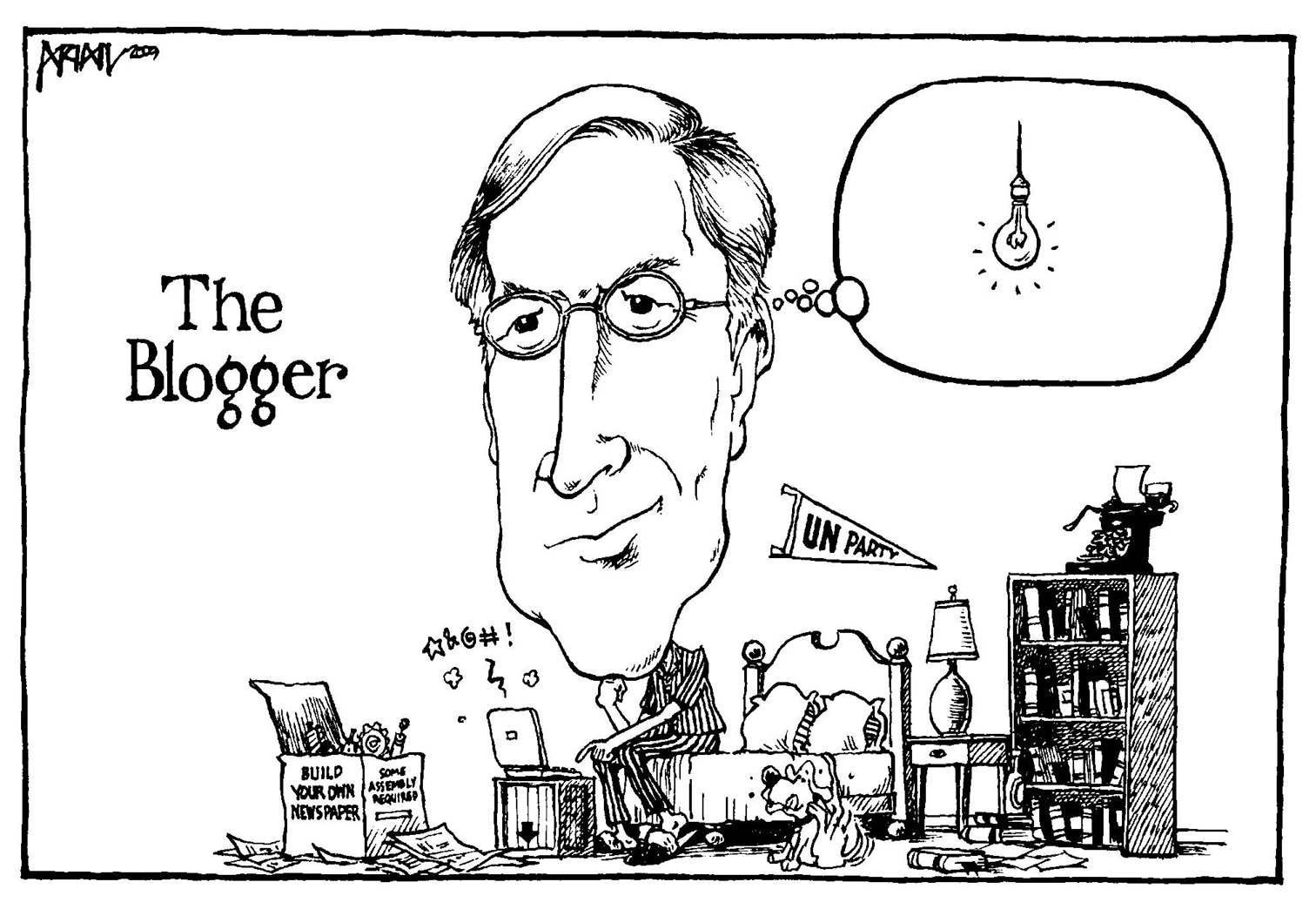
My caricature (an Ariail original, I’ll have you know)

caricature72

My colleagues from the editorial department (both past and present) had a going-away party for Robert and me Sunday night, which was really, really nice. (Why so long after we left? It was the first time that Cindi, who hosted the shindig at her place, could round up enough of us.) Aside from the present crowd, the blasts from the past included Kent Krell, Nina Brook, Mike Fitts, Claudia Brinson and John Monk — plus former publisher Ann Caulkins, who came all the way down from Charlotte just for the party, which really touched me. And a special appearance by Lee Bandy.

Actually, I’m deeply touched by everyone who played a role in the event (some would say, of course, that I am just “touched,” period). It was really great. You know, an awful lot of people just keep doing things to prevent me from feeling bad about getting laid off, so I don’t know when the shock sets in.

Anyway, a highlight of such events is always the reading of the mock page, which I won’t go into, except to say that it was full of relatively inside jokes. Some of it was a little more mainstream, such as this excerpt from a column in which I am announcing my plan to run for governor on the Unparty ticket:

Thus validated, I concluded that
there’s no way South Carolina can
get anywhere without the leadership
of my Un-Party, which we’ll
begin to demonstrate just as soon
as we can settle on what
we believe in.
We’re for a strong,
energy-independent
America, respected
worldwide. As is everybody.
We’re for a South Carolina
that pays workers
the same wages that people
expect in the rest of
America. As is everybody.
We’re for a South
Carolina that takes care
of its citizens, and makes
sure that all its children
have a good education.
As is everybody, except
Gov. Sanford.
I talked about my idea with the
governor, who listened to indulge
his self-image as political scholar.
“At the end of the day, Brad,
you’ve got to decide if South Carolina
now has the right soil conditions
for you to grow your political
endeavor,” he said.
“Well, you’ve certainly added
fertilizer to our soil,” I replied.
“You’ll have a problem convincing
voters that your Un-Party
will be as good at un-governing the
state as I have been. After all, I’ve
given the state a new definition of
un-leadership,” he said.
I then took the opportunity to
take a few quick photos and a
video for the Web. Quality wasn’t
so good, as it turned out, since this
was a phone conversation.
“The question, to me, at the end
of the day, is whether you hate
government enough to want to run
it. I don’t think you do, Brad, but
so it goes. To be continued.”
As I disconnected my telephone
headset, I looked up to see Robert
Ariail waiting for me, sketches in
hand. He might well have been
standing there for 15 minutes, just
waiting. Cartooning is not a profession
for the sane.

I should stop there, because I know most of the stuff my colleagues never intended to see published. Oh, all right, one more sample, and then I’m going away. Here, the wiseguys were making fun of my weakness for pop culture allusions (particularly The Godfather) and my propensity to digress, parenthetically, to an absurd degree:

But just as useful for the purpose of creating thinly connected
film-derivative metaphors about politics, government, society or
whatever we might be struggling to make a coherent point about
is the warning that “When they come, they come at what you
love,” with its implicit imperative to preserve and protect the
family. It is an imperative that is made unmistakably explicit in
the words of Don Vito Corleone in the initial 1972 film, The Godfather,
by far the finest movie ever produced (South Carolina, of
course, does not have a don. The governor should be the don,
and others in the organization should tremble at his approach.
But because he does not have the power to rub out discordant
rivals on a whim, instead we must endure the endless gang warfare
we see at the State House.), when he asks apostle Luca
Brasi, who was very handy with a garrote: “Do you spend time
with your family? Good. Because a man that doesn’t spend time
with his family can never be a real man.” (Of course, if Luca
Brasi had spent all the time that he should have with his family,
the core unit and strength of our society, then maybe he wouldn’t
have ended up sleeping with the fishes.)

OK, so you had to be there (like, in the office for the last 22 years). I thought it was a hoot.

And of course, the don didn’t say that to Luca; he said it to Johnny Fontane. But you knew that.

Finally, there was the cartoon — the original of which Robert gave me, framed. Which is very cool (no one on my block has an original Ariail caricature of them, ha-ha). Yet another thing that makes getting laid off worthwhile.

Ya know what I think I might do?…

Surfing channels a few minutes ago, I ran into an Andy Griffith gem that I had to go to Facebook and share with my oldest friend in the newspaper biz, Richard Crowson (you know, the cartoonist who got laid off about six months before Robert and I did). I wrote to him:

You know what I just saw, not two minutes ago? Andy and Barney were just a-settin’ on the porch, talking about going downtown to get a bottle of pop. Andy allowed as how he reckoned it might be a good idea, and Barney he said the same right back at him, and they were poised to act upon the suggestion when they noticed the fella they were a-settin’ thar with had fallen asleep, and the episode ended on that high note.

Deeply satisfying.

May none of y’all will appreciate that the way Richard would, but I pass it on just in case.

Here’s the actual dialogue:

Andy: You know what would be a good idea? If we all went up town and got a bottle of pop?
Barney: That’s a good idea, if we all went up town to get a bottle of pop.
Andy: You think Mr. Tucker would like to go?
Barney: Why don’t we ask him…..if he’d like to go uptown to get a bottle of pop?
Andy: Mr. Tucker?
(No response from Mr. Tucker)
Andy: You wanna lets me and you go?
Barney: Where?
Andy: Uptown to get a bottle of pop?
(Camera pans to a sleeping Mr. Tucker, with a completly peeled apple skin dangling from
his hand.)

I’ll go to bed now and stop bothering y’all.

Whad’Ya Know? Plenty.

notmuch

In case you missed the show today, here’s everything you need to catch up and be like the cool kids.

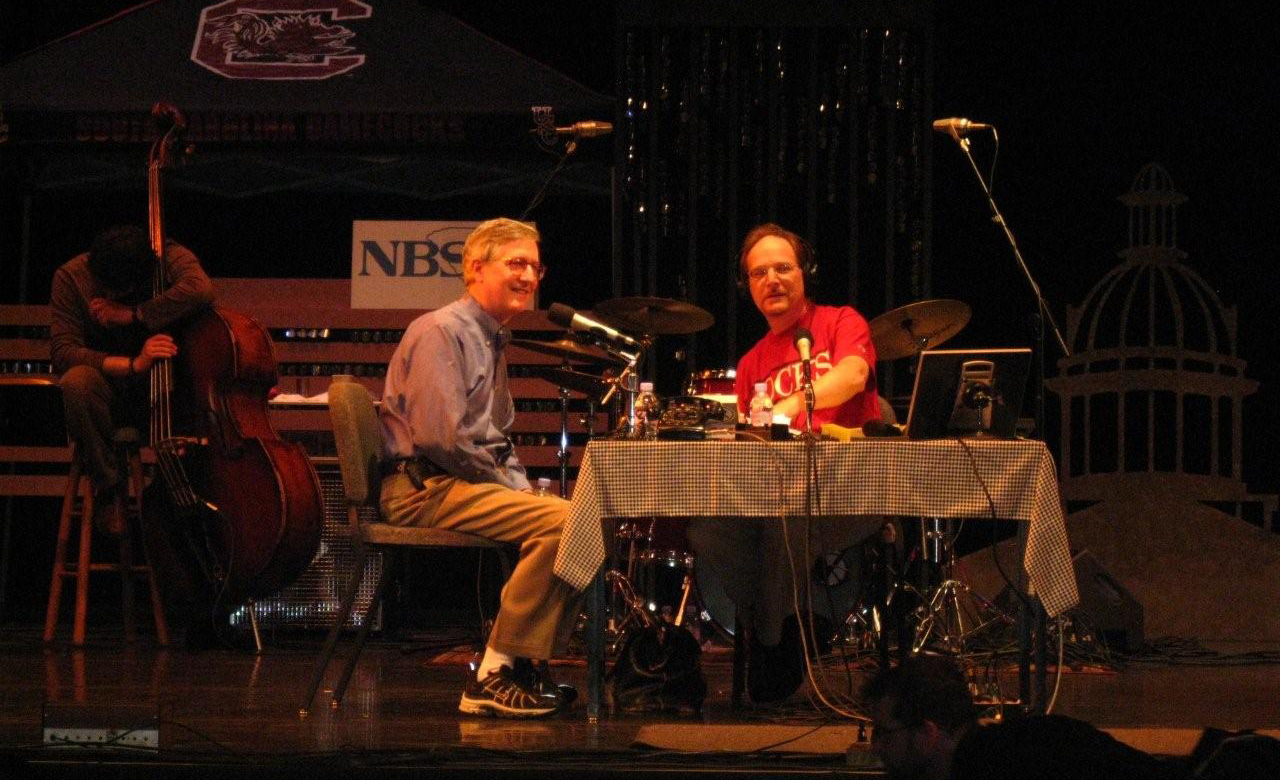
First, we have a photo above taken by my favorite “pollster,” Emerson Smith. It shows me with Michael Feldman (that’s Michael in the garnet “Cocks” shirt). That’s bassist Jeff Hamann hanging his head in the background; I don’t know what I said to make him do that.

Then, there’s this synopsis of the segment featuring me from the Web site, notmuch.com:

:10 – Michael talks with Brad Warthen, formerly of The State Newspaper and blogger of “all the opinions that weren’t quite good enough to put in the actual paper.” See http://blogs.thestate.com/bradwarthensblog/. Warthen was the Vice President of the paper and the Editor of the editorials and lost his job. What happened?! “It’s happening all over,” Warthen said. He and Michael talk about the state of the economy in South Carolina. The Governor of South Carolina doesn’t want to accept federal stimulus funds, “because he doesn’t believe in public education. He actually has control over this. Congress is sending out this money in a way that allows Governors to apply for it, assuming that they will. This is actually a moment in which he actually gets to make a decision…and we see the quality of the decision he’s made.” Other political hot buttons? “Everything is related to [the Governor’s choice]. We have 11.4% unemployment,” for example. The cigarette tax is .07 cents…it’s the lowest in the country, “all but subsidizing kids to smoke.” Is Columbia a Democratic enclave? Richland County is. Lexington County, where Warthen lives, has been one of the most Republican counties in the country. The University of South Carolina is working on a new fuel initiative. In the area of research, there’s unprecedented cooperation between USC and Clemson. Michael asks Warthen if he has season tickets. “I do not…I’m not a football fan,” he admits. He went to school here for one semester, started in the Honors College, but had a disasterous experience. “There was all this freedom!” he exclaimed. He transferred to Memphis State University after that, and majored in journalism and history. See bradwarthen.com for Warthen’s online columns, or his blog noted above.

Or, you can go to that same link and listen to the whole show.

Finally, for those who wonder what goes on in the moments before the show, here’s some very bad video from my phone, shot from the wings. About the only part you can hear clearly is when Michael is coaching the audience to say “Not much. Y’all?” instead of the usual “Not much. You?”

If you’ll forgive the cliche, a good time was had by y’all.

Whad’Ya Know? I’m gonna be on the radio

Don’t know if I mentioned this, but I’m going to be on “Whad’Ya Know?” when it broadcasts live from the Koger Center on Saturday. Show starts at 11, but I have to be there at 10:30. They said there’d be coffee.

And that’s about it. No prep. I’m told that host Michael Feldman is prepping by reading thestate.com and this blog, which is probably why his signature answer to the title question is, “Not much.” The Web site, in case you haven’t been there, is notmuch.com.

And if you haven’t seen the show at all, Otis Taylor provided a taste of what it’s like in his story today. The State also provided some “if you’re going” info.

Do you know what your sin is?

Yes, that’s a quote from “Serenity” — the Operative, in point of fact. Do you know, I once took a quiz online to find out “which “Firefly” character are you?,” and it said I was the Operative. Some of my libertarian friends out there will get a chuckle out of that, but I didn’t like it a bit. Then I took it several more times — going the other way on questions that had been close calls — and each time I was somebody else. Never did get to be Jayne, though, which was disappointing. I didn’t even get to be Mal (I was stuck with the doctor — my least favorite character — and Shepherd Book).

But that’s not the point of this post. The point is that I did the first reading in Mass today, which is a rare privilege. I much prefer doing the 1st reading (Old Testament, usually), but I almost always get scheduled to do the 2nd (usually Paul’s epistles). I really get into the Old Testament readings — they tell stories; they take you somewhere — while Paul is usually too dry and abstract to mean as much to me as it should.

So it fell to me today to do the 1st reading, and this was it, from Jeremiah 31:

The days are coming, says the LORD,
when I will make a new covenant with the house of Israel
and the house of Judah.
It will not be like the covenant I made with their fathers
the day I took them by the hand
to lead them forth from the land of Egypt;
for they broke my covenant,
and I had to show myself their master, says the LORD.
But this is the covenant that I will make
with the house of Israel after those days, says the LORD.
I will place my law within them and write it upon their hearts;
I will be their God, and they shall be my people.
No longer will they have need to teach their friends and relatives
how to know the LORD.
All, from least to greatest, shall know me, says the LORD,
for I will forgive their evildoing and remember their sin no more.

One of the ways that my faith manifests itself is that I see meaning in my being chosen to read this to the people. And this reading seems particularly pregnant with meaning for me.

You see, I’m going through a rough patch in my professional life at the moment — what with being laid off and all. And it reminds me of when I went through a much worse one, almost exactly 22 years ago. And God delivered me and my house from that. I’ll tell you the story of it in greater detail another time, but suffice it to say that the four seemingly interminable days it took my wife and me to drive our two cars and (then) four young children out of the Western wilderness to the East Coast caused the 40 years of wandering in the desert to be much more immediate and real for me. And I have always thanked God for leading us out of there, to the land of my fathers, where we have been blessed.

So that part of the reading, about the earlier covenant when God took the people by the hand and led them out of Kansas — I mean, Egypt — is a reference I personally find applicable.

But God says through Jeremiah that that deal is now off, just as my time of being blessed in my job at The State is over.

So that leaves me with two questions:

  1. What was my sin, if indeed sin there was? Maybe there wasn’t one in particular, since I don’t feel all that much of a sense of loss. But if there was one, I should know what it was.
  2. What’s the new deal?

Mostly lately, my mind has been focused on the new deal, the new covenant that lies before me. As it has begun to take shape — just bits of it so far — I’ve gotten pretty excited about it. And the mind naturally turns to “What’s next?”

But this reading causes me to wonder: Is there a lesson yet to be learned from where I was? If so, I need to figure that out. I’m planning on going to the Lenten Reconciliation Service at St. Peter’s Monday night. So I’m reflecting upon this…

Too heavy for you? Well, then go to the mall, as Jack Black’s character said in “High Fidelity,” just to bring us back to the realm of pop culture, for those who are more comfortable there.

Getting paid to have a blast: Working with Robert

robert1

By BRAD WARTHEN
Editorial Page Editor
REMEMBER “The Dick Van Dyke Show”? For you younger folks, it was about a guy named Rob Petrie, the head writer for a fictional variety show (and if you’re too young to know what a “variety show” is, go look it up) called “The Alan Brady Show.”

There were these wonderful scenes of Rob and his colleagues at work, writing comedy sketches — a process that involved a lot of bouncing around the office, acting out and collaborative improvisation. Morey Amsterdam’s frenetic character would jump up and say something like, “OK, so Alan walks into the room…” and the other two would throw in various wild things until they made each other laugh, and the skit would take shape. It looked like the most fun a person could possibly get paid for having.

That’s what it’s been like working with my friend Robert Ariail over the past 15 years. Just like that.

Robert would come into my office after the other editors and I were done with our morning meeting (Robert doesn’t do meetings), usually with several sketches. Sometimes he’d come with nothing, but that was unusual. I’d react to the sketches, maybe suggesting dialogue changes, maybe an entirely different approach. Robert pays me the compliment of saying I think like a cartoonist. And I do. I have everything it takes — except the talent.

Robert has truckloads of that. He can sketch an idea as quickly as you can describe it, and many of those initial sketches could be published as they are. But was he satisfied? No way. He might go through 10 versions in the course of the day, coming back to my office several times to seek further feedback. This was fine, although more often than not, his first instincts were the best. He would refine, and it would get better and better, but he usually had it nailed from the start.

As you know, Robert and I are both leaving the paper. Today is our last day. Such is the state of our industry. So much for getting paid to have fun, for a collaboration that almost daily, for years on end, had both of us laughing like a couple of hyenas on nitrous oxide. How many people get to do that for even one day? We’ve had 15 years, and for that I feel blessed.

But it hasn’t been just about fun. What Robert has done has mattered, to South Carolina and the nation (which is why he’s won every national award except the Pulitzer, and he’s been a finalist for that twice). Robert can pack more punch into a cartoon than I can get into a hundred columns. There’s just something about a funny picture with a point.

That’s why the prestigious Calhoun Lecture Series at the Strom Thurmond Institute at Clemson University had Robert deliver the last talk of the term, just last week. He spoke of the history of cartooning in general, and at The State in particular. Among other things, he told this story:

Robert is the second cartoonist actually to be employed (rather than contributing on a freelance basis) by the paper. During the 1910 gubernatorial campaign, the first one did a cartoon on the race-baiting populist Cole Blease. It was hard-hitting. The surviving Gonzales brothers (original editor N.G. Gonzales had been gunned down five years earlier) didn’t see the cartoon before it appeared in the paper. The cartoon was seen as so harsh that it was widely believed to have helped Mr. Blease win the election, by causing voters to feel sorry for him. The Gonzales brothers apparently decided that having a cartoonist was a risky thing, because they never hired another one.

In fact, the position remained vacant until Robert filled it in 1984. Before he started, he was interviewed by the late Ben Morris, then the publisher, who just had one thing to tell Robert: “Don’t surprise me.” It wasn’t until Robert read the history later that he understood the reference.

Here’s hoping cartoonists aren’t like comets. Here’s hoping it doesn’t take another 74 years for another one to streak across the sky.

Perhaps I’m being overly dramatic. After all, Robert will still be around. He has a new Web site, robertariail.com — just being set up as I write this — where he will post new cartoons, and where you can find links to his old ones. And he will still be syndicated nationally, which provides him with a monetary incentive to keep ’em coming.

Beyond that, I’m happy to have reason to believe Robert will be just fine.

You see, Robert is not my first close cartoonist friend. Richard Crowson and I were at Memphis State University together in the early ’70s. The first column I wrote for the editorial page of the journalism department lab paper was illustrated by a Crowson cartoon. After college, he and I worked together for a decade at The Jackson (Tenn.) Sun. After I became news editor at the much-larger paper in Wichita, Kansas, in 1985, I persuaded Richard to pull up roots and join me out West.

So imagine how I felt when The Wichita Eagle laid Richard off six months ago — for the same reasons Robert and I are leaving The State. I was so torn up about it that I didn’t call Richard to talk about it until two days ago. And guess what? He’s happy as a clam. “For me personally, the layoff has just been great,” he said as he was driving to a recording session (he’s the finest bluegrass musician I’ve ever known). “I don’t have any money, but… how do you put a value on peace of mind?” He doesn’t miss the daily pressure one bit.

And after all my worrying. Robert’s, too. We knew he was not long for this newspaper. Sadly (for me), it has cast a pall over our daily brainstorming sessions, sometimes making me impatient and crabby — although Robert kept cranking out wonderful cartoons anyway.

But the past few days, since the news broke, have been great. With the pressure off, the old fun has returned. That may sound odd, but it’s true.

And this is the way I’m going to remember it.

Robert and I will still collaborate at every opportunity. Find his future work at robertariail.com. My new address is bradwarthen.com.

robert2

‘I killed the president of Paraguay with a fork. How’ve you been?’

Just had to smile when I saw a release a few minutes ago from a company that does “pet health insurance.” Smiling not at the company, but at the association it brought to mind.

It made me think of Martin Blank, the professional assassin, rehearsing what he would say to people at his 10th high school reunion: “Hi… I’m a pet psychiatrist. Yeah, yeah. I sell couch insurance…” He goes on to say (if this guy I’m linking to quoted it right; I don’t have the DVD on me at the moment:

“… Mm-hmm. And I — and I test-market positive thinking. I lead a weekend men’s group, we specialize in ritual killings. Yeah, you look great! God, yeah! Hi, how are you? Hi, how are you? Hi, I’m Martin Blank, you remember me? I’m not married, I don’t have any kids, and I’d blow your head off if someone paid me enough.”

Not that I’m being the least bit critical; at least these people have jobs. In fact, speaking of John Cusack, I started quoting him completely unintentionally the other night when I was telling one of my kids in all seriousness the things that I would probably not do in my future pursuit. I said something like, “You don’t want to ask me to sell anything…” and my daughter, having my genes, immediately started laughing and quoting,

“I don’t want to sell anything, buy anything, or process anything as a career. I don’t want to sell anything bought or processed, or buy anything sold or processed, or process anything sold, bought, or processed, or repair anything sold, bought, or processed. You know, as a career, I don’t want to do that.”

Well, I had to laugh, too, because I guess what I said did sound sort of like that. Maybe I should be a little less picky than Lloyd Dobler, though, under the circumstances. What do you think.

Never mind maneuvers…

Just watched the end of a movie in which Lawrence Olivier was strutting about in Napoleonic-era admiral’s uniform with an empty right sleeve, which could only mean he was portraying Lord Nelson. And there was Vivien Leigh talking about Lord Keith and St. Vincent and the rest, so I was hooked to the end of it. Saw a highly melodramatic rendering of Nelson’s death at Trafalgar.

As you know, I’m a huge fan of the Aubrey-Maturin novels, and Lord Nelson was Jack Aubrey’s hero. In the books, Jack is the one to whom Nelson said, “Never mind maneuvers, always go straight at ’em.” In reality, he said that to Lord Cochrane, upon whom Aubrey is largely based.

Here’s the kicker: After the movie, the guy who introduces the features on TCM said the movie was so chock-full of homilies about the importance of standing up to dictators that the director was summoned to Congress — still gripped by isolationism — where our lawmakers were investigating pro-war propaganda by Hollywood. He was scheduled to appear on Dec. 12, 1941, so he lucked out there. By his appearance date, isolationism was no longer quite the thing, you know.

Imagine that — Hollywood being investigated for pro-war propaganda.

I’d better go to bed now.

’25 Best Conservative Movies’

As y’all know, I am inordinately fond of movies, and also of Top Five Lists and their lesser cousins, Top Ten lists and other denominations.

So it was with interest that I perused this one put together by National Review, “the 25 best conservative movies of the last 25 years,” which are described as “great movies that offer compelling messages about freedom, families, patriotism, traditions, and more.” It’s not a list it would have occurred to me to compile, since I don’t think in those left-vs.-right terms. And in some cases NR has to put an odd spin on them to make them “conservative,” but in others I see the point, to the extent that it matters. Who cares? A good movie is a good movie. But I perused it with interest, as I do all such lists. Here I add a little of my own commentary on each (for the magazine’s commentary, follow the link):

The Best Conservative Movies
1. The Lives of Others (2007): This WAS wonderful, and if you haven’t seen it, order it from Netflix or whatever. It’s in German, with subtitles — so Herb should especially like it. I think maybe it made No. 1 on this list because it was one of the last movies William F. Buckley saw, and he raved about it. Well, the man always had good taste.
2. The Incredibles (2004): This was good, but would not make any kind of “best 25” list I would compile.
3. Metropolitan (1990): Never saw it.
4. Forrest Gump (1994): OK, fine.
5. 300 (2007): Didn’t like it all that much. Too artificial.
6. Groundhog Day (1993): Definitely a Top 25 on any list, but this is one where the “conservatives” are missing the point, although they’re certainly right to say, “Theologians and philosophers across the ideological spectrum have embraced it.” You know where I first heard about it? In a homily at St. Peter’s. Msgr. Lehocky was impressed by it because the entire point of the movie is that the only way Murray’s character can escape the pointless treadmill of his existence is to live one day that is perfectly lived for other people, NOT for himself. “Conservatives” of the über-selfish, modern libertarian variety have to overlook that obvious message to like this flick. Again, it’s not about the value of “the permanent things,” but about living for OTHERS. But I’m glad for them to like it anyway. Everyone should.
7. The Pursuit of Happyness (2006): Haven’t seen it.
8. Juno (2007): Yes, it was wonderful. And yeah, it had a “conservative” message in that if affirmed life. Although I’m still, after all these years, trying to figure out how affirming life got to be “conservative.” Yet another way that Roe has distorted the way we think, and even the way we think about thinking, in this country.
9. Blast from the Past (1999): Very enjoyable, and yeah, it spoke up for traditional values.
10. Ghostbusters (1984): Bet you didn’t know that this one was political. Neither did I. The justification for this call is pretty thin. It seems mostly based on the bad guy being from the EPA, and Akroyd’s hilarious line: “I don’t know about that. I’ve worked in the private sector. They expect results!”
11. The Lord of the Rings (2001, 2002, 2003): Yeah, OK — I can see that.
12. The Dark Knight (2008): Again, seems odd on this list. And while it might be one of the best 25 new movies I’ve seen in the past year, I wouldn’t elevate it above that.
13. Braveheart (1995): Saw it. Hated it. The first sign of Mel Gibson’s obsession with characters who are gruesomely tortured to death, which is all I remember of it.
14. A Simple Plan (1998): Never saw it.
15. Red Dawn (1984): Well, of course. And I enjoyed it for what it was, minus the political preaching. I enjoyed it on this level — there were times as a high school student I would have welcomed the fantasy of paratroopers suddenly landing in the schoolyard and shooting up the school, so that I’d have a good excuse to grab some friends (including girls) and some guns and run up into the mountains for an extended adventure. Didn’t you think thoughts like that in school? OK, never mind…
16. Master and Commander (2003): Yes, folks, this is why I posted this entire item. As y’all know, I’m always bringing up O’Brian’s Aubrey-Maturin books here on the blog, and nobody ever engages the subject, which is a big disappointment. This offers me another excuse. And yes, if you’re reaching for it, I guess this movie extols conservative virtues. (I guess it didn’t strike me because, having grown up in the navy, the conservative values it portrays are ones that I, and John McCain, take for granted.) As NR says, the H.M.S Surprise is “a coherent society in which stability is underwritten by custom and every man knows his duty and his place.” Granted. And Jack Aubrey is as Tory as they come. But then the stories are equally about Stephen Maturin, who is after all a former Irish republican, who detests authority from that practiced by naval officers to that assumed by Buonoparte. But Stephen is no modern, milksop liberal — although strangely, in the movie version, he is portrayed that way (right up until the moment he boards the enemy ship sword in hand, which the movie makers really didn’t prepare the viewer for, since at every moment up to that point you were given the impression he was a pacifist or something). Yeah, the movie was great, but the books are a thousand times better — whatever your political orientation. Some of y’all go read them, so we can discuss them here.
17. The Chronicles of Narnia: The Lion, The Witch, and The Wardrobe (2005): Didn’t see it; never particularly wanted to. I’m guessing you had to read these books as a kid to be interested.
18. The Edge (1997): Never saw it.
19. We Were Soldiers (2002): This was OK, but not any kind of top 25. An ironic choice for NR, since it was written by Joe Galloway, who was there. If you’ve read Joe’s columns, you know what I mean. He doesn’t see the world their way (or mine, either).
20. Gattaca (1997): Yeah, it was OK. Worth seeing. Not that great, though.
21. Heartbreak Ridge (1986): This movie stunk up the place! I can’t get past the first 10 or 15 minutes. Awful acting. Cartoonish depiction of the Corps. Yeah, I was hoping this movie would be what NR seems to think it was. But it wasn’t. Not one of Eastwood’s better efforts.
22. Brazil (1985): Hated it. Yeah, it had its cool parts — DeNiro’s guerrilla repairman, for instance — but on the whole a bummer. I hate these nihilistic, hopeless tales that go to such lengths to conjure a world in which life is useless and meaningless. Isn’t life depressing enough?
23. United 93 (2006): A fine film, a fine tribute. Not a Top 25, though.
24. Team America: World Police (2004): Never saw it; never wanted to. (You get the idea that they included this one for ironic effect or something?)
25. Gran Torino (2008): Just saw it SUNDAY NIGHT, and it was great. My wife and I had a rare night out. It surprised me that she wanted to see it, and one of my daughters almost talked her out of it (we considered going to see “Slumdog Millionaire” instead, which would have been OK, but I really wanted to see this one). Well, we both loved it. The reviews that rave about it are not exaggerating. Clint Eastwood just gets better and better at his craft.

The magazine then listed 25 “Also-Rans,” as follows:

Air Force One, Amazing Grace, An American Carol, Barcelona, Bella, Cinderella Man, The Exorcism of Emily Rose, Hamburger Hill, The Hanoi Hilton, The Hunt for Red October, The Island, Knocked Up, The Last Days of Disco, The Lost City, Miracle, The Patriot, Rocky Balboa, Serenity, Stand and Deliver, Tears of the Sun, Thank You for Smoking, Three Kings, Tin Men, The Truman Show, Witness

Of those, several should have made the Top 25, being way better than most on the list that made it, specifically:

Air Force One — Nothing like a president who kicks terrorist butt personally. He’d have my vote. Aside from that, just a well-done action flick, as only Wolfgang Peterson can make ’em. (Although you know what I liked better? “In the Line of Fire.” Not for its conservatism, but for its communitarianism. What? You don’t remember Eastwood saying repeatedly how much he loved public transportation?)
Bella — Beautiful flick, although the parts that flash back to the terrible thing that happened are hard to take. It helps to understand Spanish (the movie’s sort of bilingual), but it’s not necessary.
Knocked Up — A real hoot, and of course we know about how it’s an unconventional evocation of traditional values. It’s still a hoot.
Serenity — A little preachier than the original series on the whole anti-Nanny State thing, but the characters and the action make it easy to ignore. Why did “Firefly” not last? Because it was too good, I guess.
Witness — Another of Harrison Ford’s best. Excellent fish-out-of-water drama.

Heck, even “The Island” was better than most of those that made the list…

Oh, just to finish the job. If I were to pick a Top Five List from among the above 50 — just Top Five, regardless of political “message” — I’d go with:

  1. Groundhog Day
  2. The Lives of Others
  3. Master and Commander
  4. Air Force One
  5. Serenity

Mind you, if I were compiling a list of Top 25 from the past 25 years without restrictions, it would include a lot of flicks not among the 50 above. Such as “Almost Famous,” “American History X” and “Apollo 13,” and that’s just the A’s. How about you?

‘That stupid ALTERNATIVE MINIMUM TAX!’

I just retreated up the stairs to my home "office" — one of the rooms my kids have moved out of over the years — because my wife was yelling about struggling to figure out "that stupid alternative minimum tax." She was telling me that if I wanted to do something useful, I could do something about that.

Mind you, this is about five minutes after we were having a conversation about how people are always coming to her with things they want ME to do something about, like the editorial page editor is in charge of the world or something. She said I have no idea how many things like that she deflects for me. I said I probably DO have an idea, because I get it all the time myself. It's weird. It's sort of like being the Godfather, with people coming to confide a problem, and you're saying in soothing tones, "What can I do for you, my old friend?…" It would be a big ego boost if I actually thought I had the power that some people seem to assume I have.

Anyway, five minutes after she's acknowledging how silly it is that people think I can do all of these things, she's asking me to do something about the alternative minimum tax. Hey, I don't even fully understand what it is. You know why? Because my wife does our taxes. Thank God.

Maybe, when things calm down a little downstairs, I should go down and think of something to do or say to express my appreciation for that, huh?

Maybe I'll tell her I gave that alternative minimum thing to one of the congressmen on the family payroll, and he's going to take care of it. That's what the Godfather would do…

My band’s playlist


You know that event over the weekend I mentioned attending back here? It was a fund-raiser for Hand Middle School over at Gallery 701. And while a lot of folks did come up and converse with me about newspaper business, our dialogue was somewhat constrained by the fact that it was hard to talk over the sound of the band.

The band was a group of local lawyers who call themselves The Sugardaddys, as in the candy. That, of course, is not nearly as cool a name as what one of the band members told me they thought about calling themselves, which was “Lawyers, Guns and Money.” That band member, by the way, was bassist James Smith, also known for his nonmusical work at the S.C. House and in Afghanistan with the National Guard.

The band was pretty good, and in fact their opening number was one I think I’ll add to my band’s playlist — The Band’s “The Weight.” That song would fit right into my band’s ouevre, or idiom, or what have you.

Oh, you don’t know about my band? Well, it’s just in the planning stages, where it’s been since about, oh, 1971. The thing is that first I’ve got to come up with a cool name for it. I mean, you’re not going to see me settling on something like “Sugardaddys” just to move things along. No, I’m taking my time; I want to get this right. For awhile there I was sort of enamored of “Wireless Cloud” as a name, but I’ve moved on. Suggestions are welcome (up to a point). I may end up with the one that a friend suggested many years ago, after inadvertently learning my first name: “Donnie B. and the All-Night Newsboys.”

But I did draft a preliminary playlist of cover songs a couple of years back. I meant to post it on the blog, but didn’t get around to it or something. I ran across it the other day, and here it is:

This list, now that I look back on it, is WAY incomplete and poorly thought-out. For instance, as I say, I don’t know how Desperado got on there (watching too much Seinfeld, maybe). If I went with anything Eagles-related, it would have to be Don Henley’s “Dirty Laundry.” And when it comes to Beatles covers, I’d do “I Should Have Known Better” way before the one listed above — or “Eight Days a Week.”

And this doesn’t even get into my original material (perhaps mercifully).

Anyway, once the name is set and the playlist is all worked out, I’ll see about trying to line up some actual musicians. Oh, and a manager. Don’t be bugging me with gig requests; that’s for the manager to deal with. All in good time.

Well, that would be a radical departure

Headline from the Greenville News site:

I also enjoyed this quote from the AP story (which we also ran, under a more realistic headline), which in Mark Sanford's book is a major admission:

"Throw enough money at any problem and you're going to help some folks."

Watch now — Lee's going to start calling him a socialist…

One more thing… you notice how, if you want to know what Mark Sanford is doing or saying, you have to go to Washington or tune in to national media? He's never been very interested in South Carolina, much less in governing it, but he's definitely gone to new extremes in recent weeks.

Keep a clean nose

Here's a little news-you-can-use info.

You remember how sick I was before Christmas? Well, I never really got over it. I had the usual resolution to start working out in the New Year, and still haven't done it once, because I haven't had a day when I didn't feel like total crud, Ferris.

It's morphed. Started out as upset stomach, turned into bronchitis, followed by asthma, followed by recurring bouts of the worst head cold/allergy symptoms I've experienced in many a day. I've done two courses of antibiotics, been on prednisone over a week in between, and in the last few weeks have been taking antihistamines and associated remedies every four hours, including in the middle of the night, and STILL haven't been able to stop my nose from running.

And when I talk runny nose, I'm talking incapacitating. Like you can't do anything but blow. Night before last, my wife was leaving the kitchen and asked me to mash the potatoes she had just cooked. I said I couldn't. Feeling guilty, I TRIED while she was out of the room, but it went like this — blow nose (and I'm talking fire hose here, not some dainty dabbing), throw away the tissue, wash hands, dry hands, pick up fork, turn to the potatoes, DROP fork, grab tissue, blow just in time, and so on. Had lunch yesterday with Clemson's President James Barker, and it was really embarrassing. I must have gone through half a box of tissues; poor President Barker.

I was taking antihistamines (diphenhydramine, Alka-Seltzer Plus) on top of other antihistamines (zyrtec, or, when I lose faith in that, allegra 180) and still couldn't stop it. The only way I could go to sleep was stop up my nose with cotton balls. Yeah, way more than you wanted to know; I getcha.

But I say all this not to gross you out or cry the blues, but to tell you about the drug that my allergist's office called in yesterday. It was a nasal spray called ipratropium bromide, the generic name (and of course, I got the generic) for something that is marketed as Atrovent.

It worked unbelievably well. No, I still don't feel great; my sinuses still hurt — but my nose is no longer like a busted fire hydrant. It's dry. I'm able to use my hands for extended periods for something other than reaching for the Puffs.

And I'm sort of shocked that in 55 years of fighting severe allergies, with all the major hay fever bouts I've had, I've never run across this before. Or if I did, I'd forgotten it.

So, in case you have similar problems, I thought I'd let you know about it. Look on this as one of those "ask your doctor about…" ads, except that I'm not getting paid for it. Which shows you what a terrible businessman I am. Maybe I should get an agent.

There's one cool side effect. All of a sudden, I understand "Subterranean Homesick Blues." Maybe that's what I've got. Seems as good a diagnosis as any. Just follow the links:

Johnny's in the basement
Mixing up the medicine
I'm on the pavement
Thinking about the government
The man in the trench coat
Badge out, laid off
Says he's got a bad cough

Wants to get it paid off

Look out kid
It's somethin' you did
God knows when

But you're doin' it again
…

Keep a clean nose
Watch the plain clothes
You don't need a weather man
To know which way the wind blows…

Historians: Lincoln is tops; W. ranks 36th

Just for a talker, I thought I'd share the results of this C-SPAN survey on how historians rate the leadership of presidents:

C-SPAN RELEASES SECOND
HISTORIANS SURVEY OF

 PRESIDENTIAL
LEADERSHIP

      Abraham Lincoln Retains Top
      Position;

Ronald Reagan, George H.W. Bush
and Bill Clinton Advance Since 2000 Survey; George W. Bush Ranks 36th
Overall By Historians

(Washington, DC, February 15, 2009) –  Timed
for Presidents Day 2009, C-SPAN today releases the results of its second
Historians Survey of Presidential Leadership, in which a cross-section of 65
presidential historians ranked the 42 former occupants of the White House on ten
attributes of leadership.

As in C-SPAN’s first such survey, released in
2000, Abraham Lincoln received top billing among the historians, just as the
nation marks the bicentennial of his birth. George Washington placed second,
while spots three through five were held by Franklin D. Roosevelt, Theodore
Roosevelt, and Harry Truman, in that order.

Based on the results of historians surveyed,
George W. Bush received an overall ranking of 36.  Among other recent
Presidents, Bill Clinton who was ranked 21 in the 2000 survey, advanced six
spots in 2009 to an overall ranking of 15; Ronald Reagan moved from 11 to 10;
George H.W. Bush went from 20 to 18, and Jimmy Carter’s ranking declined from 22
to 25.  

As in 2000, C-SPAN was guided in this effort by
a team of academic advisors:
Dr. Douglas Brinkley, Professor of History at Rice University; Dr. Edna Greene Medford, Associate Professor of History, Howard
University; and
Richard
Norton Smith
, Scholar in
Residence at George Mason University. The team approved the ten criteria, which
were the same used in C-SPAN’s 2000 Survey, reviewed the list of invited
participants, and supervised the reporting of the results. 
Harvey C. Mansfield, William R. Kenan, Jr., Professor of Government at
Harvard,
also consulted on the names of invited historians with an
overall goal of geographic, demographic, and ideological diversity.

“Bill Clinton and Ulysses S. Grant aren't often
mentioned in the same sentence – until now.  Participants in the latest C-SPAN
survey of presidential historians have boosted each man significantly higher
than in the original survey conducted in 2000. All of which goes to show two
things: the fluidity with which presidential reputations are judged, and the
difficulty of assessing any president who has only just recently left office,”
said Richard Norton Smith. 

“As much as is possible,
we created a poll that was non-partisan, judicious and fair minded, and it’s
fitting that for the 200th birthday of Abraham Lincoln that he remains at the
top of these presidential rankings
,” noted Dr. Douglas Brinkley.

“How we rank our presidents is, to a large
extent, influenced by our own times. Today’s concerns shape our views of the
past, be it in the area of foreign policy, managing the economy, or human
rights.  The survey results also reinforce the idea that history is less about
agreed-upon facts than about perceptions of who we are as a nation and how our
leaders have either enhanced or tarnished that image we have of ourselves.
Lincoln continues to rank at the top in all categories because he is perceived
to embody the nation’s avowed core values: integrity, moderation, persistence in
the pursuit of honorable goals, respect for human rights, compassion; those who
collect near the bottom are perceived as having failed to uphold those values,”
concluded Dr. Edna Medford.

Full rankings for each of the 42 presidents are
available at

www.c-span.org/presidentialsurvey <http://www.c-span.org/presidentialsurvey>

Methodology

C-SPAN’s academic advisors
devised a survey in which participants used a one ("not effective") to ten
("very effective") scale to rate each president on ten qualities of presidential
leadership: "Public Persuasion," "Crisis Leadership," "Economic Management,"
"Moral Authority," "International Relations," "Administrative Skills,"
"Relations with Congress," "Vision/Setting An Agenda," “Pursued Equal Justice
for All,” and “Performance Within the Context of His Times."

Surveys were distributed to 147
historians and other professional observers of the presidency, drawn from a
database of C-SPAN's programming, augmented by suggestions from the academic
advisors.  Sixty-five agreed to participate.  Participants were guaranteed that
individual survey results remain confidential.  Survey responses were tabulated
by averaging all responses in a given category for each president.  Each of the
ten categories was given equal weighting in the total scores.  Overseeing the
2000 and 2009 tabulations were C-SPAN CFO Robert Kennedy and Dr. Robert
Browning, a political scientist who serves as director of the C-SPAN
archives.

Note that presidents might do well in one category, not so well in another. For instance, Bill Clinton made the top ten on "Public Persuasion," but was sixth from the bottom on "Moral Authority." Which makes sense.

I was going to construct my own Nick Hornby-style Top Five List, but I found it hard to argue with the one that the historians came up with:

  1. Abraham Lincoln
  2. George Washington
  3. Franklin D. Roosevelt
  4. Theodore Roosevelt
  5. Harry Truman

I hated that my favorite Founder John Adams didn't make the Top Ten — he came in 17th — but it's hard to argue with. His greatest contributions to the nation came long before he was president, and however much I like him, he was not that successful a president (probably the greatest thing he did as president was surrender power peacefully to Jefferson). Sort of like the fact that I LIKED Jimmy Carter, but can't say he did that great a job, accomplishment-wise.