Category Archives: The Nation

And, for a less nuanced view, here’s Jon Stewart

Earlier today, I set forth a morally ambiguous view of the Franken amendment. For the simpler, this-is-such-a-slam-dunk-it’s-funny view, I share with you the way the matter was presented by Jon Stewart.

You can’t say you don’t get all sorts of views here. And there’s no question, this whole gang-rape issue is funnier the way Jon Stewart tells it than the way I do, but… oops — is the way I just put that prejudicial? (Could it be I’m one of those fogeys who is offended by the idea that so many college-educated young people rely on this guy for their news?)

Whatever. Just go ahead and make up your own minds.

Don’t know what Chad McGowan’s strategy is for taking on DeMint. Let’s hope it’s not name recognition…

Actually, that’s about all I have to say. That headline is a Tweet from earlier today; I just thought I’d reproduce it here so y’all could discuss it.

Oh, all right; here’s some more information:

Rock Hill lawyer Chad McGowan, a Democrat, jumped into the U.S. Senate race Monday, vowing to take on Republican incumbent Sen. Jim DeMint.

McGowan, a trial attorney who has primarily handled medical malpractice cases, says he is a conservative Democrat willing to vote with Republicans or Democrats to improve conditions for South Carolina’s working and middle classes.

“I don’t think anybody can rationally say the middle class is being represented by anybody in Washington,” he said.

McGowan’s list of complaints about Washington politics includes a nearly $12 trillion national debt and the bailouts of the automobile and financial services industries, which, he said, have proved to be “a bill of goods.”

Still, McGowan supports Democratic causes, including health care reform, with or without a public option.

“To do nothing is not an option,” McGowan said. “To do everything is not possible.”…

Over on his blog, Wes Wolfe says it’s not bloody likely that any Democrat can do what Inez Tenenbaum failed to do. And he’s probably right, barring unforeseen circumstance. Of course, life is all about unforeseen circumstances…

Who CARES whether the balloon thing was a “hoax?”

You may have noticed that I did not write about the famous missing balloon boy when he was allegedly aloft — or when he was “missing,” or when he was “found.”

That’s because it never struck me as real news (and also because, since I don’t watch TV news and God is merciful, I missed most of it). It was not anything about which you or I needed to make a decision as a voter or a citizen. It did not give any of us “news you can use” — seriously, how many of the suckers who watched that “drama” unfold on the telly took away any useful, cautionary information from it? (“Hey, Martha, before we cut loose that helium-filled balloon in the backyard, let’s make sure none of those pesky neighborhood kids have crawled into it. Boy, am I glad I saw THIS!”)

Yes, weird occurrences are a legitimate (although lesser) form of news. And in a saner day, before 24/7 TV “news,” before “news” outlets maintained small air forces in such markets as Los Angeles, ready to go aloft and stay aloft in a tacky modern mockery of the Strategic Air Command’s mission in the Cold War, all in the mad pursuit of live, but meaningless, video (the O.J. Simpson “chase” being the definitive example of such “news” that told us exactly nothing that we needed to know), such a tale would have been reported — once the facts were in. You might read a news feature on a boy’s terrifying drift into the Wild Blue, if he turned out to have been on board. You might even read of how law enforcement was taken in by a crazy story, as you are now doing. But you would not have had breathless live, real-time coverage of what turned out to be nothing. Or perhaps I’m idealizing a better time that wasn’t really better. Perhaps. (“Why, back in my day we didn’t know when our kids drifted off in balloons, and we LIKED it!…”)

The 24/7 TV “news” culture and its twin, “reality” TV, created the Heenes. People like them could not exist in a world without those media forms. And that same culture, by the way, has infected the “serious news” of politics. Otherwise, the Joe Wilson “You lie!” story would have ended with his apology that night. But instead, his supposed “defiance” went viral, and he pulled in $2.7 million (so far), which made him a whole lot less sorry. And thus another media monster was created.

By all means, charge the Heenes with a crime. But remember that from the beginning, this was a bogus story, whether the Heenes were lying or not.

Of COURSE most of Wilson’s and Miller’s money is from outside SC. Those donors don’t know them.

I see that most of the money that has unfortunately flowed into the coffers of Joe Wilson and Rob Miller came from out-of-state:

Over the next 21 days, through the Sept. 30 end of this year’s third quarter, Wilson and Miller combined to raise $4.34 million – more than Democratic Rep. John Spratt and GOP challenger Ralph Norman collected over two years for their 2000 election in what had been the state’s richest U.S. House race ever.

No less remarkably, the vast majority of the largest donors to Wilson or Miller live outside South Carolina – 77 percent of Wilson’s new backers, and 86 percent of Miller’s recent supporters…

Nothing remarkable about it. It stands to reason — out-of-state donors don’t know these guys.

A more discriminating, local giver would probably wait and give to a candidate who could provide better representation to the 2nd District (ahem!). These ideologues from elsewhere couldn’t care less about the 2nd District or any other part of South Carolina; they’re just doing their bit to keep the partisan spin cycle spinning.

A donor who’s giving money to Joe Wilson because he yelled “You lie!” probably wouldn’t give it if he knew that normally, Joe is not a natural vessel for delivering such hostility. He’s a fairly mild-mannered guy who lost control for a moment, and initially did what came naturally and apologized, before getting swept up in something ugly.

A donor who wishes to express outrage over what Wilson does probably wouldn’t give to Rob Miller if he knew what a weak candidate he was. (My prediction: If no other candidates get into this — and unfortunately, with them sitting on all this money now, probably no one will — Miller will probably lose to Wilson by almost the same margin by which he’s trailing him in fund-raising. $2.7 million to $1.69 million — well, maybe the Democrat would do a little better than just under 40 percent, but he still will lose substantially.)

Is the M4 a lethal weapon (to the user)?

Something Burl wrote in a comment reminded me of this story the other day:

WASHINGTON — In the chaos of an early morning assault on a remote U.S. outpost in eastern Afghanistan, Staff Sgt. Erich Phillips’ M4 carbine quit firing as militant forces surrounded the base. The machine gun he grabbed after tossing the rifle aside didn’t work either.

When the battle in the small village of Wanat ended, nine U.S. soldiers lay dead and 27 more were wounded. A detailed study of the attack by a military historian found that weapons failed repeatedly at a “critical moment” during the firefight on July 13, 2008, putting the outnumbered American troops at risk of being overrun by nearly 200 insurgents.

Which raises the question: Eight years into the war against the Taliban in Afghanistan, do U.S. armed forces have the best guns money can buy?…

I’ve sort of wondered for years why this country couldn’t simply produce a weapon as simple, as effective, as cheap, and most of all as RELIABLE as the AK-47.

I read part of the recent book by Larry Kahaner about that remarkable weapon (one of the many books I’ve read “part of” while drinking coffee but not buying anything at Barnes & Noble, my favorite leisuretime activity), and it reads like pretty much an indictment of the free enterprise system. The way it developed was this: A soldier in the Red Army, dissatisfied with what guys like him had to rely on in battle, decided to design a multi-purpose infantry weapon that would get the job done, and always work. So he did, the Soviets mass-produced it, and it became the number-one weapon in the world, the favorite of rebels, terrorists, thugs, and child soldiers everywhere.

It’s cheap; it’s ubiquitous. It puts a LOT of high-impact bullets on a target in a big hurry, so you definitely don’t want to go up against one if you can help it. It’s simple, and easy to maintain. It requires so little skill — and upper-body strength — to operate that it makes a child soldier into a particularly dangerous person.

In other words, it’s pretty horrible. But it’s a way better weapon, in lots of ways, than anything we’ve mass-produced.

We’ve heard about the troubles with the M16 since Vietnam, and the M4 is its descendant. The M16 fires a lower-weight slug at a high velocity, so it rips up whatever it enters — although it doesn’t have much knockdown power. (In Black Hawk Down — the book, not the film — a Delta team member gripes about the M16 because when he shoots somebody who’s shooting at him, he wants to see the guy go down.)

Meanwhile, nothing ever seems to go wrong with Kalashnikovs, no matter what you do to them. The story Burl told matches one I’ve heard before:

A friend (now deceased) who was part of the Army test team for the M-16 told me this anecdote.
He thought the M-16 was delicate and undependable, told the Army so, he was told to shut up and buy stock in Colt.
A few years later, he’s in command of a firebase in Vietnam, and they’re clearing a kill zone. The bulldozer uncovers a dead Viet cong who has buried for a year or so, along with his AK-47. Dave jumped down in the hole, said “now here’s a REAL weapon,” and cocked the muddy, rusty AK, pointed it at the sky and pulled the trigger.
It fired.

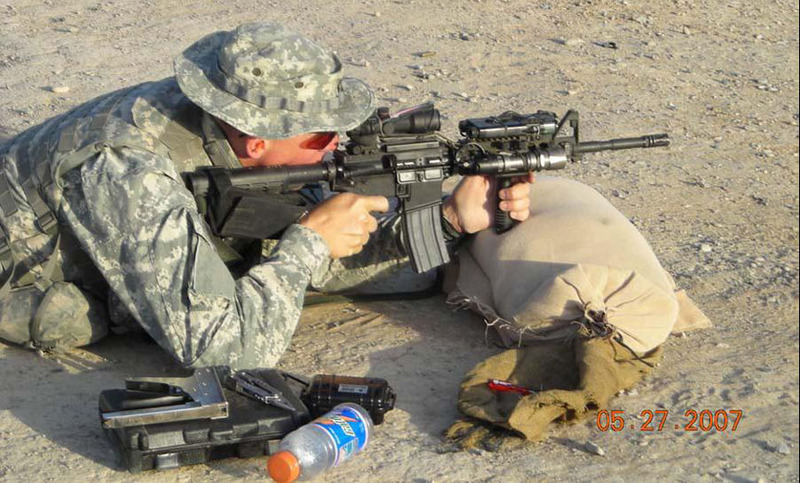
So — are our soldiers taking unnecessary risks because of inadequate weapons?  I’d be interested in particular to hear from Capt. James Smith and others who have actually taken the M4 into battle (that’s him below getting his ACOG zeroed in on arriving in Afghanistan — at least, I think that’s an M4).

Smith

Wimping out in Honduras?

Remember when I expressed my regret that my only sources of information on what’s happening in Honduras (or anywhere else in Latin America, for that matter) were columnists with axes to grind?

Well, there was a fairly complete update on the situation on the WSJ’s news pages today, which I appreciated. For instance, I learned for the first time that the military had forced ex-President (or is he really “ex-“?; that’s sort of what the argument’s about) Manuel Zelaya was forced to leave the country “in his pajamas.” Not that that’s important; I just enjoyed learning it.

More to the point, I thought I got a better appreciation of the Obama administration’s position on the situation, in this paragraph:

Resolving the crisis would be welcome not only in Central America but in Washington, too. The U.S. has put pressure on the interim government to allow the democratically elected Mr. Zelaya to return, even though the leftist is a fierce critic of Washington and a close ally of Venezuela’s populist Hugo Chávez.

That fact, of course, is what Jim DeMint and other conservative critics can’t get over — the fact that the administration is siding with this rather obnoxious ally of someone who is so inimical and destructive toward our national interests. But in that paragraph, I could sort of appreciate that we were trying to be fair and impartial, backing the guy even though he hangs with folks who aren’t our friends.

You know, sort of the way I’ve bent over backward to accommodate and be “fair” and nonjudgmental toward some of the bullies who have run off nice people on my blog. And I wrung my hands and fretted over the implications of cracking down. I hesitated to just ban someone because of past behavior — after all, in this country, doesn’t a person always have the opportunity, nay, the right, to redeem himself?

Oddly, it was one of our more “liberal” Democrats on the blog who, in sidebars, would whisper to me of how I needed to toughen up, stopping being squishy and tolerant, be the king, and cry “off with their heads.” I’m not going to name this person, in the interests of protecting the guilty, but the advice took the form of such admonitions as: “Stop trying to look like a good guy. You are a good guy.”

Which, it occurs to me, may be where Obama’s got it wrong, and DeMint’s got it right, on Honduras. Aside from the fact that the best assessment we have in hand does not support (clearly, anyway) that Zelaya was ousted in an extralegal manner, what principles are we standing up for here? At the very best, it’s a tossup whether Zelaya has a legitimate claim. So in such a situation, why would we not stand up for our nation’s legitimate interests, and more importantly, ideals (which the Chavezistas in the hemisphere scorn), without hesitation or apology?

In short, are we wimping out in the interests of being fair to all concerned, and in the process so blinding ourselves to reality that we don’t even see that it’s NOT fair to all concerned, that this guy actually doesn’t even (necessarily) have any of the rules on his side?

Wishing I had another perspective on Honduras

Has anyone run across an objective, reasoned account of recent events in Honduras and the U.S. policy with regard to those events? Or, for that matter, an argument from a liberal or Democratic point of view supporting the Obama administration’s support for ex-President Manuel Zelaya?

The reason that I ask is that, given my background, I’m one of those rare Americans who cares about Latin America. I lived there at an impressionable age, and was particularly impressed by the short-lived Kennedy Administration efforts to at least act like that part of the hemisphere mattered. I haven’t seen anything approaching this level of interest since then. Meanwhile, over the past couple of decades, I’ve watched such nations as China deftly increase their influence in the region, much to the detriment of the legitimate interests of the United States and of the people of those countries.

Unfortunately, it’s not all that easy to keep up, given the almost complete apathy of the U.S. news media. Back when I was at the paper and got The Economist every week, I could sort of keep up — the Brits have always cared far more about all corners of the world than Americans care even about their own backyard — but even though my colleagues kept giving me the Economists that came in after I left (I was the only one in that office who read it, after Mike Fitts had left).

I still subscribe to The Wall Street Journal at home, however. And what that means is that my one regular source of information about Honduras and the rest of the countries below the Rio Grande has been Mary Anastasia O’Grady’s opinion columns. And while they are well-informed, they are written from such a strongly anti-administration point of view that leaves me wondering what it is that I’m not hearing.

Her indictments of Obama administration for perverse blindness are pretty powerful, such as this recent piece that indicts Zelaya for his connections, direct and indirect, to Chavez, Mahmoud Ahmadinejad and virulent anti-Semitics in his own country. She begins this piece with a quote for one of the leading voices for Zelaya’s return:

Sometimes I ask myself if Hitler wasn’t right when he wanted to finish with that race, through the famous holocaust, because if there are people that are harmful to this country, they are the Jews, the Israelites.

Beyond the sensational stuff, though, I intuit that she may be onto something. I’ve previously noted my great discomfort at Obama’s decision to knuckle under to Big Labor rather than support freer trade with our ally Colombia. In fact, some of you who did not like our endorsement of John McCain castigated me for citing what you considered to be a side issue — although it wasn’t to me. To me, it was a disturbing portent, which would seem to have predicted a tendency to be terribly wrong on Latin America, if Ms. O’Grady is right.

But is she? I’d like to see an independent assessment, or even one from the other end of the political spectrum — if a liberal can get interest in Latin America long enough to provide one. It strikes me as passing strange that, given the recent ugly nativism we’ve seen rising on the Right in this country, that I’d only be hearing from conservatives on internal affairs in Honduras.

So it is that read with interest today a piece on the subject by someone other than Ms. O’Grady, also on the opinion pages of the WSJ. Unfortunately, it was by our own Jim DeMint — a man who has in recent years lost a lot of credibility with me, thanks to his opportunistic appeal to the aforementioned surge in nativism, his siding with our governor on the stimulus, and his execrable remark alluding to the climactic land battle of the Napoleonic Wars.

Setting all that aside, his piece seemed well-reasoned, and persuasive. Sure, members of Congress visiting foreign countries often see what they want to see, or what their hosts want them to see, but I was still impressed that he said of all the people he spoke with in Tegucigalpa, the only person who stuck up for the administration’s position, the only one who called the Honduran government’s removal of the ex-president a “coup,” was our ambassador:

As all strong democracies do after cleansing themselves of usurpers, Honduras has moved on.

The presidential election is on schedule for Nov. 29. Under Honduras’s one-term-limit, Mr. Zelaya could not have sought re-election anyway. Current President Roberto Micheletti—who was installed after Mr. Zelaya’s removal, per the Honduran Constitution—is not on the ballot either. The presidential candidates were nominated in primary elections almost a year ago, and all of them—including Mr. Zelaya’s former vice president—expect the elections to be free, fair and transparent, as has every Honduran election for a generation.

Indeed, the desire to move beyond the Zelaya era was almost universal in our meetings. Almost.

In a day packed with meetings, we met only one person in Honduras who opposed Mr. Zelaya’s ouster, who wishes his return, and who mystifyingly rejects the legitimacy of the November elections: U.S. Ambassador Hugo Llorens.

Of course, maybe Sen. DeMint was speaking to the wrong sources, just as I worry that maybe I’m reading the wrong sources. But he certainly seems to make a reasonable case.

By the way, both Ms. O’Grady and Sen. DeMint cite a source that sounds pretty legit to me in supporting their views: a senior analyst at the Law Library of Congress. But while you can read that report as supporting their views, it’s also a little more ambivalent than they make it sound, such as in this conclusion:

V. Was the removal of Honduran President Zelaya legal, in accordance with Honduran
constitutional and statutory law?

Available sources indicate that the judicial and legislative branches applied constitutional
and statutory law in the case against President Zelaya in a manner that was judged by the
Honduran authorities from both branches of the government to be in accordance with the
Honduran legal system.
However, removal of President Zelaya from the country by the military is in direct
violation of the Article 102 of the Constitution, and apparently this action is currently under
investigation by the Honduran authorities.50

Anyway, does anyone know of good arguments to the contrary, or is the administration just really, really wrong on this one?

Hey, guys: Just insult the president, and RAKE in the dough

This morning I ran into Dwight Drake yet again at breakfast — I swear, all that guy does is eat — and he told me that he exceeded his goal of raising $250,000 in the past quarter, reaching $300k.

Then, at another Kaffeeklatsch in Five Points with Steve Benjamin and Jack Van Loan, Steve told me that he raised $100,000 in the same period — which he says Richard Gergel tells him is a record, although he doesn’t know for sure.

Here’s what I told both of them: Hey, guys; you’re missing the boat: Just shout an insult at the president of the United States, and you can be rolling in the dough…

Can you believe this guy? As I said this morning on Twitter:

How does Joe Wilson live with himself, KNOWING he’s cashing in on something he did that was inappropriate?

He knew he did wrong as soon as he yelled “You lie!” His first instinct, and it was the right one, was to apologize. The Joe Wilson I know, while he’s an excitable guy, is better than that.

But then he got a taste of the wages of demagoguery, and he was ruined. Now, he basks in the adoration of those who celebrate the degradation of political deliberation in our country.

It’s disgusting. And while a guy who’s unemployed like me could use $2.7 million (and think about what an UnParty candidate could do with that — he’d have the chance to really torpedo this crazy partisan system), I honestly don’t see how he looks himself in the mirror as it comes pouring in.

Obama should seize historic opportunity, say “No, thanks” to Nobel

Barack Obama has a tremendous opportunity now to recapture lost political capital, unify this country behind his leadership and increase (if that’s possible, in light of today’s development) his international prestige — all of which would be an enormous boost to the things he’s trying to achieve:

He should say, “Thanks, but no thanks” to the Nobel Peace prize.

If he does that, everyone will think more of him. That is to say, everyone who is susceptible to being influenced. The Rush Limbaughs and Glenn Becks who make a good living from criticizing him will still do so, but no one but the nuttiest fringe types would still be listening. Everyone with a scintilla of fairmindedness would be impressed if he declined this honor.

If he doesn’t do it, this award will simply be another occasion for the Right to hoot and holler and deride, and the Left to dig in its heels and defend Their Guy, and the crazy polarizing spin cycle will spin on, while health care and everything else gets lost amid the shouting.

I got a foretaste of this this morning. I was about to get out of my truck to go in and have breakfast when I heard the news that had stunned the White House and everyone else: Barack Obama has been awarded the Nobel Peace Prize. In the next few moments, I quickly filed the following three tweets:

Obama wins the Nobel Peace Prize? The White House is stunned, and so am I. Isn’t it a tad premature or something?

What did Obama win the Nobel FOR? Good intentions? I mean, seriously, the man just GOT here…

Hey, I LIKE Obama; I have hopes he’ll EARN a Nobel one day soon. But he hasn’t had the chance to do so yet…

Then, when I walked in to get my breakfast, I ran into Steve Benjamin and Samuel Tenenbaum, and asked them if they’d heard the news. They had. I expected them to share my shock. I mean, I saw one report (which I haven’t been able to confirm yet) that Obama was only sworn into office TWO WEEKS before the nominations for the Nobel had to be in. The president himself knows better than to claim he’d earned it. Here’s what he said this morning:

Mr. Obama said he doesn’t view the award “as a recognition of my own accomplishments,” but rather as a recognition of goals he has set for the U.S. and the world. Mr. Obama said, “I do not feel that I deserve to be in the company of so many transformative figures that have been honored by this prize.”

But Steve and Samuel — especially Samuel — felt like they had to defend the president’s receiving the prize. And here’s why: While I had just heard the news and was naturally flabbergasted, with no other stimuli acting on me, Samuel gets up at 4:30 every morning, and has usually had several full cycles of spin by the time I leave my house. He had already heard right-wingers attacking the award on the airwaves, so he was in defensive mode.

This is what the whole Left vs. Right thing gets us: We can’t even agree when something wild and crazy happens. And the president of the United States getting the Nobel Peace Prize for what he MIGHT do, for what he INTENDS to do, for his POTENTIAL, is wild and crazy.

Face it, folks: The Nobel committee gave him this prize for Not Being George W. Bush. This is a measure of how much they hated that guy. I didn’t like him much either, but come on… (While I haven’t talked to my friend Robert Ariail today, I can picture the cartoon already: Obama clutching the prize to his cheek saying, “They LIKE me! The really, really LIKE me!…”

Here’s where the opportunity comes in. The president was on the right track with the humble talk, but he should go a big step further: He should decline the prize, insisting that he hasn’t earned it yet.

This would transform perception of Barack Obama both domestically and internationally. If he simply takes the award, no matter how eloquent his words, he’ll be seen as an ordinary guy who can’t resist being honored, whether he deserves it or not. The Right will go ape over it and keep on going ape over it, and the Left will ferociously defend him, making all sorts of improbable claims to support his receiving it, and those of us in the middle will see the Right as having the stronger point at the same time that we’re put off by their meanspiritedness, and nothing will be accomplished.

But turning it down, saying, “Not yet; wait until I’ve earned it” would catapult Obama to such a state of greatness that he would overarch all ordinary partisan argument. No one could say he was wrong, and most people would be blown away by such selflessness. It would give him tremendous amounts of juice to get REAL health care reform instead of some watered-down nothing, which is probably what we’re going to get.

Internationally… well, if they love the guy now, they’d be ecstatic over him if he turned it down. I mean it. Think about it: What do they love about this guy? His perceived nobility and humility. They hated Bush for what they perceived as his arrogance, and they love Obama for what they perceive as his humility before the rest of the world. If he just took the prize, the world would just shake his hand and that would be that. But if he turned it down, suddenly Iran would be negotiating with a guy with more respect than anyone in the whole wide world has had in a long time. And maybe we’d get somewhere — with Iran, with Russia, with China, in Afghanistan, in Palestine, take your pick.

As I said, I like Obama, and I want him to succeed. But I know he hasn’t earned this honor yet. And I’m firmly convinced that turning it down would afford him the greatest opportunity to succeed with his agenda that he’ll ever have.

Trying to explain Joe Wilson to France

This morning I had a very pleasant breakfast at the usual place with Philippe Boulet-Gercourt, the U.S. Bureau Chief for Le Nouvel Observateur, France’s largest weekly newsmagazine. I forgot to take a picture of him, but I found the video above from 2008 (I think), in which I think he’s telling the folks back home that Obama was going to win the election. That’s what “Obama va gagner” means, right? Alas, I have no French, although I’ve always felt that I understand Segolene Royal perfectly. Fortunately, Philippe’s English is superb.

It was my first encounter with a French journalist since I shot this video of Cyprien d’Haese shooting video of me back in 2008, in a supremely Marshall McLuhan moment. If you’ll recall, I was interviewed by a lot of national and foreign journalists in the weeks and months leading up to the presidential primaries here. (You may also recall that a lot of them came to me because of my blog, not because I was editorial page editor of the state’s largest newspaper. Philippe, of course, also contacted me because of the blog, although he was aware of my former association, and expressed his kind concern for my joblessness.)

He had come to Columbia from New York, which has been his home for 14 years, to ask about “this summer uprising among the conservatives, peaking with the Joe Wilson incident,” as he had put it in his e-mail.

Well, to begin with, I disputed his premise. I don’t think there has been a resurgence of conservatives or of the Republican Party, which is still groping for its identity in the wake of last year’s election. What we’ve seen in the case of Joe Wilson — the outpouring of support, monetary and otherwise, after the moment in which he embarrassed the 2nd District — was merely the concentration of political elements that are always there, and are neither stronger nor weaker because of what Joe has said and done. Just as outrage over Joe’s outburst has expressed itself (unfortunately) in an outpouring (I’m trying to see how many words with the prefix “out-” I can use in this sentence) of material support for the unimpressive Rob Miller, the incident was a magnet for the forces of political polarization, in South Carolina and across the country.

What I tried to do is provide historical and sociological context for the fact that Joe Wilson is the natural representative for the 2nd District, and will probably be re-elected (unless someone a lot stronger than Rob Miller emerges and miraculously overcomes his huge warchest). It’s not about Obama (although resistance to the “expansion of government” that he represents is a factor) and it’s not about race (although the fact that districts are gerrymandered to make the 2nd unnaturally white, and the 6th unnaturally black, helps define the districts and their representatives).

In other words, I said a lot of stuff that I said back in this post.

We spoke about a number of other topics as well, some related, some not:

He asked about the reaction in South Carolina to Obama’s election. I told him that obviously, the Democratic minority — which had been energized to an unprecedented degree in the primary, having higher turnout than the Republicans for the first time in many years — was jubilant. The reaction among the Republican minority was more like resignation. Republicans had known that McCain would win South Carolina, but Obama would win the election. I explained that McCain’s win here did not express a rejection of Obama (as some Democrats have chosen to misinterpret), but simply political business as usual — it would have been shocking had the Republican, any Republican, not won against any national Democrat. I spoke, as I explained to him, from the unusual perspective of someone who liked both Obama and McCain very much, but voted for McCain. I think I drew the distinction fairly well between what I think and what various subsets of Republicans and Democrats in South Carolina think…

That got us on the topic of McCain-Bush in 2000, because as I explained to Philippe, I was destined to support McCain even over someone I liked as much as Obama, because I had waited eight years for the opportunity to make up for what happened here in 2000. Philippe agreed that the world would have been a better place had McCain been elected then, but I gather that he subscribes to the conventional wisdom (held by many of you here on the blog) that the McCain of 2008 was much diminished.

Philippe understood 2000, but as a Frenchman, he had trouble understanding how the country re-elected Bush in 2004 (And let me quickly say, for those of you who may be quick to bridle at the French, that Philippe was very gentlemanly about this, the very soul of politeness). So I explained to him how I came to write an endorsement of Bush again in 2004 — a very negative endorsement which indicted him for being wrong about many things, but in the end an endorsement. There was a long explanation of that, and a short one. Here’s the short one: John Kerry. And Philippe understood why a newspaper that generally reflects its state (close to three-fourths of those we endorsed during my tenure won their general election contests) would find it hard to endorse Kerry, once I put it that way. (As those of you who pay attention know, under my leadership The State endorsed slightly more Democrats than Republicans overall, but never broke its string of endorsing Republicans for the presidency, although we came close in 2008.)

Anyway, when we finished our long breakfast (I hadn’t eaten much because I was talking too much, drinking coffee all the while) I gave him a brief “tour” of the Midlands as seen from the 25th floor of Columbia’s tallest building, then gave him numbers for several other sources who might be helpful. He particularly was interested in folks from Joe’s Lexington County base, as well as some political science types, so I referred him to:

  • Rep. Kenny Bingham, the S.C. House Majority Leader who recently held a “Welcome Home” event for Joe Wilson at his (Kenny’s) home.
  • Rep. Nikki Haley, who until recently was the designated Mark Sanford candidate for governor, before she had occasion to distance herself.
  • Sen. Nikki Setzler (I gave him all the Lexington County Nikkis I knew), who could describe the county’s politics from the perspective of the minority party.
  • Blease Graham, the USC political science professor who recently retired but remained plugged in and knowledgeable. (Philippe remarked upon Blease’s unusual name, which started me on a tangent about his ancestor Cole Blease, Ben Tillman, N.G. Gonzales, etc.)
  • Walter Edgar, the author of the definitive history of our state.
  • Neal Thigpen, the longtime political scientist at Francis Marion University who tends to comment from a Republican perspective.
  • Jack Bass, the ex-journalist and political commentator known for his biography of Strom Thurmond and for his liberal Democratic point of view.

I also suggested he stop in at the Gervais Street Starbucks for a downtown Columbia perspective, and the Sunset Restaurant in West Columbia.

I look forward to reading his article, although I might have to get some of y’all to help me with understanding it. With my background in Spanish and two years of Latin I can generally understand French better when written than spoken, but I still might need some help…

What I learned about swine flu

IMG00314

Ever since Monday I’ve been meaning to share some things I learned about swine flu at Rotary on Monday. Dr. Stephen L. Shelton from Palmetto Health spoke from a wealth of expertise on the H1N1 virus. (Over at the hospital they call him Boss Hog.)

Some of it was highly technical, such as the diagram of the virus that he used to explain why it’s called H1N1. I’m afraid that sort of went in one ear and out the other. Other parts were sort of obvious, such as a list of typical flu symptoms, or what to do if you get it (drink fluids, avoid contact with others, stay home for 24 hours after fever is gone).

More useful were some of the slides in his presentation, such as the one I photographed above about how to tell when your child needs to go to the emergency room rather than simply be treated at home.

Beyond that, the following points really stood out in my mind:

  • You probably know the signs of flu (fever, cough, body aches, sore throat, runny or stuffed nose, headache, chills, fatigue, diarrhea, vomiting), but how do you know you’ve really got it, as opposed to a cold or some such? By the rapid onset of the symptoms. If one hour you’re fine and an hour later it’s like you’ve been hit by a truck, it’s the flu.
  • And if it’s the flu, and you’re getting it now, the odds are 99 to 1 that it’s swine flu, because the regular seasonal variety hasn’t arrived yet.
  • Most swine flu victims are children so far — and they started getting it when school started.
  • Because there is so little immunity in the population, if you are exposed to swine flu, you will almost certainly get sick. This is not true of the more common seasonal flu bugs.
  • Interestingly, the one subset of the population that has some immunity to H1N1 is folks over 55. So for a change, older people are actually the lowest-priority group needing to get the swine flu shots when they arrive (and Dr. Shelton swore this was not a “death panel” plot to get rid of old folks). The highest priority? Pregnant women. Having that baby crowding the diaphragm really makes them vulnerable to a lower-lung infection.
  • However, old folks should still, as usual, get the regular, garden-variety flu shot, if they haven’t already. It helps boost immunity for the other kind.

Anyway, those are the points that made an impression on me.

By the way, for a video version of Dr. Shelton’s presentation, follow this link.

O wad some Power the Internet gie us

Folks who routinely travel beyond state lines return shaking their heads at the image of South Carolina that those from elsewhere hold in their heads. You know the drill: Mark Sanford in Argentina, Joe Wilson shouting “You lie!,” the Confederate flag flying on the lawn of our State House, etc.

If only there were some way to tell objectively what image others truly hold of us (and we’ll suspend for a moment the debate over whether we give a damn what others think; we know that many of you don’t, which is one of the sources of our problems). Well, thanks to the magic of the World Wide Web, we do occasionally get an unbiased glimpse.

For instance, I inadvertently had one this morning. On a press release from the University of South Carolina, I saw that a USC study on breast cancer was cited in a story in The Sacramento Bee. Curious to see whether the study played a prominent role in the piece, I followed the link, and saw that the “South Carolina” in the reference to the University was also in hypertext. So I followed it, and found one of those results pages that provided a mishmash of references, from items that are truly about our state to some that merely mention us in a list.

But my eye was drawn to the graphic element on the page, which provided four images under the heading “Sacbee.com photos.” Each image was itself a link to a news item having to do with South Carolina. Here’s what they were:

  1. The first was a locator map that showed the site of a fatal helicopter crash. A tragedy that could have happened anywhere, which doesn’t reflect upon us particularly one way or another.
  2. The next was a sports photo in a garnet-in-black motif, taken by Mary Ann Chastain of our local AP office, leading to a story headlined, “Gamecocks pull Top 5 surprise, beat Ole Miss 16-10.” Wow. Sometimes it seems like all anybody here talks about is Gamecock football. Now it seems that it’s what people elsewhere talk about, too. Huh.
  3. The next photo didn’t look like much of anything — a few scraps of debris scattered on an unremarkable bank of faded red clay. It led to a story out of Anderson about a man who died, alone and penniless, in a tent on the bank of Lake Hartwell. He was described as a “bright but reclusive Civil War buff” who had lost his job at a local museum. Here I was looking for some universal image about our state as a community, and here was a painfully personal tale of a man who died for lack of community. Read into that what you will.
  4. 7FO13WILSONLTRS.xlgraphic.prod_affiliate.4The fourth, alas, was an image all too familiar. I didn’t particularly want to see what it led to, but I followed the link, which was to a letter to the editor of that newspaper. A letter about us, or at least about one of us. And what do folks in California have on their minds when they take up pen to write about one of us? An excerpt: “Similar vitriol and disrespect was the norm from Southern politicians during the years and months leading up to the American Civil War. I fear we may be headed down a similar path, toward disunion, given the tone of our political dialogue since the 2008 national election.”

Sigh.

So, what has the giftie shown you about how others see us?

Of COURSE the health care status quo hurts small businesses

Sometimes the things said in connection with the health care “debate” are so painfully obvious that they make me want to shout. And while I’m shouting, I wonder, Is it possible anyone doesn’t already know this?

The latest thing to get to me in this way is this bit from a series on health care reform:

Thompson’s challenge is common among small-business owners in South Carolina. Many are too busy to keep up with the complex health care reform policy proposals that Congress is debating. But they know one thing: The current cost of health insurance for very small groups is stifling their growth and hurting their competitiveness.

At this point I would scream “Duh!,” if screaming “Duh!” were not so last-decade.

Of course our current health care “system” is stifling small businesses’ growth and hurting their competitiveness! It’s helping drive some of them out of business. And it’s keeping plenty of others from coming into being in the first place. I know it’s kept me from at least one good job opportunity in the last few months. And it’s the consideration that keeps me from simply hanging out a shingle and earning a living as a “consultant” in communications. Sure, I might be able to pay the light bill and buy groceries and such that way, but I have to have medical coverage — the same sort of coverage that is simply not a consideration in other advanced countries when individuals make career decisions.

Right now, I’m pursuing a number of job opportunities. But most of the opportunities I’m seeing either don’t pay enough to pay my mortgage but have good benefits, or they pay well but the bennies are quite iffy. But one thing I CAN’T consider going forward is going into business for myself. Sure, I can pay a few bills here and there with free-lance work while I’m on COBRA. But my COBRA premiums more than double starting in December.

This strongly discourages entrepreneurship. It seems increasingly to me that the only way a person can go into business for himself is if he and his family and his employees and their families never have to go to the doctor and never will have to go to the doctor. In other words, the only way you start a business in this country is by hypnotizing yourself into believing a lie.

I’d probably be a lot happier if I were able to delude myself that way.

Anyway, yeah, the current health care situation stifles small businesses. Duh.

Friedman plugs the Energy Party agenda

We haven’t spoken much about the Energy Party lately, what with being obsessed with the economy and all (see, I told y’all this wouldn’t be fun before we started). Thank goodness, Tom Friedman took the time earlier this week to get us back on track by touting a key plank of the Party platform, in a piece headlined “Real men tax gas.” An excerpt:

But are we really that tough? If the metric is a willingness to send troops to Iraq and Afghanistan and consider the use of force against Iran, the answer is yes. And we should be eternally grateful to the Americans willing to go off and fight those fights. But in another way – when it comes to doing things that would actually weaken the people we are sending our boys and girls to fight – we are total wimps. We are, in fact, the wimps of the world. We are, in fact, so wimpy our politicians are afraid to even talk about how wimpy we are.

How so? France today generates nearly 80 percent of its electricity from nuclear power plants, and it has managed to deal with all the radioactive waste issues without any problems or panics. And us? We get about 20 percent and have not been able or willing to build one new nuclear plant since the Three Mile Island accident in 1979, even though that accident led to no deaths or injuries to plant workers or neighbors. We’re too afraid to store nuclear waste deep in Nevada’s Yucca Mountain – totally safe – at a time when French mayors clamor to have reactors in their towns to create jobs. In short, the French stayed the course on clean nuclear power, despite Three Mile Island and Chernobyl, and we ran for cover.

How about Denmark? Little Denmark, sweet, never-hurt-a-fly Denmark, was hit hard by the 1973 Arab oil embargo. In 1973, Denmark got all its oil from the Middle East. Today? Zero. Why? Because Denmark got tough. It imposed on itself a carbon tax, a roughly $5-a-gallon gasoline tax, made massive investments in energy efficiency and in systems to generate energy from waste, along with a discovery of North Sea oil (about 40 percent of its needs).

And us? When it comes to raising gasoline taxes or carbon taxes – at a perfect time like this when prices are already low – our politicians tell us it is simply “off the table.” So I repeat, who is the real tough guy here?

As Friedman correctly asserts, raising the gas tax would be a “win, win, win, win, win” that would make us “physically healthier, economically healthier and strategically healthier.” But none of our politicians, of either party, have the guts even to bring up the subject, because they can hear the voters screaming at them with all the mature outrage evinced in this unrelated, but hilarious, commercial (only instead of screaming, “I want those sweeties,” we’d be hollering, “We want our cheap gas!”)

Anyway, I posted something on Twitter about the Friedman column earlier this week, and Doug Ross responded on Facebook. I’ll share our exchange here just to get the blog discussion going:

Doug Ross

Real men must like double digit inflation, high food prices, and punishing low income Americans who need to drive to work
Brad Warthen

We love all that stuff. We just don’t like quiche.
Did you read the piece?
Doug Ross

I did read the article. He says he wants to take 10 cents of each dollar and give it to “the poor” to cushion the $1 per gallon cost. What about the people who aren’t “poor” who will see their fuel costs go up by several thousand dollars a year? and the increase in cost of every single item that is manufactured and transported. it’s a recipe … Read Morefor economic disaster. Some of Friedman’s ideas go beyond “ivory tower” to the point where the people in the ivory towers have to crane their necks to see him.
We have all the money we need to do what Friedman wants currently in the federal coffers. Our political “leaders” choose to do other things.
Brad Warthen

But raising the revenue isn’t the point; it’s just a side benefit.
The point is making ourselves more energy-independent so we stop underwriting the thugs of the world.
If France and Denmark can do it, so can we.
Doug Ross

Oh, if we could just be like Denmark and France!!! Apparently that’s the new American Dream
And yeah, for those who are confused — I was using that “irony” thing again when I said “we love all that stuff.” But I was serious about not liking quiche.

Ammo!

ammo

It was either late 2008 or the start of 2009 when a co-worker at The State mentioned that he’d had trouble laying his hands on buckshot, and that the shopkeepers he’d talked to said this started to happen at about the time of the election. It’s been so long that I forget whether he said that it was just before the election or just after that the run on ammunition started. But I do remember he said you could get birdshot; the problem was with the deadlier stuff that you’d need to take down a deer — or a man.

It was sometime after that that I noticed at a local Wal-Mart that the case where ammunition of all kinds was locked behind glass was mostly empty. Looking more closely, I saw none of the usual pistol stuff (.38-cal., 9 mm). In fact, all I saw was shotgun shells with the smaller sort of shot.

I filed this away as interesting, even ominous. And I figured I would write something about it once it became better documented and the fact was established. I assumed I’d see news stories about it soon. (As you know, in my former position I had nothing to do with news or decisions on what to cover; I was kept as separate from that as I was from advertising. Like you, I saw things in the paper when I saw them.) Then I forgot about it. I was pretty busy in those days.

So when I saw it on the front page of The State today, I sort of went “Wow,” on a couple of levels. First, that it took this long to make news, and second, that there was still a shortage.

Back when I first heard about it, I didn’t know what I wanted to say about it. Some things popped into my head, of course. One of the first was my memory of being in South Carolina when Martin Luther King Jr. was killed. I remember knowing at least one very nice white person who had never owned a gun before going out and buying one, because of fear of what might happen next. And I heard of others. I didn’t want to think this was related to that, but it did pop into my head.

Another was that Barack Obama had inspired some fairly weird Internet conspiracy theories. You know, like the one that he’s not really a citizen. I hadn’t attached importance to that — after all, the man was elected — but it popped into my head that there was something going on in the dank underbelly of the American psyche. Everything might be fine on the conscious level, but maybe some things were brewing down in the more reptilian parts of our collective brain.

But I set it aside. We had lots of other stuff to think about, what with the economy collapsing around us, and all the debates over what to do about it. The stimulus, for instance, was about as unemotional and bloodless, colorless subject as you were likely to find; it was not something to inspire dark dreams of violence.

Now that the ammunition story is documented and verified and duly reported, it comes at a time when we have additional information, and this colors our perception. We’ve seen that a lot of people are really, REALLY emotional about this president and his policies. I mean, we’ve had a lot of heated debates about health care in this country in the past, but even when it involved the polarizing figure of Hillary Clinton, people didn’t get THIS stirred up. Harry and Louise and the rest of the insurance industry’s allies simply deep-sixed reform, and it went away for 15 years.

But the last couple of months have been … weird. You might expect a guy like me, who has griped for years about our health care situation and finds himself paying $600 a month for COBRA, with the prospect of it going up to $1,200 or even $1,500 very soon) would be emotional about it, but I’m Lake Placid compared to the people who DON’T WANT reform. “Death panels.” Old folks absurdlyObama Joker Poster Popping Up In Los Angeles demanding that the gummint stay out of their Medicare. People showing up in crowds with automatic weapons. An otherwise mild-mannered congressman yelling “You lie!” at the president during what I thought was a fairly ho-hum speech. Then there’s the truly disturbing “Joker” posters. (I thought Democrats really went overboard with hating Bush, but this plumbed new depths.)

Against that background, a run on ammunition sounds really ominous.

The sunniest interpretation you can put on this phenomenon is that when the economy is collapsing, people naturally fear our devolving into a state of nature, and naturally want to arm themselves. Under that interpretation, we’d have run out of ammo whether Obama or McCain had been elected.

But there’s this other thing going on, and it has to do with some fairly unpleasant things rattling around in our collective subconscious. Some people have tried to give it a simple name, saying it’s about race. But it’s more complicated than that. Just as scary and ugly perhaps, and entangled somehow with race, but more complicated.

And frankly, I’m still not sure what to think of it.

Waiting for my UnParty Peter Boyle

Wow, I am really humbled by the nice things some of y’all said about me running for office back on this post (am I sounding like a candidate yet? they’re supposed to say stuff like that, about being humbled, etc.).

But again, what office? The context was that we were talking about Congress. But as Karen suggested, maybe I’m better suited for state office. State issues are the ones I’m most knowledgeable about and passionate about.

Not that I don’t know as much as (or more than) the other declared candidates for Congress about national and international issues. I’m pretty confident that I do — or at least that I can hold my own, and I can certainly approach those issues in a fresh way that would break the partisan, shouting-back-and-forth pattern that I, for one, am sick of.

But what if I were elected to Congress? I would just feel pretty weird going off to Washington and watching another lame governor take office back here. And you know what? My own mother called me up the other day and said I should run for governor. So that’s one vote I could count on, I guess. (Right, Mom?)

You know what I need at this point? I need Peter Boyle to come see me and make a pitch. You ever see “The Candidate?” Excellent movie. Peter Boyle plays a political consultant type who talks Robert Redford — son of a prominent politician — into running for the U.S. Senate. Redford is a nonprofit activist who is uninterested in the compromises one must make to run for office. Boyle promises him he can stand up for everything he believes in, and points out that this is a great opportunity to give those things he believes in greater exposure. Redford asks something like How does that work? or What’s the catch? and Boyle hands him a matchbook on which he has written two words: “You lose.” On that basis, Redford agrees to run.

But as the campaign proceeds, the itch to win — or at least not lose by an embarrassing margin — starts to get to him….

Anyway, to run for office what I need is a Peter Boyle moment — somebody to say, we’ll take care of the mechanics of the campaign, you just be the candidate. Because I’m an issues guy, not a mechanics guy. Renting an office and getting phone lines set up would be the overwhelming part for me. Seriously.

This, of course, is why most people run under the auspices of parties. Each of the parties has loads of people like Peter Boyle who can say, here’s your infrastructure, you just concentrate on running for office (and raising money).

What I need is an UnParty Peter Boyle. I guess that would be a party stalwart who has become disillusioned. Or who sees greater opportunity in breaking away from the two-party dichotomy.

It’s interesting to contemplate where such a person would come from. On an earlier post, I speculated that if I were to give in and run under the banner of one of the parties next year for pragmatic reasons (see the above discourse on Peter Boyle), especially for Congress, it would probably have to be the Democratic Party. Why? Well, not because I’m a Democrat, but because I don’t see a Republican having a good-enough shot against an incumbent of that party. Too much of an uphill climb.

But it occurs to me that if I run as an independent, my theoretical Peter Boyle would be more likely to come from the Republican Party. It’s the party in trouble. It’s the party that’s falling apart, rather pathetically clinging to tired slogans and petty resentments that have not served it well of late (whereas the Democrats have been doing OK, for the moment, with their tired slogans and petty resentments). It seems more likely that a smart Republican would calculate that an UnParty bid would be advisable than that a smart Democrat would do the same. Democrats are smelling opportunity now, and are unlikely to jump ship.

Then again, there could be a smart Democrat who would rather see me elected than Joe Wilson, and who also sees as I do that Rob Miller is not the best candidate to take advantage of this moment, and yet he’s the Democrat with the money, and has a leg up toward the nomination. Going with me might be the way to step around that problem. I don’t know. That’s the kind of hard-eyed political calculation that I’m depending on this Peter Boyle person to make — I’m the candidate, not the backroom strategist.

Anyway, now would be a good time for my Peter Boyle to step forward. I’ve got a job interview later this week, and possibly another soon after. This window won’t be open for long (I certainly hope.)

The kindness of friends is one thing, and I truly appreciate the supportive things y’all have said here. But at this point I need a nudge from a hard-eyed professional who truly believes this can be done. You might say I should go out and find that person. But I’m thinking that if I truly have a chance, that pragmatic person will see it and come to me. If I don’t — if it’s just me indulging myself and some friends egging me on — then there’s no point in continuing the discussion. Does that make sense? It does to me… Call it the first test of my viability…

Let’s see if we can help the Souper Bowl go viral

Y’all hear enough from me. Now, for a message from the “Good Brad” — Brad Smith, the founder of the Souper Bowl of Caring.

That Brad spoke to Rotary today. Although he’s now the senior pastor at Eastminster Presbyterian in Columbia, he still believes strongly in the organization he founded, and headed up full-time for seven years. (To remind you of the story, it all started with a line from a prayer that Brad said on Super Bowl Sunday in 1990: “Lord, even as we enjoy the Super Bowl football game, help us be mindful of those who are without a bowl of soup to eat.” Some kids at his church — Spring Valley Pres at the time — stood outside after services with a cookpot asking folks to give a buck. Then kids at lots of other churches started doing it…)

And he’s got this dream about it. Even though it has grown far beyond anything he could have imagined at the beginning — the Souper Bowl has raised $60 million for charity, and on the most recent Super Bowl Sunday involved 200,000 kids in its good work, and now has the backing of two former presidents (and their First Ladies) and seven NFL team owners — he has a vision of it being even bigger.

His vision is a two-parter: That the president of the United States would decide to highlight the Souper Bowl (as one of the inspiring stories of volunteerism that presidents are always citing in such speeches) in his State of the Union address. And that would inspire enough people to give that during the Super Bowl itself, the Souper Bowl would be mentioned, and the announcer would say that X hundred thousand kids participated, and an amount equal to a dollar for each person (the standard “ask” for Souper Bowl is a dollar) watching the game had been raised.

That would be over a hundred million dollars, which would eclipse what the program has raised in total thus far.

Yes, it’s a reach, but it’s possible, given the right conditions. As Brad (the other one) said today, “Somebody here knows someone who can make that vision come to pass…”

Well, maybe. And if not, then maybe somebody reading this knows somebody who knows somebody who can make it happen.

It’s worth a try, anyway.

They keep pushing me to run…

Today after Rotary, Kathryn F. buttonholed me and started egging me to run for office. Hey, it’s easy for her to say — I’m the one who would be making a fool of himself, not to mention having to go to all those chicken dinners.

Run for what, you’re thinking? Yeah, I know — it’s hard to remember what Brad isn’t running for today: Is it the S.C. House? Or governor? Or Congress?

In this case, it’s specifically Congress that I’m being coy about.

Kathryn’s not the only one, by the way. Nathan Ballentine asked me about it when I ran into him this morning. Of course, he said it with a smile.

Anyway, I gave Kathryn all the reasons why I can’t run, and she tried to knock them all down:

  • Neither of the parties can stomach me, and I can’t stomach the parties. And so far, no member of the UnParty has been elected to Congress. There’s a reason for this: Anything as stretched out and gerrymandered as a congressional district in the former Confederacy is really tough to win by shoe leather and personal perseverance. A state House seat, maybe. But a district that stretches to Beaufort sort of needs the simple answers and mass media approach and organization that only a party can provide. And on some of the hot-button issues that separate the parties, I agree with one side, and on some of them with the other. And on some of those issues, I have no easily explained opinion, but explaining WHY I don’t have a position is the work of at least a newspaper column, and how do you get a majority of voters in a congressional district to pay attention to something with that kind of nuance?
  • I don’t have a job, and I need to get one and get some money coming in soon. Kathryn says running for Congress would BE my job. But far as I know, you’re not allowed to pay your mortgage and personal phone and light bills with campaign contributions — assuming I can get campaign contributions (and who’s going to contribute to someone who’s neither a Democrat nor a Republican?). And when I get a job, the odds are that it will be one that wouldn’t allow me to run for Congress. Most jobs wouldn’t allow you to run for Congress. If I were independently wealthy, yeah, this would be a great time to run. But as things are…
  • Who would vote for me? Based on the kinds of comments I get here, not even a majority of my putative base here on the blog would vote for me. I mean, if the overall electorate receives my ideas the way some of y’all do, I’ll be lucky not to be ridden out of the district on a rail. I’m way too candid with y’all about too many things to be a successful candidate for high office.
  • Of the three offices I’m not running for, Congress would be my least favorite. Running for governor or state legislator, I would feel pretty confident that I would know the issues better than just about anyone who ran against me, and the issues aren’t nearly as bifurcated according to party. There’s more room for a Third Way kind of guy like me. With Congress, every conversation is a big political battle. Say I tell folks what I think about health care — well, that would automatically label me as being to the left of Barack Obama (that’s the area assigned to us single-payer types), which would endear me to the Democrats (some of them) and make me persona non grata to the Republicans. And there’d be no avoiding that issue. But suppose abortion comes up (no reason it should since we’re not talking about the Senate, but suppose it did)? On that one I’d be solid with the Republicans, and the Democrats would despise me. And people would accuse me of waffling, when it is my personal belief that I’m the coherent one, and “left” and “right” as they are currently defined don’t make sense. But could I sell that, with all the other messages out there being against me?

And lots and lots of other reasons. Y’all can probably think of more reasons than I can — after all, I would vote for myself.

At least, I think I would. The idea of sending myself up to Ground Zero of all the partisan madness I constantly decry… well, it’s not something I’d wish on a yaller dog. Or an elephant.

But at least Kathryn has given me a small taste of that phenomenon that causes candidates to piously claim that they’re only running because of the people urging them to do so…

Anyway, now that I’ve totally turned you off with my self-absorption — and made some of you laugh because it may sound like I’m actually considering this… Think about this: Almost any normal person who thinks about running for office goes through these same sorts of thoughts. And for almost any normal person, the answers to all these questions would add up to a big, resounding NO. In fact, you have to ask, given that there are all these natural objections to running for office, what it is that’s wrong with the people who actually DO? And you begin to understand why politics is as messed up as it is…

Before you ask: No, I have not been hiking the Appalachian Trail

Further evidence that no one can resist reminding the world at every opportunity of South Carolina’s recent embarrassments. This is from a piece on the front of The Wall Street Journal today about unemployed people (not me; other unemployed people) hiking the Appalachian Trail:

In any case, there has been a surplus of hikers this year on the Appalachian Trail, which was unexpectedly in the news in June when South Carolina’s Gov. Mark Sanford used the excuse of hiking the trail while pursuing an extramarital affair in Argentina. Typically, about 1,000 hikers leave Georgia each spring in hopes of completing the trail in one all-out trek. This year, trail monitors say, close to 1,400 hikers were in the first wave, with hundreds more following behind through early summer.

That was the sixth paragraph. They could hardly wait to get to it.

I stopped reading at the point, so I can’t tell you whether they also worked in about Joe Wilson shouting “You lie!”

Why would anyone have lied about that?

As y’all know, I pretty well dismissed John Edwards early on, to avoid the rush. Therefore I had nothing to say when he crashed and burned later.

But I do find myself wondering something when I read this:

CHAPEL HILL, N.C. — A man who once claimed to have fathered the child of John Edwards’ mistress says in a book proposal the former presidential candidate is the real father and that he and Edwards worked with his campaign finance chairman to hide that secret, according to a newspaper report published online Saturday….

What I wonder is, Why would anybody have bothered to lie about that? I mean, if you admit (finally) that the affair happened, why on Earth bother to deny being the father if you were the father? What would be the point? Are we to believe that Edwards was calculating that if we just thought he was fooling around with a woman sufficiently loose as to be carrying on a separate affair with one of his aides while his wife was campaigning her heart out for him during a recurrence of cancer, then just maybe he could salvage his political prospects — but if he was technically (as opposed to morally) responsible for impregnating her, we just couldn’t forgive him?

I don’t know. And I don’t care. But I can assure you that, with or without the sensational teasers, I will not read this book. So don’t bother.