Category Archives: The World

Slouching toward history’s first intentional Great Depression

We’ve been here before, back in the late ’20s and throughout the ’30s. But this time, we’re going to do it on purpose.

There’s blame to go around, in the long view. The Democrats did their bit leading us up to this point, but they’ve been offering compromises lately, and occasionally even making sense. Here in the home stretch, most of the “credit” for a crash will belong to the Republicans and their Kool-Aid-drinking — I mean Tea-drinking — friends.

Yesterday, the five Republican members of South Carolina’s congressional delegation “distinguished” themselves by being the most obstinate state bloc in the GOP caucus. Not that the Boehner plan was anything to write home about, or anything likely to get us toward a resolution. Today, I see that Boehner’s doing better among his caucus, but for all I know, our guys are still firing on Fort Sumter. (Anybody see an update on the SC part? I haven’t yet.)

But after all the tears and folderol in the House, whatever they pass will be DOA in the Senate, where Reid has a plan of his own. I fail to see how these two plans lead us to an actual solution before Tuesday.

And here’s the thing, folks — it’s not good enough to raise the debt limit. The ratings agencies will still probably downgrade the nation’s (AND South Carolina’s) credit rating, which will likely take our already staggering economy (did I mention that the newspaper company that laid me off two years ago just posted a 2nd-quarter loss of 32 percent?), and knock it right down onto the mat. UNLESS we take serious steps toward getting the deficits under control. And that’s WAY harder than just raising the ceiling.

You’d think — what with the fact that about the only thing our state’s leaders have had to brag about for the last 20 years has been our vaunted AAA rating — that the SC delegation would want to do something positive toward averting this disaster, wouldn’t you? Well, so far, you’d be wrong.

You know what happened in the U.K. after the Conservatives — the real conservatives, not these ruffians over here who take pride in throwing the Tories’ tea into the harbor — took over the government? They cut spending, and raised taxes. I was there when the taxes went up (see, “The terrible, awful, horrible day that the VAT went up,” Jan. 4) Far as I know, England is still there. Scotland, too. Maybe even Wales, and Northern Ireland.

Nobody wants to raise taxes at a time like this. It can have a cooling effect. Nor does a sensible person want to see drastic spending cuts, which can do the same. But the alternative to doing both looks considerably worse at the moment. And wanting to do one without the other — no, insisting upon doing one without the other, no matter what — is a form of madness.

Just something to think about, guys. Here at the last minute.

While WE waste time on the stupid debt ceiling…

Bud has a legitimate desire to read more about the debt debate here. And if I can when I get done with ADCO stuff today, I’ll have something to say about the embarrassing behavior of South Carolina’s House Republicans.

But in the meantime, I’ll take just a second to express my utter frustration that we’re having such a big fight over THAT (which we should have been able to work out in a few hours, long before now), when there are things such as this going on in the world:

WASHINGTON—The U.S. for the first time formally accused Iran of forging an alliance with al Qaeda in a pact that allows the terrorist group to use Iranian soil as a transit point for moving money, arms and fighters to its bases in Pakistan and Afghanistan.

The Treasury Department outlined on Thursday what it said was an extensive fund-raising operation that uses Iran-based operatives and draws from donors in oil-rich Persian Gulf countries such as Kuwait and Qatar. The Treasury said it had sanctioned six al Qaeda members for allegedly overseeing this network.

The U.S. has long been concerned about alleged Iranian support for the terrorist group, though Iran and al Qaeda hold differing interpretations of Islam and divergent strategic interests.

But Tehran, anticipating the U.S. troop withdrawals from Iraq and Afghanistan, has been moving increasingly to assert its regional influence. Iran has helped smuggle sophisticated weapons into those countries to hasten the withdrawal of American forces, the U.S. says—a charge Tehran has denied….

That was the lede story in the WSJ today. But this idiotic ideological garbage over debt is sucking up all the oxygen…

A pair of lads get cheeky in Walmart

Not cheeky in the way these young women got infamously cheeky — we wouldn’t want to see that sort of mucking about, would we? — but in the English slang sense.

Kathryn brought this to my attention, and it brought a smile. Hands across the water, and all that. No harm in a bit of fun within the context of the Special Relationship. Cheers…

All right. OK. Here’s a post about the stupid debt “debate”

Kept hoping — against hope, of course — this debt thing would get resolved before I had to say something about it. I’ve had observations to make about it along the way, but just haven’t wanted to get into it. I hate the subject; it bores me to tears. But it also makes me angry. Part of the anger is over the substance, of course. But part of it is that they’re making me think about this stuff. This is why we have representative democracy, you see. We elect people to go off and handle this stuff and make sure they don’t drive the country onto the rocks — and NOT bother us with the excruciating details.

They’re not getting the job done. Part of the reason, of course, is that there are a bunch of people in the House — the Tea Party guys — who don’t get what the responsibility of public office is all about. They think their bumper stickers slogans, the things that got them elected, are reality, and don’t understand that the world is more complicated than the concepts that got them elected. Unfortunately, they also have a certain cognitive block from ever learning they are wrong. Most people go into elective office with all sorts of misconceptions and foolish ideas. Most, whether they are “liberal” or “conservative,” realize with experience that there are broader responsibilities to the country (and in this case, to the entire world, since the already-weakened worldwide economy is poised to go over the brink with us). It’s not just about how they and their constituents feel about things, and unfortunately they have very powerful resistance to learning, ever, how wrong they are.

Part of the problem is that a significant part of their ideology involves rejection of the idea that experience is valuable. This is a common populist fallacy, of course, but it’s particularly malignant in this case, in terms of its effect on the world. People who go to Washington — or Columbia, or wherever — and study issues and come to understandings different from the prejudices they had originally… are considered sellouts, under this ideology. Such people who embrace larger responsibilities are not wiser in this view; they are corrupted.

Another obstacle is that this ideology is particularly nihilistic toward what happens to the world at large, as long as the ideology is served.

This makes it very dangerous for people with such a worldview to hold office. Oh, it’s not so bad to have one or two of these anti-Mr. Smiths at the table (Mr. Smith went to Washington to make the world a better place; these guys go to Washington to tell the world to go to hell). Unfortunately, the party that now holds a momentary (and at my age, I consider two-year cycles to be “momentary”) majority in the House knows that it holds that tenuous power because of the knot of such people in its midst. And is held hostage by it.

Speaking of “hostage,” did you see that performance by Boehner last night? He was like the prisoner forced to recite the propaganda with an AK-47 pointed at his head just off-camera. The only think lacking in his performance was the blinked Morse code (or maybe it was there; I don’t read Morse) saying “I don’t really believe this stuff; I just have to say it.” But his tone and body language did that. The performance brought to mind all those meetings I read about in which Boehner was the Soviet commanding officer caught in the middle, trying to do the right thing, and Eric Cantor was the sneering zampolit, ready to report him to the Central Committee for the slightest lack of revolutionary zeal.

Obama, by contrast, was more convincing last night. Part of that was pure talent. I’m not accustomed to watching Boehner, but I doubt that he’s nearly the orator Obama is. Almost no one is, particularly at communicating sober conviction.

I heard some commentary on the radio (NPR) this morning that said neither man gave America what it wanted last night — a way out — but simply acted as apologist for his own side’s position.

I suppose that’s true. But Obama’s position is the defensible one. He wants cuts and revenue increases, which is what a rational person who is not blinded by ideology would choose. Neither is what said rational person would want. Until the economy is ticking along a lot more strongly, both spending cuts and tax increases could have a chilling effect.

But here’s the thing: NOT getting control of our mounting debt, under these circumstances, would have a much worse effect. It’s not just about raising the debt ceiling. If you do that, and don’t reduce the gap between spending and revenue, we’re still likely to have a devastating downgrade of the nation’s credit rating. And we can’t afford that.

To let one’s natural reluctance to cut spending or raise taxes get in the way of dealing with that would be unconscionable. And letting a narrow ideology (particularly one that holds that it is ALWAYS right to do one and NEVER right to do the other, regardless of circumstances, which is the height of foolishness — but I guess that’s a workable definition of ideology) get in the way is much, much worse.


A word from someone who knows PART of what the Norway killer was thinking

When I saw this headline this morning in the WSJ — “Inside the Mind of the Oslo Murderer” — I thought, “Here we go again, with someone presuming to know something he couldn’t really know.”

I was wrong. You might want to go read it. It’s written by a guy who apparently helped inspire the shooting suspect:

But I was stunned to discover on Saturday that Breivik was a reader of my own work, including my book “While Europe Slept: How Radical Islam Is Destroying the West from Within.” In comments posted in 2009 on a Norwegian blog, document.no, Breivik expressed admiration for my writings, but criticized me for not being a cultural conservative (although he was pleased that I was not a Marxist, either)….

In his manifesto, which is written in such good English that one wonders whether he had the assistance of a native speaker, Breivik quotes approvingly and at length from my work, mentioning my name 22 times. It is chilling to think that blog entries that I composed in my home in west Oslo over the past couple of years were being read and copied out by this future mass-murderer in his home in west Oslo.

It is also chilling to see the way he moves from a legitimate concern about genuine problems to an unspeakably evil “solution.”…

That’s gotta make a guy think twice about what he’s written.

It did not change the writer’s mind, however. And it would be facile to say that it should have. Of course, he may advocate many offensive ideas — I don’t know, not having read his books. But the fact is, Islamism does present a challenge to liberal societies. The main challenge being how to absorb large numbers of people whose cultural frame of reference is at odds with liberal values, without losing sight of those values.

Separated at birth? John Bercow & Terry Jones

Watching PM David Cameron being grilled in the House of Commons yesterday over the hacking scandal, I was struck by the fact that Speaker John Bercow kept reminding me of somebody…

He would interrupt the grumbling and harrumphing with calls to order that were occasionally starchy (such as when he said this is the “Mother of Parliaments,” and therefore should show the world how it’s done with decorum), but occasionally with jolly good humor.

And then it struck me — Terry Jones of Monty Python.

OK, they don’t look exactly alike, but if you see them in action, they have a similar manner about them. Maybe they were just fraternal twins…

I don’t know what it’s saying, but I think I agree

You’ll never guess why I was looking at the above picture.

No, really.

Remember when I mentioned communitarianism back here? Well, I was looking for a link in connection with that, and I ran across Amitai Etzioni’s Twitter profile, and Twitter told me about some other guys who Tweet about similar topics. So I thought I’d check them out.

This guy’s profile led me to this magazine website, and I found this picture at the bottom of the page. I don’t know why it was there. It seemed to be a stand-alone, rather than illustrating some article. I don’t know what it was saying about the nation and the world and geopolitics, but I think it was very profound. Something about strength, combined with balance. Symmetry comes into it somewhere. Warm sunshine also. Water. Um, other stuff…

Nothing like esoteric, academic treatments of foreign policy, I always say….

Well said, Murray Kimber. See more of his stuff here. Buy something from him.

Next, they’ll be dropping bombs on us like rocks from a highway overpass

No, this is not a reference to the report that terrorists are now planning to board planes with surgically-implanted bombs — although we can talk about that if you’d like.

I was just facetiously invoking Tom Wolfe’s characterization of the hysteria in this country when Sputnik went up. I don’t think any politician actually said “the Soviets would send up space platforms from which they could drop nuclear bombs at will, like rocks from a highway overpass,” but I enjoyed Wolfe’s hyperbolic description of the concerns of House Speaker John McCormack.

Anyway, I thought of that when I realized that the Russians are about to have the monopoly on space travel:

The last U.S. space shuttle is scheduled to blast off Friday. After that, the U.S. and other nations will rely on vintage Russian spacecraft to ferry their astronauts to the $100 billion station. Russia will hold a monopoly over manned spaceflight, and tensions already are rising. The Russians are in the process of nearly tripling the cost of using their Soyuz crew capsules for transport to the orbiting base, and other countries have little choice but to pay up.

“We are not in a very comfortable situation, and when I say uncomfortable, that is a euphemism,” said Jean-Jacques Dordain, director general of the European Space Agency, one of five international agencies that jointly manage the orbiting laboratory. “We made a collective mistake.”

While there is less chance today of our going to sleep “by the light of a communist moon” (as LBJ warned), I still find this development disturbing.

I miss the halcyon days when this country did exciting stuff in space (and the Shuttle, essentially a space bus driving around the block, never quite qualified). I’m ready for Mars.

Usually, papers are done in by the business side

Or rather, done in by the lack of business.

This is the first instance I can think of in which a newspaper shut down over a scandal:

LONDON — The tabloid at the center of the British phone hacking is to be closed after a final, ad-free Sunday edition this weekend, according to a top official at News Corp., James Murdoch, in a sudden statement that underscored the devastating effect of allegations that targets included not only a 13-year-old murder victim but also relatives of fallen soldiers in Iraq and Afghanistan.

The statement was so sudden that the paper, News of the World, was still advertising a subscription deal on its Web site.

The new reports of stunning intrusions came a day after Britain’s Parliament collectively turned on Rupert Murdoch, the head of theNews Corporation, which owns The News of the World, and the tabloid culture he represents, using a debate about the widening phone hacking scandal to denounce reporting tactics by newspapers once seen as too politically influential to challenge.

Whether this is a precedent or not depends upon your definition of “newspaper,” of course.

An economic argument for supporting Israel

For years, Samuel Tenenbaum has tried to turn the attention of economic development types in SC toward Israel. This is understandable, given that Samuel is the father of our state’s endowed chairs program, and Israel’s tech prowess.

But I hadn’t seen the same argument presented in strategic terms until I read this piece this morning:

America’s enemies understand deeply and intuitively that no U.S. goals or resources in the Middle East are remotely as important as Israel. Why don’t we?

Israel cruised through the recent global slump with scarcely a down quarter and no deficit or stimulus package. It is steadily increasing its global supremacy, behind only the U.S., in an array of leading-edge technologies. It is the global master of microchip design, network algorithms and medical instruments…

While it wasn’t the main point of the piece, I also was struck by what a neat summation, from the pro-Israel perspective, this was of why the peace process hasn’t worked in recent years:

Actions have consequences. When the Palestinian Liberation Organization launched two murderous Intifadas within a little over a decade, responded to withdrawals from southern Lebanon and Gaza by launching thousands of rockets on Israeli towns, spurned every sacrificial offer of “Land for Peace” from Oslo through Camp David, and reversed the huge economic gains fostered in the Palestinian territories between 1967 and 1990, the die was cast…

Not the whole story. But neither is blaming Israel.

“Again with the negative waves, Moriarty!” (Redux)

Yeah, I used that headline once before. But I’m making the point again.

This morning’s lead headline in The Wall Street Journal was tiresome:

Economic Outlook Darkens

Markets Stumble as Factories, Hiring Slow Down; Biggest Drop in Stocks in a Year

The drumbeat of bad news about the U.S. economy got louder on Wednesday, rattling financial markets and driving stocks to their biggest drop in a year.

The U.S. factory sector, which has been an engine of the recovery, notched its biggest one-month slowdown since 1984 as companies hit the brakes on hiring and production. Another report showed private-sector hiring dropped precipitously in May, prompting economists to ratchet down their expectations for the closely watched nonfarm payrolls report due on Friday.

The Dow Jones Industrial Average tumbled 279.65 points, or 2.2%, to 12290.14, its biggest point decline since June 4 of last year. Investors piled into the safety of Treasury bonds, sending yields on the 10-year note below 3% for the first time this year. Yields move in the opposite direction of price….

Sheesh. I’m not going to go on and on about my own unified field theory of the economy (after all, I couldn’t even get y’all to watch that hilarious Keynes and Hayek rap video), but in a nutshell it is this: All the bad economic indicators result, at some point down the line, from someone having a lousy attitude.

That applies whether you’re talking the stock market, or manufacturing figures, or retail sales, or jobs, what have you. We start tightening up, and things get as bad as we thought they were, or even worse.

So snap out of it, people! I’m a veteran of the front lines of this singularly monotonous war, and have no glory or medals to show for it. Just a lot of PTSD. Don’t need any more, thanks…

Bush was Sonny; Obama is more like Michael

I said this as a comment back on a previous post, and liked it enough to say more prominently…

After reading that quote I cited in the WSJ about how the Obama administration is, ever so quietly, without saying anything overt, taking advantage of its stunning effectiveness in taking out bin Laden:

This month’s military strike deep inside Pakistan is already being used by U.S. officials as a negotiating tool — akin to, don’t make us do that again — with countries including Pakistan thought to harbor other terrorists. Yemen and Somalia are also potential venues, officials said, if local-government cooperation were found to be lacking…

… I got to thinking how this was similar to the effect that Bush’s invasion of Iraq had on thugs like Moamar Qaddafi — for a very brief time, before everybody around the world figured out that (given our internal dispute over that invasion) W. wasn’t likely to get the chance to do that ever again…

And then it hit me: In terms of the politics of projecting a credible threat that gets others to do what you want (an idea that I realize makes a lot of us squirm), George W. Bush was like Sonny Corleone. The blusterer, the guy you just know is going to jump in the car and come after you in a mad, blind rage if you touch his sister. The guy who doesn’t want to negotiate; he just wants Sollozzo dead. And ultimately, the guy who has trouble achieving all his goals.

Barack Obama, by contrast, is more like Michael. The clean-cut college kid who was never involved in the muscle end of the business, who held himself aloof from that, even expressed distaste for it. The guy who was supposed to be “Senator Corleone, President Corleone,” and not a wartime don. The guy who speaks softly and reasonably, and never utters a threat. The guy who takes out the heads of the other four New York families in one stunning stroke, right when you’ve forgotten about the bad blood. The guy who keeps on speaking reasonably after that, but nevertheless everybody respects him now, in the uomo di rispetto sense…

Not that, you know, I’m saying either president is a criminal. Far from it. I’m just using very familiar fictional characters in order to draw a comparison…

Some thoughts on the president’s Mideast speech

Coverage of President Obama’s speech today is concentrating on one big item related to the conflict between Israel and Palestinians: “Obama Sees ’67 Borders as Starting Point for Peace Deal.” Plenty is being said about that.

Setting that aside, here are my favorite parts of his speech today:

He didn’t sugarcoat the way people have been manipulated in the region for too long: “In the face of these challenges, too many leaders in the region tried to direct their people’s grievances elsewhere. The West was blamed as the source of all ills, a half century after the end of colonialism. Antagonism toward Israel became the only acceptable outlet for political expression. Divisions of tribe, ethnicity and religious sect were manipulated as a means of holding on to power, or taking it away from somebody else.”

He made sure no one could doubt where we stand on the change sweeping the region (while specific responses to specific situations may, and should, vary): “Not every country will follow our particular form of representative democracy, and there will be times when our short term interests do not align perfectly with our long term vision of the region. But we can – and will – speak out for a set of core principles – principles that have guided our response to the events over the past six months:

“The United States opposes the use of violence and repression against the people of the region.
“We support a set of universal rights. Those rights include free speech; the freedom of peaceful assembly; freedom of religion; equality for men and women under the rule of law; and the right to choose your own leaders – whether you live in Baghdad or Damascus; Sanaa or Tehran.
“And finally, we support political and economic reform in the Middle East and North Africa that can meet the legitimate aspirations of ordinary people throughout the region.”
When he WAS specific, he was generally right: “The Syrian people have shown their courage in demanding a transition to democracy. President Assad now has a choice: he can lead that transition, or get out of the way. The Syrian government must stop shooting demonstrators and allow peaceful protests; release political prisoners and stop unjust arrests; allow human rights monitors to have access to cities like Dara’a; and start a serious dialogue to advance a democratic transition. Otherwise, President Assad and his regime will continue to be challenged from within and isolated abroad.”
Finally, he committed us to the most empowering thing we can do for people in the region, and for ourselves — help them bring something other than oil to the world economy: “Fourth, the United States will launch a comprehensive Trade and Investment Partnership Initiative in the Middle East and North Africa. If you take out oil exports, this region of over 400 million people exports roughly the same amount as Switzerland. So we will work with the EU to facilitate more trade within the region, build on existing agreements to promote integration with U.S. and European markets, and open the door for those countries who adopt high standards of reform and trade liberalization to construct a regional trade arrangement. Just as EU membership served as an incentive for reform in Europe, so should the vision of a modern and prosperous economy create a powerful force for reform in the Middle East and North Africa.”

Were there weaknesses? Yes, from my perspective. I could have done without another ritualistic slap at our decision to go into Iraq, which took this form: “…we have learned from our experience in Iraq just how costly and difficult it is to impose regime change by force – no matter how well-intended it may be.”
But I don’t think he meant it quite as negatively as that sounded at first, as I determined upon rereading it. I realized that after I heard this strong endorsement of what has been achieved there: “In Iraq, we see the promise of a multi-ethnic, multi-sectarian democracy. There, the Iraqi people have rejected the perils of political violence for a democratic process, even as they have taken full responsibility for their own security. Like all new democracies, they will face setbacks. But Iraq is poised to play a key role in the region if it continues its peaceful progress. As they do, we will be proud to stand with them as a steadfast partner.” None of which would have happened, of course, with Saddam Hussein still in power.
On the whole, a speech that hit the right notes, and was a coherent and appropriate American response to a complex web of events and issues of critical importance to the world.
Good job.

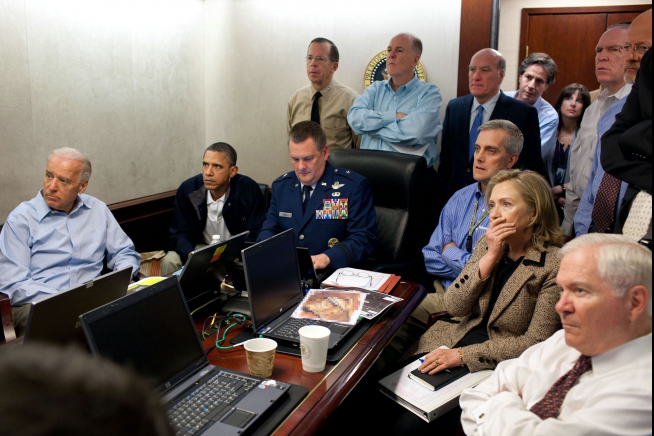
How much do I actually NEED to know about the bin Laden raid?

How much of what THEY know do WE need to know?

Here’s a consideration I hadn’t though much about before now, and should have (given all those spy novels, and military history books, and Tom Clancy thrillers I’ve read):

Has the U.S. Said Too Much About the Bin Laden Raid?

Military officials fret that constant stream of leaks may hinder future missions, put Navy SEALs at risk.

By Josh Voorhees | Posted Friday, May. 13, 2011, at 11:09 AM EDT

In the nearly two weeks since the U.S. operation that killed Osama Bin Laden, a near-constant stream of detailed information about the raid’s specifics has seeped out from White House officials, lawmakers, and pretty much anyone else with security clearance.

But that’s not how things were supposed to be, at least not according to Defense Secretary Robert Gates. “Frankly, a week ago Sunday, in the Situation Room, we all agreed that we would not release any operational details from the effort to take out Bin Laden,” Gates told Marines at a Wednesday town hall at Camp Lejeune. “That all fell apart on Monday—the next day.”…

The White House announced last week that it was done briefing reporters on the specifics of the mission, but that has done little to stop the ongoing flow of new details from being reported. The latest major leak came Thursday night, when CBS News gave a detailed play-by-play of what the Navy SEAL team’s helmet cameras captured during the raid….

There is the danger that the more we know about details of the raid, the greater potential for threatening our capability to do something like it in the future.

For instance, the lede story on The Washington Post‘s front page yesterday told us that a key element in preparing for the raid involved high-altitude drones flying WAY deeper into Pakistan than the Pakistanis suspected we were going. So that we could get higher-resolution photos than you get from satellites. And if you consider how high-resolution satellite photos can be, these images must have been pretty awesome. So… you have a revelation of greater technical capability than the world might have expected, and of a tactical deployment that no one knew about.

Of course, it’s a two-edged thing. Let enemies and potential enemies know what you can do, and it could intimidate them into deciding they don’t want the United States as their enemy after all. Or at least, it MIGHT work that way with some — say, your less fanatical foes. But let anyone know what measures you are capable of, and it empowers them to develop countermeasures. That’s a huge theme in military history — measures and countermeasures — and it never ends.

We may find all these details fascinating — I know I do. But how much of it do we really need to know?

Trotsky, and other Reds In Name Only

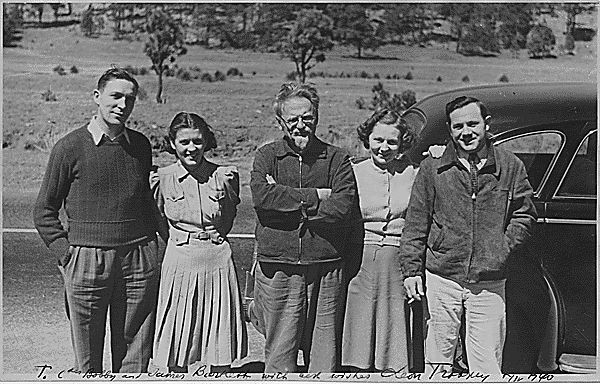
The Old Man in Mexico with some American comrades.

Something about our finding and killing bin Laden in his home after all these years got me to thinking about Leon Trotsky.

Yeah, I know — not the same thing at all. We’re not the USSR, and President Obama isn’t Stalin. And people knew Trotsky was in Mexico, and he wasn’t killed by Spetznaz commandos (and I think it would kind of anachronistic if he had been).

But still, it made me think of him. The mind sometimes makes strange leaps.

Trotsky wasn’t far from my mind because a while back, I started reading a recent biography about his Mexico years. I had been attracted to it by a review in the WSJ, and asked for it and got it for my birthday or something last year. I had been really curious about the story of a top icon of the Russian Revolution living south of our border, and largely supported by American Trotskyists.

But after the first few chapters, and reading all about the soap opera with Diego Rivera and Frida Kahlo and ALL the propaganda from Moscow and from Trotsky himself over the show trials and so forth, I got bogged down.

And the thing that wore me down the most, that frankly bored me to tears, was all the long-distance ideological arm-wrestling. You know how I have little patience with ideologues. There were all these titanic arguments going back and forth between the Trotskyites and the Stalinists about who was the REAL commie, each side working so hard to delegitimize the other (with the stakes being life or death for Trotsky), essentially accusing each other of being RINOs — Reds In Name Only.

And I just couldn’t care about any of them. I mean, talk about pointless. Trotsky was as ruthless as they come, while Stalin was one of the great monsters of the century. And it was pathetic that leftists in this country would actually take up the cudgels to defend or make excuses for either of them. The arguments over doctrine — stupid, irrelevant points of doctrine argued heatedly among people who, ironically given what they believed in, were on the wrong side of history — were particularly tedious.

At some point, I need to get back to the book and see how the guy with the ice ax got in and did the deed. But I haven’t been able to make myself do so yet…

Shooting replaces tough talk

In case you weren’t worried enough about this whole relationship thing with Pakistan:

Well, this isn’t going to make an alreadytense relationship any better.

A brief firefight between Pakistani ground troops and NATO helicopters erupted early Tuesday morning near the Afghan boarder. Pakistan claims that two of its soldiers were wounded as a result of the clash, and officials are demanding a meeting with NATO leaders to address the situation, Reutersreports.

Pakistan has admitted that the ground troops opened fire first, but maintains that they were in the right because the two helicopters had crossed into Pakistan’s airspace from Afghanistan, the New York Timesreports. Western military officials, meanwhile, have so far declined to say whether the helicopters were indeed over Pakistan…

… and what Noam Chomsky thinks

I just shared with you a poll about what normal Americans think about killing Osama bin Laden. Here’s what Noam Chomsky thinks:

We might ask ourselves how we would be reacting if Iraqi commandos landed at George W. Bush’s compound, assassinated him, and dumped his body in the Atlantic. Uncontroversially, his crimes vastly exceed bin Laden’s…

“Uncontroversially,” he said. Which sort of makes him demonstrably, inarguably, objectively — that is to say, “uncontroversially” — wrong, doesn’t it?

As usual.

Ran across that this morning, and had been meaning to share it with you all day. Talk about your outliers. Talk about your people who are very, very lucky that they live in this particular country — or in a pluralistic liberal democracy, in any case.

Chomsky ended his statement with,

There is much more to say, but even the most obvious and elementary facts should provide us with a good deal to think about.

Yep.

As you may know, bin Laden was a Chomsky admirer. Liked to quote him.

The connection to the royals didn’t do the trick

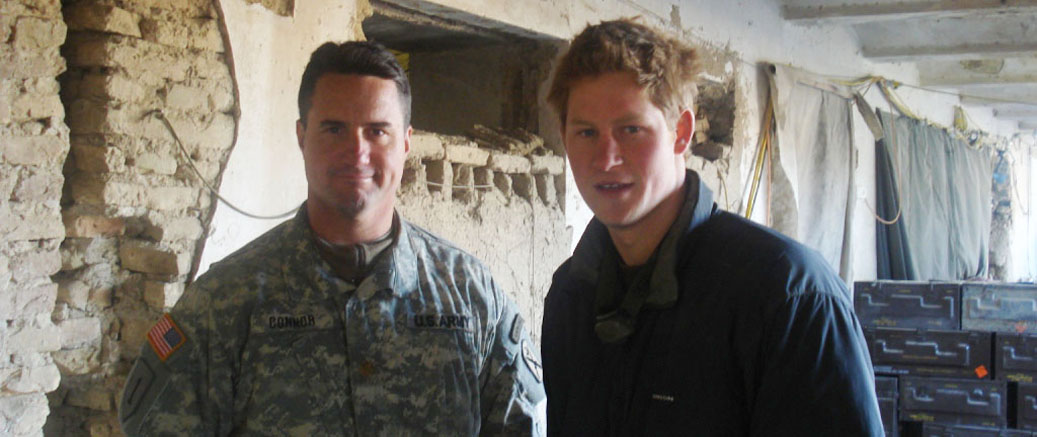
That's 2nd Lt. Prince Harry (Henry Charles Albert David) of Wales on the right, Lt. Col. Bill Connor on the left, in 2008 (or late 2007; I'm not sure): "He called me Bill and I called him Harry."

Remember all the back-and-forth between the candidates for Democratic Party chair back before the convention, some of which I kept track of here (to the point that I was sort of sorry I started)?

I just didn’t get those kinds of releases from the candidates for GOP chair beforehand. Oh, I saw some back-and-forth on Twitter about how Nikki Haley was backing one candidate, and her critics at SCTruth were backing another, and so forth and so on. But they didn’t give a lot of context, and if there was a battle of emailed press releases, I missed it. Even though I had specifically asked to be kept in the loop (and folks, I seldom ASK for press releases), and at least two of the three campaigns said they’d send me whatever they sent out.

But about all I received via that medium in the last days was this one Facebook alert from Bill Connor, on the day of the royal wedding:

“Brad,
Thought you might like this bit of history in honor of the Royal Wedding (the picture is on my fb profile).  Hope you are well!:  http://www.facebook.com/l/ae801_1klnj9MQbQucenXRWIjsA/seattletimes.nwsource.com/html/nationworld/2004253009_harrypal01.html

As it happened, I had already known that about Connor. In fact, he had written us an op-ed piece about it, right after his highness had spent a brief time serving alongside SC Guard troops in Afghanistan (before the word got out and they had to yank him out of the country). The above photo ran with that piece.

Anyway, so much for any of the fairy-tale effect of the royal wedding rubbing off. Bill Connor came in third in the competition state GOP chair.

Which reminds me — I need to get winner Chad Connelly in here for a “Brad Show.”

Big, tough, confrontational talk out of Pakistan

Did you see this in The New York Times:

ISLAMABAD, Pakistan — The head of Pakistan’s army, Gen. Ashfaq Parvez Kayani, said Thursday that he would not tolerate a repeat of the American covert operation that killed Osama bin Laden, warning that any similar action would lead to a reconsideration of the relationship with the United States.

Of course, this stimulates three immediate reactions:

  1. You won’t “tolerate” it? Really? Perhaps you’d like to explain what that means.
  2. What a coincidence. We just reconsidered our relationship with you.
  3. So… you think another such raid by us is likely? Does that mean you’ve got somebody else at the top of our list hiding on your turf? Tell you what — why don’t you just can the tough talk and give us a map to his house? Save everybody a lot of trouble.

Yeah, I know this is about Pakistan’s extremely fouled-up internal politics. But you know what? I’ve had it up to here with Pakistan’s extremely fouled-up internal politics. Reconsider away, fellas, and make up your minds which side you’re on in this war.

Yeah, I know I’m sounding like the arrogant Ugly American (with “big, tough, confrontational talk” of my own) in dismissing your hurt pride in this way. But finding out you’d been letting bin Laden hang in the ‘burbs with your own generals for the last 6 years sort of put me in an ugly mood.