Category Archives: Words

More evidence in defense of John Rainey

As long as I’m mentioning Cindi and Warren today, I’ll go ahead and call your attention to something else I saw in The State this morning. It was a column by Kathleen Parker, in which she stuck up for John Rainey in light of our governor’s emotional attack on him.

Remember her oh-so-classy way of defending herself against the ethical questions Rainey had raised? She called him “a racist, sexist bigot who has tried everything in his power to hurt me and my family.”

I briefly touched on a couple of things that just leapt to mind about John Rainey that seemed at odds with that assessment. Since Kathleen is still paid to write columns, she dug a good bit deeper and came up with some other examples of things that make Rainey sound like anything but what Nikki Haley says he is:

Inarguably, the governor’s charges, made publicly and aimed at a citizen, albeit a powerful one, are far more damaging than whatever Rainey said during a private meeting. Judge as you may but consider the following facts before accepting Haley’s indictment of Rainey.

Rainey

For no personal gain, Rainey frequently has raised money and organized groups in common cause across party lines. He and his wife, Anne, marched in 2000 with 46,000 others to protest the Confederate flag, which then flew atop the state Capitol dome. He personally hosted several private meetings with NAACP and legislative leaders to find a compromise for the flag’s removal.

He served as executive producer and raised funds to finance Bud Ferillo’s documentary “Corridor of Shame,” about the dismal condition of public schools along the Interstate 95 corridor through South Carolina. Candidate Barack Obama visited one of those schools and cited the corridor in campaign speeches.

In 1999, Rainey chaired the fundraising committee for the African-American History Monument on Statehouse grounds. In 2002, while chairman of Brookgreen Gardens, he raised funds to erect a World War I doughboy statue in Columbia’s Memorial Park and sponsored a bust of a 54th Massachusetts Infantry African American soldier. He received the sixth annual I. DeQuincey Newman Humanitarian Award in 2004, named for the United Methodist minister and first African American elected to the state Senate following Reconstruction.

Latest to the roster is a sculpture that Rainey has commissioned, honoring two Camden natives, financier Bernard Baruch and baseball great Larry Doby. Baruch was a philanthropist, statesman and consultant to presidents (Woodrow Wilson and Franklin D. Roosevelt). Doby was the first African American to play in the American League and was inducted into the National Baseball Hall of Fame in 1998.

The sculpture, which will be unveiled in April, is a monument not only to two local heroes but also to the sort of reconciliation Rainey represents. His record speaks louder than words.

Warren’s absolutely right, Moe

What caused him to change his mind?/Photo by Brett Flashnick

I certainly hope Moe Baddourah read Warren Bolton’s column this morning, and took it to heart. Excerpts:

WHILE COLUMBIA City Councilman Moe Baddourah will take his first formal vote at today’s council meeting, it’s doubtful that many of his official votes loom as large as an unofficial decision he made following a May 8 public hearing.

That was the day he back-tracked on what had been a strong stance in favor of allowing voters to decide whether the city should change its form of government from council-manager to strong mayor. Up until then, it seemed evident that when Mr. Baddourah and Cameron Runyan joined the council — they both were sworn in last week — the seven-member body would have a majority in favor of putting strong mayor on the ballot.

As a matter of fact, some had questioned whether the council seated in May should even have voted, knowing that it could make a decision very different from what the new council that assembles today would make. It was generally thought that there was a 4-3 split against strong mayor at that time…

When Mr. Baddourah visited with our editorial board prior to the April city elections, he was emphatic in saying that Mayor Steve Benjamin needed more authority. “I think Columbia is ready for that,” he said.

“We need a (full-time) mayor for the city to bring business in,” Mr. Baddourah said. “I’d love for Benjamin to be a full-time mayor. I think he’s a really good face for the city.”

So, imagine my surprise as I watched the public hearing, held during a council meeting, live online only to see Mr. Baddourah do a 180 when he and Mr. Runyan were put on the spot as to how they might vote once they joined the council.

Maybe it was the pressure of the moment. Or maybe he genuinely changed his mind. Whatever the case, it was abrupt and damaging to the effort to allow voters to have a say as to what form of government they choose to live under…

I’m not much of one for campaign promises. I generally think candidates should keep their options open for what they encounter in office. I even think when they do make the mistake of promising something, they should be free to change their minds — as long as they can make a good case for it.

But come on. In this case, Moe had just been elected, and had been elected not only indicating he’d support letting voters decide, but asserting strongly that he favored a certain outcome from that public vote.

And then, without having been through any discussion or other discernment process that was visible to the voters, he announces that he won’t even let the voters themselves decide the issue, and does it before he even takes office? Really?

It’s as shocking and as sudden and as premature a turn-around as I’ve ever seen.

This is indeed a case in which a mind so easily changed should carefully consider changing back. And then he should explain fully to the people who elected him what caused him to make such a strange announcement between the election and taking office.

Yes, “trackers” HAVE gone wild, and then some

A shot from video footage taken outside the home of a candidate.

Earlier today, Politico posed the question on Twitter, “Democratic trackers gone wild?”

While most serious campaigns on both sides use campaign trackers — staffers whose job is to record on video every public appearance and statement by an opponent — House Democrats are taking it to another level. They’re now recording video of the homes of GOP congressmen and candidates and posting the raw footage on the Internet for all to see.

That ratcheting up of the video surveillance game is unnerving Republicans who insist that even by political standards, it’s a gross invasion of privacy. Worse, they say, it creates a safety risk for members of Congress and their families at a time when they are already on edge after a deranged gunman shot former Arizona Democratic Rep. Gabrielle Giffords 18 months ago.

Wisconsin GOP Rep. Reid Ribble, who said he’s also been followed by a cameraman when shopping for groceries, said the home videos cross a line.

“I feel it’s totally inappropriate,” said Ribble, a freshman facing a competitive race for reelection. “It was disturbing to me that they would put that online. I don’t understand any political benefit that can be achieved with that.”…

Yes, indeed, say I. They’ve gone too far. But then, I think the whole phenomenon went overboard, across the spectrum, years ago. I have a low threshold with this kind of stuff.

There’s nothing illegal, certainly, about following one’s opponent around with a video camera. And everyone does it, right? One can even argue that a conscientious candidate should be fully aware of what his opponent has to say.

But in this era of saturation communication, stalking one’s opponent with a camera hoping for a slipup, a gotcha! moment, is not only unnecessary, there’s something low about it. And I confess that when I’m at a political event, and I spot the opposition’s tracker, I can’t help looking upon that person with something akin to disdain.

I don’t expect many people to agree with me on this. Certainly not many journalists today, since so much of their material comes from this sort of thing.

But I was always a different sort of journalist. I always wanted to know what a candidate has to say after he thinks for a minute, not what he says when he misspeaks. Some pop-Freudians believe the slip is the truth. Sometimes it is, sadly. But I’ve always valued more what the candidate says when you give him or her a chance to think a little harder about it. When a candidate says, “That’s not what I meant,” the gotcha folks snicker. Me, I start paying closer attention to find out what he or she did mean. And I flatter myself that I can tell, usually, if the further explanation is just blowing smoke.

Maybe I look for the second thought because that’s how I hope (idealist that I am) that they will govern — in a deliberative manner, with their ideas morphing and growing and getting better in a ferment with other ideas. I want to be governed by what people think upon further reflection, not the first thing that pops into their heads.

And even if they never achieve that, I want to give them every opportunity to do so.  I want to hear the “yes, but…,” the second and third and fourth thoughts. I want depth of consideration. Deliberation, the thing upon which republican government relies.

But the “tracker” is a manifestation of a political culture that does not value further reflection. And therefore is a sign of a political culture in decline.

Russia backs down, somewhat, on Syria

Maybe Hillary Clinton’s tongue-lashing last week has had a good effect:

MOSCOW (AP) — Russia on Monday signaled that it would not sign new weapons contracts with Syria until the situation there calms down.

The country will continue with previously agreed exports, but will not be selling new arms to Syria, Vyacheslav Dzirkaln, deputy chief of the Russian military and technical cooperation agency, told Russian news agencies on the sidelines of the Farnborough air show southwest off London.

Putting it in conflict with the West, the Russians have blocked the U.N.’s Security Council from taking strong, punitive action against the Assad regime and are seen as the country’s key arms supplier. Syrian activists say that about 14,000 people have been killed in an uprising in the country since March 2011…

Russian President Vladimir Putin earlier on Monday said that Russia is still committed to a peace plan by U.N. envoy Kofi Annan, saying that the Syrian government and opposition groups should be “forced” to start a dialogue….

OK, it’s not a huge concession, but it’s a concession, which is encouraging.

This is interesting, from further down in the story:

U.S. Secretary of State Hillary Rodham Clinton last month issued a harsh reprimand to Russia, saying that Moscow “dramatically” escalated the crisis in Syria by sending attack helicopters there. The State Department acknowledged later that the helicopters were actually refurbished ones already owned by the Syrian regime.

Doh! Oh, well. I guess that’s something else Hillary can claim credit for, in keeping with the old joke: Guy stands on the corner snapping his fingers. Cop comes along and says to stop loitering and move along. Guy says, “I’m not loitering; I’m keeping the elephants away.” Cop says, “There are no elephants around here.” Guy says, “See what a great job I’m doing?”

You tell ’em, Hillary! It’s about time somebody called Russia and China on their obstructionism

When the Cold War ended, we were supposed to finally get this New World Order that made it possible to advance the cause of civilization across the globe, without the agendas of competing superpowers overriding consensus in the United Nations. (Either that, or some global conspiracy to undermine national sovereignty and do dirt to People Like You, if you are of a conspiracy orientation.)

But time and time again, two countries — a superpower wannabe and a superpower used-to-be — have repeatedly, usually perversely, stood in the way of any effort to crack down on bad actors from dictators who crush their own people to nutjobs who seek to go nuclear. Time and time again, the best friend of the Assads of the world turn out to be either China or Russia, or both of them. (True, France and Germany also demurred when we were gearing up to go after Saddam, but that was an instance in which reasonable people could disagree.)

Now, Hillary Clinton has called them on it:

Syria crisis: Clinton lambasts China and Russia as Annan urges unity

Hillary Clinton demands rivals ‘pay price’ for backing Assad as UN’s Kofi Annan warns Iran must play role in ending conflict

International divisions over Syria were laid bare today as Kofi Annan issued a blunt warning that world powers must end their “destructive competition” over the future of the Assad regime even as Hillary Clinton demanded that Russia and China “get off the sidelines” and support the Syrian people.

Clinton used a conference of the Friends of Syria group in Paris to demand that Russia and China join the three western members of the UN security council to pressure Assad over an escalating conflict that has left 15,000 dead and is inflaming the wider region…

Clinton called for “real and immediate consequences” for non-compliance with the peace plan, including sanctions against the regime, but with Russia and China boycotting the event, there was no chance of agreement on punitive action under Chapter 7 of the UN charter. “What can every nation and group represented here do?” Clinton asked. “I ask you to reach out to Russia and China, and to not only urge but demand that they get off the sidelines and begin to support the legitimate aspirations of the Syrian people.

“I don’t think Russia and China believe they are paying any price at all, nothing at all, for standing up on behalf of the Assad regime,” she said. “The only way that will change is if every nation represented here directly and urgently makes it clear that Russia and China will pay a price. Because they are holding up progress, blockading it. That is no longer tolerable.”…

I like the “pay a price” part. I think if Hillary Clinton said I was going to pay a price if I didn’t straighten up and act right, I’d believe her.

Wouldn’t you?

You can see video of her address here.

Here’s hoping her tough talk will have a good effect. Just as her apology to Pakistan (which has really had touchy inferiority complex ever since we killed bin Laden in one of their suburbs) did earlier in the week. Sometimes you need to make nice, other times not so much.

No, ma’am: If OBAMA killed him, he’d be dead

Unfortunate choice of words by Ann Romney this morning:

(CBS News) On a mission to shatter the image of her husband as rigid and unrelatable, Ann Romney told CBS News she worries that President Obama’s entire campaign strategy is “kill Romney.”

“I feel like all he’s doing is saying, ‘Let’s kill this guy,” she said, seated next to her husband, presumptive GOP presidential nominee Mitt Romney, in an exclusive interview with CBS News chief political correspondent Jan Crawford. “And I feel like that’s not really a very good campaign policy.

I say that because, well, Barack Obama just happens to be the only president in history who we know has an actual “kill list” that he personally maintains. And he doesn’t mean the word “kill” figuratively. You end up on Obama’s list, and you’re dead.

So, since Mitt Romney’s still kicking, that’s a really good argument that he never made the list.

Of course, I then read on to see that Mrs. Romney didn’t come up with the word herself; some idiot in the Democratic Party did:

In August, some Democratic strategists let leak to the press that Obama’s top aides were looking at a massive character takedown of Romney in light of a deterring economy; “kill Romney” was a phrase used by one. “That was their memo that came out from their campaign,” Ann Romney said. “And it’s like, ‘not when I’m next to him you better not.”

Still, I wouldn’t bandy that word about so carelessly. Not with this president.

No question, Ronald Regan was a great Amercian

OK, now we’re getting into the nit-picking, since this time it was small type way down in a slide, rather than the title of an initiative. And it wasn’t the candidate himself who made either mistake:

First “Amercia,” then “sneak-peak,” and now “Ronald Regan.” No wonder the Romney campaign is searching for a copywriter. (Required skill: “Ability to edit and proof own work.”)

Buzzfeed spotted the latest spelling error from the Romney team on Wednesday after taking a look at a slideshow the campaign’s pollsters put together for bundlers, and the rest of the Web appears to have taken notice. (The Gipper’s last name is spelled Reagan.) Among the international outlets currently running the story: Britain’sTelegraph, Canada’s Star and Ireland’sIndependent.

The typo was in a chart showing the approval ratings of incumbent presidents in the May before their re-election attempt. “Ronald Regan” was noted as having a 53 percent approval rating. (For the record, Obama’s was 47 percent, according to the chart).

But that’s the way it works. Poor ol’ Gerald Ford stumbles once, and the heartless media marketplace labels him a klutz.

For Romney, it looks like it’s gonna be spelling. Sorry, Mitt; them’s the breaks.

Some faves from the late, lamented @PhilBaileySC

Just got around to seeing this…

On Sunday in The State, The Buzz (a descendant of a tidbits column I started in the ’80s called “Earsay”), lamented the cruel demise of @PhilBaileySC, and remembered some of his best Tweets:

• “Happy Confederate Memorial Day South Carolina. The rest of the country calls this day ‘Thursday’ ”

• “At what point do I freak out about Sharia Law coming to SC? Right after Bigfoot is proven real?”

• “Haley to send it to Georgia tomorrow. RT @WLTX: 30-foot-tall State Christmas Tree arrives in Columbia”

• “Happy Valentines Day, Ladies. The @scsenategop will be attempting to regulate your womb tomorrow.”

• “Besides the latest Winthrop Poll numbers having @NikkiHaley at 37%, Angies List gives the SC Guv a D-.”

• “ Mitt Romney and Nikki Haley settled on the endorsement in an email. Unfortunately, Haley pressed delete on the email out of habit.”

Not sure those are the exact ones I would have chosen (the fourth certainly doesn’t reflect my views), but they give you the idea. My fave of these is the first one. Very Phil.

Brooks sees Obama the way I do, as a mensch

David Brooks didn’t quite go all the way to calling President Obama a Michael Corleone (as opposed to a Sonny, which is more like what George W. Bush was), but he did everything else but say the name:

The key is his post-boomer leadership style. Critics are always saying that Obama is too cool and detached, arrogant and aloof. But the secret to his popularity through hard times is that he is not melodramatic, sensitive, vulnerable and changeable. Instead, he is self-disciplined, traditional and a bit formal. He is willing, with drones and other mechanisms, to use lethal force.

Normally, presidents look weak during periods of economic stagnation, overwhelmed by events. But Obama has displayed a kind of ESPN masculinity: postfeminist in his values, but also thoroughly traditional in style — hypercompetitive, restrained, not given to self-doubt, rarely self-indulgent. Administrations are undone by scandal and moments when they look pathetic, but this administration, guarded in all things, has rarely had those moments….

Brooks said that in the process of marveling at the fact that Obama even has a chance at re-election, since so many of the fundamentals are against him. He concludes that “In survey after survey, Obama is far more popular than his policies” because of what Americans think of him as a man. Not just as a person, but as a man.

Oh, and for those who are tired of me talking about “guy stuff” this week, don’t blame me on this one; Brooks brought it up.

I don’t think either of us has precisely hit the nail on the head. I keep saying “Michael Corleone” to describe his quiet, non-blustering toughness. But of course, the president is a better man than Michael Corleone. “Mensch” doesn’t quite say it either, but it points in that direction. As for Brooks’ reference to “ESPN masculinity” (a term so important to his piece that it’s his headline) — well, I don’t even know what he means by that. Maybe I don’t watch enough sports. (I’ll confess that I also get confused with what people mean when they say “postfeminist.” Some seem to use it to refer to feminism being over and done with, and therefore “NONfeminist.” Others seem to refer to a state in which feminism is taken for granted and no longer a movement, just part of life. So the word is unhelpful to me.)

Another way to say what Brooks is trying to say — “thoroughly traditional in style — hypercompetitive, restrained, not given to self-doubt, rarely self-indulgent” — is “Gary Cooper.”

But we all want to be Gary Cooper (in “High Noon,” specifically — “I’ve got to, that’s the whole thing.”). What Brooks is saying, in a way, is that Obama pulls it off.

Maybe this rhetorical approach is a GIRL thing…

Something struck me when I was reading this release just now from Mia Butler Garrick:

Friends,

Today, we are just 43 days away from the Primary Election on June 12th and I need your help.  Right now in South Carolina, hundreds of special interest groups lobby the good ole boy network here at the State House to vigorously maintain control of the failed status quo that continues to plague our state.  They use their influence to ensure that SC remains at the bottom-of-the-best list by continuing to enact policies that wreak havoc on public education, hinder economic development and job creation and foster an environment of partisanship, nepotism and corruption at all levels of government.

I’m proud of the fact that the folks of District 79 always stand firmly against the good ole boys.  We stand boldly for jobs, for small businesses, for public education, for better infrastructure and safe schools and communities.  But more importantly, we stand firmly and boldly, together.  My campaign has never been about me.  It’s about what we can accomplish together for the future of South Carolina!

That’s why today, I’m asking all of you to step up just as you did two years ago, and show your support by volunteering now.

Election Day is Tuesday, June 12th.

Did it strike you that that sounded very much like the way the Nikki Haley presents herself to voters? As the lone beacon of transparency and virtue in a squall of self-dealing “good ol’ boys”?

Of course, the difference between them might be that Mia actually means it when she says those things. But the similarity in the general line of expression struck me…

Forgive me for intrusinating on your day with a word about Twinspeak

My three youngest granddaughters, in an intrusination-free moment.

Saturday night, we kept all three of our youngest granddaughters. Sunday morning, I was recuperating on the couch, just barely dozing, while the Twins played a few feet away from me.

I was awakened by a sudden loud dispute, as Twin B got frustrated with her sister for grabbing at some toys she was playing with.

“Stop intrusinating me!” she cried.

I lifted my head to look in that direction in wonder: “What did you say?”

Twin A, speaking as one would to a hard-of-hearing elder, explained, “She said to stop intrusinating her.” Like, what did you think she said?

OK, I said. Thank you.

I suppose the word — which I’m guessing is kin to both “intrude” and “insinuate,” and perhaps “excruciating” — if fine, as long as the one to whom it is spoken understands. Which she did.

The twins are 4 now.

Hopefully, they’ll let us use the word this way

Stan Dubinsky brings to my attention this attempt by a grammarian to defend ordinary folks’ most common use of “hopefully” as something less than a mortal sin. It’s a dense piece, for something so short, but here are some relevant bits:

Many adverbs are used as manner adjuncts: He saw her clearly uses clearly as a modifier specifying the manner of the seeing. Some are used as what The Cambridge Grammar of the English Language calls modal adjuncts, necessarily and possiblybeing the most basic and familiar ones. Clearly happens to have both a manner use and a modal use: Clearly he saw her is an example of the latter (modal adjuncts are often placed at the beginning of the clause; notice that this sentence doesn’t comment on the clarity of the glimpse, it says that given the evidence it’s indubitable that he saw her)…

With truly extreme caution, the AP Style Guide nonetheless waited a decent further interval: Its editors let more than a quarter of a century go by before they finally risked accepting what had now been normal Standard English usage for a lifetime. On April 17, 2012, they announced correctly that the modal-adjunct use of hopefully is not a grammatical error.

And people acted as if the sky was falling. “The barbarians have done it, finally infiltrated a remaining bastion of order in a linguistic wasteland,” wrote an overheated (and since then, overquoted) Monica Hesse in The Washington Post on April 18. (Perhaps she wrote ironically, but it doesn’t look like it.)

Barbarians? A single additional use of a single adverb undergoes a tiny expansion in its uses, fully in line with normal developments in the history of English syntax. No threat of ambiguity arises (I have never seen a case in which it was in doubt whether hopefullywas intended as a manner adjunct or a modal adjunct). And when AP makes a small move, decades late, toward acceptance of an easily accessible fact about how English speakers employ a word, it means our language is being reduced to a “wasteland”?

The author, Geoffrey Pullum, blames the late usage specialist Wilson Follett for inspiring “Five Decades of Foolishness” over the common usage.

I’ve always been able to see that the use of “hopefully” was structurally problematic, but I’ve also known that it communicates clearly and concisely. Which is generally seen as a virtue.

Were any of these “members” female?

Note how self-restrained I am. I held myself back from using as my headline, “I got your ‘member’ right here!” Even though that would have better expressed my exasperation.

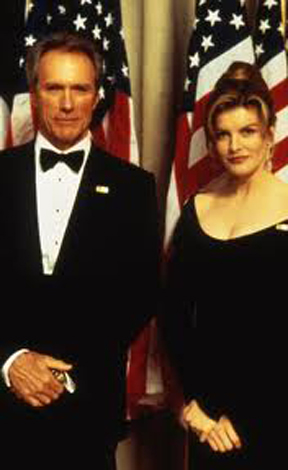
Clint Eastwood and Rene Russo as Secret Service 'members' in 'In the Line of Fire.'

We used to have “servicemen” in our armed forces. Or, more broadly, military personnel. Now, we have this horrendous construction that drives me nuts every time I hear it: “military members.” That’s the best we seem to be able to come up with as a way of referring generically to soldiers, sailors, marines, and that least ideologically correct of all designations, airmen.

What are we saying? That the military is a club? Like belonging to Rotary, or the Elks? To me, it sounds vaguely insulting to those who serve us in uniform, to refer to them as “members.” Like fingers or toes, or perhaps some even less presentable member.

With the scandal over the weekend involving both Secret Service and military personnel, this linguistic absurdity has been taken to new depths.

To begin with, one assumes that all the agents sent home for consorting with prostitutes were male. And if you read non-American news sources such as Agence France-Presse or the Daily Mail, they go ahead and refer to them as male. That’s because in those countries, the fact that men tend to do certain things that women tend not to do (such as, bring hookers to their rooms) is confronted somewhat more directly, and not treated like a secret of which we must not speak. (Someone is inevitably going  to contradict me by pointing to U.S. sources that do mention gender. But the fact remains that, after having read U.S. sources that did not mention gender, the first ones I found that did were foreign. It’s a tendency thing, not an absolute rule.)

I haven’t yet found any stories that tell the gender of the five “military personnel” who were also implicated, but not sent home, supposedly because their skills were too much in demand in protecting the president (rooftop snipers, perhaps?). If anyone has seen such a reference, please share it, if only to satisfy my morbid curiosity.

But whether they are male or (against the odds) female, there are better ways to refer to them than as “military service members,” as the NYT does here in its own stilted fashion:

Five United States military service members who were working with the Secret Service and staying in the same hotel are also facing an investigation because they violated a curfew and may have participated in the misconduct.

The use of such a slightly off-sounding construction has a bad effect on journalists. They become jaded to awkwardness, and therefore their radar doesn’t go off when they inadvertently type something that is not just awkward, but downright nonsensical:

Mr. Obama’s comments came several hours after Representative Darrell Issa, Republican of California and chairman of the House Oversight and Government Reform Committee, suggested that more Secret Service personnel members may have been involved in the incident.

Did you catch that? “Secret Service personnel members”? Really? Not “Secret Service members,” which would sound awkward enough, or “Secret Service personnel,” which would have been fine, but the entirely redundant “Secret Service personnel members”!

Why not take it to another level, or two? Why not “Secret Service personnel members people employees,” while you’re at it?

Or… and excuse me for getting radical here… how about if the reporter covering this for you just went ahead and asked the question, “Are any of these people female?” Because if not, you don’t have to perform any of these acrobatics, and can just go ahead and refer to the “men.” And if they are, even an awkward construction like “servicemen and -women” would be less jarring than referring to them as “personnel members.”

Or how about just scraping your fingernails on a blackboard? That would probably get on my nerves less…

(Sort of) thrilled to see ‘subsidiarity’ mentioned

You sort of have to be a member, or former member, of The State‘s editorial board to get what this means to me, but I was excited to see that, in a column in yesterday’s WSJ, Daniel Henninger made repeated references to the concept of subsidiarity.

Subsidiarity is a concept I first ran across, and was intrigued by, in the communitarian classic The Good Society by Robert Bellah, et al.

In the years after I first read about it, I was enough of a bore about the concept in the editorial suite of The State that one April 1st, at the instigation of then-Publisher Ann Caulkins, my colleagues played a truly elaborate April Fool’s prank on me that was entirely based on some supposed new research debunking subsidiarity. It was probably the most esoteric, nerdy prank ever played on anyone in South Carolina history. The sort of thing the geeks on “The Big Bang” might play on each other, only with them it would be about physics instead of political philosophy — some knee-slapper having to do with the Heisenberg Uncertainty Principle, perhaps.

The Bellah book, and other references I have seen since, defined the concept this way:

As you can see, the idea is sorta, kinda related to what conservatives in the early 90s used to call “devolution” — the concept of moving governmental functions down to lower, more local levels. And yes, subsidiarity generally demands that. But it can also work the other way when you consider the duty “of the larger unit being to support and assist the local body in carrying out its tasks.” Also, the smallest unit isn’t necessarily the best; you look for the smallest unit “at which decisions might reasonably be made.”

While I haven’t used the word much over the years, if you peruse my work, you’ll see the influence of the concept in, for instance, my constant battles with the Legislative State to let local governments make the decisions that are properly left to the governments closest to the people. (I know of no state in the union more reluctant to allow that than South Carolina.) You also see it in my occasional mentions that the federal government has no business trying to run public schools. But then you see it work the other way, too — I’ve realized that many of the poor, small districts in South Carolina are unable to govern themselves effectively, and have a need for the state to “support and assist” them (by, for starters, consolidating many of them).

Anyway, so I was at first pleased to see Henninger mention “subsidiarity” — not once, but three times! But as I read the way he and Paul Ryan defined it, I grew confused:

Subsidiarity—an awful but important word—attempts to discover where the limits lie in the demands a state can make on its people. Identifying that limit was at the center of the Supreme Court’s mandate arguments.

Huh? I hadn’t run across that before. It’s a concept I’ve certainly encountered thousands of times in the WSJ, but I’d never heard it called “subsidiarity.”

But he’s not completely out of line. Sure enough, the Wikipedia entry on the Catholic social teaching (forgive me for citing such a plebeian source, but I’m too tired on a Friday evening to go poring through papal encyclicals) does mention this:

The principle of subsidiarity was developed by German theologian Oswald von Nell-Breuning.[2] His work influenced the social teaching of Pope Pius XI in Quadragesimo Anno and holds that government should undertake only those initiatives which exceed the capacity of individuals or private groups acting independently.

Of course, it does so after citing the more general definition that I have always understood:

Subsidiarity is an organizing principle that matters ought to be handled by the smallest, lowest or least centralized competent authority. Political decisions should be taken at a local level if possible, rather than by a central authority. [1] The Oxford English Dictionary defines subsidiarity as the idea that a central authority should have a subsidiary function, performing only those tasks which cannot be performed effectively at a more immediate or local level.

The word subsidiarity is derived from the Latin word subsidiarius and has its origins in Catholic social teaching.

So forgive me if I continue to believe that the concept is about the proper relationships between the biggest entity for making societal decisions (the federal government, the United Nations) and the smaller units (municipal government, neighborhood associations, the family — and taken to an extreme, the individual, although it seems to me that any concept of social structures sort of needs two or more to be present), and not yet another way of speaking of the monotonous, never-ending political battle between public and private, which is a different sort of dynamic altogether.

When, I wondered, did emphasis on the word’s meaning shift from the idea that things should be handled on the most local competent level, and become a servant of the libertarian concept of freeing the individual from the supposed “tyranny” of government, a mere matter of asserting the superiority of private over public?

Again, Wikipedia helps me out:

Subsidiarity is also a tenet of some forms of conservative or libertarian thought. For example, conservative author Reid Buckley writes:

Will the American people never learn that, as a principle, to expect swift response and efficiency from government is fatuous? Will we never heed the principle of subsidiarity (in which our fathers were bred), namely that no public agency should do what a private agency can do better, and that no higher-level public agency should attempt to do what a lower-level agency can do better – that to the degree the principle of subsidiarity is violated, first local government, the state government, and then federal government wax in inefficiency? Moreover, the more powers that are invested in government, and the more powers that are wielded by government, the less well does government discharge its primary responsibilities, which are (1) defense of the commonwealth, (2) protection of the rights of citizens, and (3) support of just order.[2]

Aha! Suddenly, I realize that the editorial board of The State was not the only entity in South Carolina given to pulling pranks regarding the concept of subsidiarity. Reid Buckley runs The Buckley School of Public Speaking right up the road in Camden.

So…  I see the libertarian ideologues have gone to messing with my pet concept, emphasizing one small consideration at the expense of the larger, more constructive idea, in their never-ending battle against the notion that we might ever dare to work together as a society to address concerns that are legitimately public.

Oh, well. At least I got to read the word in a general-circulation newspaper.

Memo to Harvey Peeler and Senate Republicans: ‘Conservative’ means you SUPPORT status quo

This artwork came with the release.

This release from Wesley and the Senate Republicans is intriguing on a couple of levels:

From today’s Associated Press:
State treasurer, House speaker oppose restructuring bill

There have been some unfortunate developments with the Senate’s bill eliminating the Budget and Control Board, with “The state treasurer and House speaker opposing the Senate’s version of a bill restructuring state government.”

“Senate Majority Leader Harvey Peeler shot back that the Senate’s version is more conservative than what the House passed last year. He accused the two of supporting the status quo.”

If you support conservative governance, and real restructuring, NOW is the time to stand up to the failed status quo.

Contact the Speaker’s Office and the Treasurer’s Office TODAY, and tell them to support the Senate version of the Department of Administration bill, and to support elimination of the Budget and Control Board.

First, you have the Senate Republicans attacking the Republican House and Republican Treasurer. In a nostalgic sense that’s not weird, because historically the biggest, nastiest split in SC was not between Democrats and Republicans, but between Senate and House. But that was when senators identified themselves primarily as senators, and not as R and D. Now that they think of themselves as Republican senators first and foremost (and this is being sent by the “South Carolina Senate GOP”), it comes across as odd.

Then, there are the really strange words that Harvey chooses to express his disagreement with the House and Loftis: “Senate Majority Leader Harvey Peeler shot back that the Senate’s version is more conservative than what the House passed last year. He accused the two of supporting the status quo.”

Senator, to the extent that language has meaning, if you are “more conservative” than someone else, that means that you support the status quo more than the other person does. By definition. Go look it up. OK, I’ll save you the trouble. When I Google the word “conservative,” the first dictionary definition that comes up is the one at Dictionary.com, and the first sense of the word is: “disposed to preserve existing conditions, institutions, etc., or to restore traditional ones, and to limit change.”

(I would quibble a bit with that definition. If you want “to restore traditional ones,” you are “reactionary.” But the rest is fine.)

Here’s what a Coble endorsement looks like

Some readers seemed confused earlier as to what an “endorsement” of a candidate looked like. It looks like this, in The State today:

COLUMBIA City Council District 3 runoff opponents Moe Baddourah and Daniel Coble are solid candidates who share common priorities, from focusing on district needs to improving public safety and providing long-term funding for the public bus system.

They also share a common drawback: We fear their strong focus on constituent and district needs could lead them to put those interests ahead of more important citywide issues.

While the two men are pretty even in many ways, Mr. Coble does distinguish himself as the better candidate. His knowledge and understanding of city issues and how government works stood out among all candidates in the just-concluded council races….

Now I can’t say it’s a ringing, unequivocal endorsement. Daniel is The State‘s second choice for the seat. My old colleagues initially endorsed Jenny Isgett, who did not make it into the runoff.

Now if I did endorse someone, it would be Daniel. It so happens that the candidate ADCO is doing work for is the one I would choose were I endorsing. But wait, you say! Isn’t my saying that an endorsement?

Not to me. I’ve spent many years of my life doing endorsements, and I have a very clear idea of what one is. To me, an endorsement involves setting forth a series of arguments as to why someone is the better candidate. As I’ve said thousands of times over the years, the value in an endorsement is the reasons why, not the mere who.

That goes to the core of why newspapers do endorsements (and should do endorsements). It doesn’t matter whether a reader ultimately agrees with the endorsement or not. It is valuable to have considered the arguments, whether you accept them in the end or not. For having spent that time reading a carefully constructed case for a candidate, your own ultimate decision will have been better-considered.

The endorsement in The State today is pretty good. It’s not exactly what I would have written, and were I still the editor I’d have made some changes in the piece, but I generally agree with the points made.

Here they come, all right — and ‘they’ includes YOU

A fragment from the latest of the DCCC releases that come to me several times a day, which was headlined, “here they come…“:

Since Rick Santorum dropped out yesterday, the Obama-Romney general election has fully engaged.

Just hours after Santorum’s announcement, Karl Rove teamed up with the Koch Brothers to launch a $1.7 million SuperPAC ad buy attacking President Obama in key battleground states.

There’s too much at stake to fall behind Romney, Rove, and the Koch Brothers.

Since the general election kicked off yesterday, we’re only 951 donors away from our goal of 10,000 supporters standing strong for President Obama and a Democratic Majority.

Contribute $3 or more right now to fight back against the Republicans’ swift-boat attacks >>…

My favorite part, I think, is that excellent example of the way parties use completely nonsensical terminology that they know has a proven track record of stirring the emotions of their base — in this case, “swift-boating.” (A term that hasn’t had any sort of relevance for eight years, and never had the meaning that Democrats ascribe to it — but it stirs the indignation of the faithful, and that’s the point.)

This release can be understood on several levels. One is face value: Now that his chief rival has dropped out, Mitt Romney will turn his full evil machine on our beloved President Obama, so you must give us money so we can fight him! Which is problematic in that the situation is not new. Romney has been trying to ignore his rivals and focus on the general election since before the Iowa caucuses; he just kept getting distracted. Now, you’ll see more of the same, with fewer distractions.

Then there’s another, ironic level. This is but one of a very long series of missives over the past few months going after Mitt Romney (remember how bemused I was that the Dems were totally focused on Romney, even as Gingrich was winning the SC primary?), and also trying to scare you into giving money so the party could keep doing so. No Rubicon is being crossed here, folks. Just another step on a long, boring road.

But there is one sense in which we are seeing a qualitative change at this moment. We are, with the departure of Santorum (although not of Gingrich or Paul), entering waters that partisans on both sides have longed to enter. We are entering the area where, according to the self-justifying propaganda of both sides, they believe they have the excuse to throw off any constraints that might in the past have pulled them somewhat in the direction of truth and proportion.

In other words, here they come — the Dems and Repubs both — and their coming at us with stuff likely to be even more outrageous than what we’ve seen.

For months, the two sides have been preparing their followers for this moment. During the SC primary campaign, I repeatedly heard and saw Republicans excusing the attacks they were hurling at each other by saying, “You’d better toughen up and learn to take it now, because if you’re the nominee, this is nothing compared to the horrible stuff that Obama will throw at you in the fall.” And I would turn and look at Obama, and I would wonder whom they were talking about. We’ve all seen the kinds of campaigns Obama runs. The fact that he was NOT like that was a prime reason why we endorsed him in the 2008 SC primary.

Meanwhile, the Dems have been working as hard as ever to demonize the opposition, building to this moment when they could say, “Now these monsters will stop chewing on each other and come after US!” At which point we’re all supposed to run for the hills or something. No, excuse me — we’re supposed to throw all our money at the Democratic Party (which will FIGHT for us!) and then run for the hills.

Well, thanks for the warning. You’ve  reminded me that it’s time to batten down the hatches. A squall of foolishness is headed our way. Here they come…

Letter from the ‘Alamo’ of Texas public schools

Thought this was interesting. A public school administrator in Texas penned a letter (last year, but I didn’t see it until now), based on that written by South Carolinian William Barret Travis from the Alamo, describing how he was besieged by ideological “reformers” in his state.

Will anyone ride to his rescue? And if he falls, will there be a San Jacinto?

Here’s his letter:

From: John Kuhn, Superintendent, Perrin-Whitt CISD
To: Senator Estes, Representative Hardcastle, Representative Keffer, and Representative King during these grave times:

Gentlemen,
I am besieged, by a hundred or more of the Legislators under Rick Perry. I have sustained a continual Bombardment of increased high-stakes testing and accountability-related bureaucracy and a cannonade of gross underfunding for 10 years at least and have lost several good men and women. The ruling party has demanded another round of pay cuts and furloughs, while the school house be put to the sword and our children’s lunch money be taken in order to keep taxes low for big business. I am answering the demand with a (figurative) cannon shot, and the Texas flag still waves proudly from our flag pole. I shall never surrender the fight for the children of Perrin.

Kuhn

Then, I call on you my legislators in the name of Liberty, of patriotism & everything dear to the American character, to come to our aid, with all dispatch. The enemy of public schools is declaring that spending on a shiny new high-stakes testing system is “non-negotiable”; that, in essence, we must save the test but not the teachers. The enemy of public schools is saying that Texas lawmakers won’t raise 1 penny in taxes in order to save our schools.

If this call is neglected, I am determined to sustain myself as long as possible and fight for the kids in these classrooms like an educator who never forgets what is due to his own honor & that of his community. Make education a priority!

With all due respect and urgency,

John Kuhn
Superintendent
Perrin-Whitt CISD

And here is the Travis letter upon which it is modeled:

Commandancy of the Alamo——

Bejar Fby. 24th 1836

To the People of Texas & all Americans in the world——

Fellow citizens & compatriots——

Travis

I am besieged, by a thousand or more of the Mexicans under Santa Anna —– I have sustained a continual Bombardment & cannonade for 24 hours & have not lost a man —– The enemy has demanded a Surrender at discretion, otherwise, the garrison are to be put to the sword, if the fort is taken —– I have answered the demand with a cannon shot, & our flag still waves proudly from the wall —– I shall never Surrender or retreat

Then, I call on you in the name of Liberty, of patriotism & every thing dear to the American character, to come to our aid, with all dispatch —– The enemy is receiving reinforcements daily & will no doubt increase to three or four thousand in four or five days. If this call is neglected, I am determined to sustain myself as long as possible & die like a soldier who never forgets what is due to his own honor & that of his country —– Victory or Death

William Barret Travis
Lt. Col. Comdt
P. S. The lord is on our side- When the enemy appeared in sight we had not three bushels of corn— We have since found in deserted houses 80 or 90 bushels & got into the walls 20 or 30 head of Beeves—

Travis

You may also be interested in a speech Kuhn delivered more recently at a recent Save Texas Schools rally in Austin. It concludes:

These and other grievances were patiently borne by the teachers of Texas, until they reached that point at which patience is no longer a virtue. We appealed to our government last spring in this very spot, called upon those in power to encourage and support the teachers who day by day struggle to educate the poorest children in the most neglected corners of our state. Yet they responded to our entreaties with new condemnations of the work we do. Our appeals have been made in vain.

We are forced to the melancholy conclusion that this government favors business interests that want a profit-based education system that would enrich investors, rather than a publicly owned system that enriches our children.

You can keep your for-profit schools. I want a locally elected school board that answers to me, to parents and local taxpayers, not to shareholders. I want a quality public education for ALL Texas children. I want adequate and equitable funding, so that families in every part of Texas can count on the consistent quality of our public school system like we count on the consistent quality of our interstate highway system, because we don’t want to wreck our children any more than we want to wreck our cars.

Texas officials, you build your hateful machine that blames teachers for the failures of politicians; we’ll still be here teaching when your engine of shame is laid upon the scrapheap of history. For now, we’ll bravely take these lashes you give because we know that — no matter what you say — the only crime of the public school teacher in 2012 is his or her willingness to embrace and teach broken children. If that’s a crime, then find us guilty. If caring for the least of these makes us unacceptable, then bring on your label gun. We’re not afraid.

Perhaps I was born too late. I miss speeches like that. This guy’s not afraid of anything, least of all a scrap.

A thoughtful, informative elaboration on a kick-in-the-gut campaign

In a previous thread, in response to Bud suggesting that there’s not as much hyperbolic pandering on the left as on the right, I cited the ridiculous rhetoric about a supposed “war on women,” and such other things as the billboard I’d seen near 5 Points that said, “contraceptives could become contraband.”

Over the weekend, I saw the above, which is evidently part of the same campaign as the other one, and doubled back and got a picture. This one was on 378 between West Columbia and Lexington.

Rather than just fulminate, I thought I’d pose some questions, which the above website helped me do. Under the headline, “OK, I’ve just got to ask,” I sent the following email to the organization:

Who on Earth are these lawmakers who supposedly want to “outlaw birth control?” And could you please cite a bill that would do that?

Even though it was Saturday, I got this quick response:

Hi Brad~

Thank you for emailing me with your question (and for the photograph).

Every year for the past 15 years, legislation has been introduced in South Carolina that would outlaw birth control. Currently, there are 4 bills that would do that through establishing personhood (aka defining life at conception). The sponsors listed on these bills are Senators Bright, Verdin, Fair, Cromer, S. Martin, Reese, Bryant and Grooms. Currently, the bills in the South Carolina legislature are S. 165: Life Beginning at Conception Act, S. 245: Life Beginning at Conception Act, S. 616: Personhood Act of South Carolina, and H. 3945: Personhood Act of South Carolina (I know it looks like I’m repeating myself, but they are all named similarly).

“Pregnancy” is established when a fertilized egg has been implanted in the wall of a woman’s uterus. Hormonal contraceptives (“The pill” is the most common form of hormonal contraception, but newer options of hormonal contraception include “the patch” and “the ring” – both of which provide a combination of hormones to control ovulation) act before implantation and prevent pregnancy. Nonetheless, a movement emerged in the U.S. during the decade of the 1990s that seeks to outlaw all hormonal contraceptives on the grounds that these forms of birth control may interfere with a woman’s ovulation, may prevent fertilization of a woman’s egg by a sperm, or may prevent the implantation of a fertilized egg in a woman’s uterus. Members of this movement consider any form of hormonal birth control to be the equivalent of an abortion in spite of medical evidence to the contrary. They lobby aggressively in state legislatures, including South Carolina’s General Assembly, and they are behind “personhood” ballot initiatives, most recently in Mississippi.

Any legislator, at any level of government, that supports personhood or defining life beginning at conception rather than implantation supports outlawing hormonal birth control. Similar bills have been introduced and failed to pass in numerous states, including Mississippi (ballot initiative), Virginia, and Oklahoma. All of the current Republican nominees for President have pledged their support for establishing life beginning at conception (Mitt Romney did so during an interview with Mike Huckabee; Rick Santorum, Newt Gingrich and Ron Paul have all signed the Personhood Pledge).

I have attached our Personhood legislative fact sheet to give you more information about Personhood bills and how they would affect South Carolina. I hope that this answers you questions, but I would be more than happy to speak with you about this further. Please feel free to email me back with any further questions or comments.

~Emma

Emma Davidson

Tell Them Program Manager

Imposing further on Ms. Davidson’s patience, I responded thusly:

… you don’t think calling that “outlawing birth control” a bit of a stretch? Because they would outlaw one small subset of what some people would call “birth control?”

Do you not think that when most folks say “birth control,” they’re talking about the Pill (and not the “morning after” pill, but the one that’s been around for 50 years), condoms, foam, diaphragms and the like?
In any case, for the statement, “Some lawmakers want to outlaw birth control” to be remotely true, they would have to be outlawing all forms of it — not just one relatively small subset of the category. I don’t see how a reasonable person could possibly read it any other way.

Ms. Davidson hasn’t gotten back to me yet. And that’s cool; I very much appreciate the time she took to answer me so thoroughly the first time, especially on a weekend. (When she does respond, I’ll share it here.)

But really — when you’re driving down the road and see the statement “Some lawmakers want to outlaw birth control,” do you read it as meaning “some very specific and limited forms of birth control”? Because I don’t. And that’s what bugged me about the billboard to start with.

Too bad Ms. Davidson’s very specific and informative email won’t fit on a billboard (actually, it would fit, but you couldn’t read it safely). I wouldn’t have a beef with that, because that would be very clear about what it was the organization opposes, and I could make an informed response to it. But as things are, I hope I can be forgiven for believing the group is looking for a kick-in-the-gut, emotional response from the average motorist.

Which brings up the fact that maybe, with such powerfully loaded issues, it would be better to conduct the debate in a manner somewhat more extensive and specific than the billboard/bumper sticker level.

Mercifully, I had forgotten this incident

Talking to Kara Gormley Meador yesterday, I momentarily drew a blank when she mentioned her run-in with John Graham Altman some years ago. She reminded me of the details, which made me go, “Oh, yeah.” Here’s a summary of the incident:

Excerpts from the exchange between WIS-TV reporter Kara Gormley and Rep. John Graham Altman, R-Charleston, over a S.C. House committee’s vote to make cockfighting a felony while tabling a bill that would toughen criminal domestic violence laws

Gormley: “Does that show that we are valuing a gamecock’s life over a woman’s life?”

Altman: “You’re really not very bright, and I realize you are not accustomed to this, but I’m accustomed to reporters having a better sense of depth of things, and your asking this question to me would indicate you can’t understand the answer. To ask the question is to demonstrate an enormous amount of ignorance. I’m not trying to be rude or hostile, I’m telling you.”

Gormley: “It’s rude when you tell someone they are not very bright.”

Altman: “You’re not very bright, and you’ll just have to live with that.”

So basically, when she talks about the lack of civility in politics, she’s speaking from personal experience.