Couple of nights ago, I Tweeted, “Missed the president’s speech. Too early. My wife caught it, though, and said he did well. And she’s a tough audience. So I’m satisfied…”
The headline in the paper over the weekend said, “S.C. Democrats: ‘We’re coming back'”:
S.C. Democrats still are smarting from a brutal November that stripped them of one of their two congressional seats, their only statewide office and a handful of General Assembly seats.
But, after some serious post-election number crunching, the state party contends Palmetto State Democrats fared better than Democrats in other states — whose candidates were clobbered by wide margins, too — and actually grew their ranks, laying the groundwork for a comeback.
“We’ve grown our base. These new numbers show we’re not dead and done like some people say,” said Jay Parmley, director of the S.C. Democratic Party. “Yes, we lost everything, but we’re coming back.”…
And what that headline tells us is, SC Democrats are delusional.
Oh, I’m not saying that it’s impossible that some new megatrend that has not yet been spotted by anyone could begin a reversal of the process that started in 1964, when Strom Thurmond joined the Republican Party, and white folks across the state started following him — first in a trickle, then in an accelerating flood.
What I’m saying is that there is no evidence extant at this time to believe that the Democrats are reversing nearly five decades of history trending against them in this state.
Certainly not the main “evidence” the optimists, whistling past their own partisan political graveyard, cite.
Vincent Sheheen’s strong showing is by no means a good sign for Democrats. Vincent Sheheen didn’t do that well because he was a Democrat. He did that well in spite of being a Democrat.
Vincent Sheheen was obviously a stronger candidate, who would clearly have been a better governor, than Nikki Haley. This could not be hidden from SC voters. They liked him better. But he lost, barely, because there are so many white folks in this state who would rather poke themselves in the eye with a sharp stick than pull the lever for a Democrat. His being a Democrat was therefore a huge liability.
If he had NOT been a Democrat — if he and Nikki had both run as Republicans, or if voters had somehow been kept ignorant of the party identification of the two candidates or, if you’ll allow me to dream (and Lord, hasten the day!), no candidate had had ANY party label — then he would have won.
This was obvious. Other statewide Republican candidates, in this huge year for Republicans nationally (and if you will recall, Nikki did everything she could to make the campaign national, running against Barack Obama instead of Vincent Sheheen, who was more likable than she) won in landslides. We’re talking double-digit margins. As I wrote right after the election:
It was so evident that Nikki was the voters’ least favorite statewide Republican (yes, Mick Zais got a smaller percentage, but there were several “third party” candidates; Frank Holleman still got fewer votes than Vincent). I look at it this way: Mark Hammond sort of stands as the generic Republican. Nobody knows who he is or what he does, so he serves as a sort of laboratory specimen of what a Republican should have expected to get on Nov. 2, 2010, given the prevailing political winds. He got 62 percent of the vote.
Even Rich Eckstrom — and this is truly remarkable given his baggage, and the witheringly negative campaign that Robert Barber ran against him — got 58 percent…
Oh, for those of you who don’t know, Mark Hammond is the secretary of state. Voters, by and large, don’t know that. All they knew was that he was labeled “Republican.”
That Nikki Haley, with her 51 percent, didn’t come anywhere close to their margins testified to voter discomfort with her (as opposed to a generic Republican like Hammond), and to the strength of her opponent (because SOME of those voters who went for the GOP in every other race voted for Vincent).
If she hadn’t had an R after her name, and he hadn’t had a D, he would be governor now.
And Democrats who say otherwise are fooling themselves.
Of course, we knew that — I’ve noted it before (most recently with regard to the Darla Moore affair). But it’s interesting that any national media have noticed it, given the hagiographic coverage she usually receives outside the state.
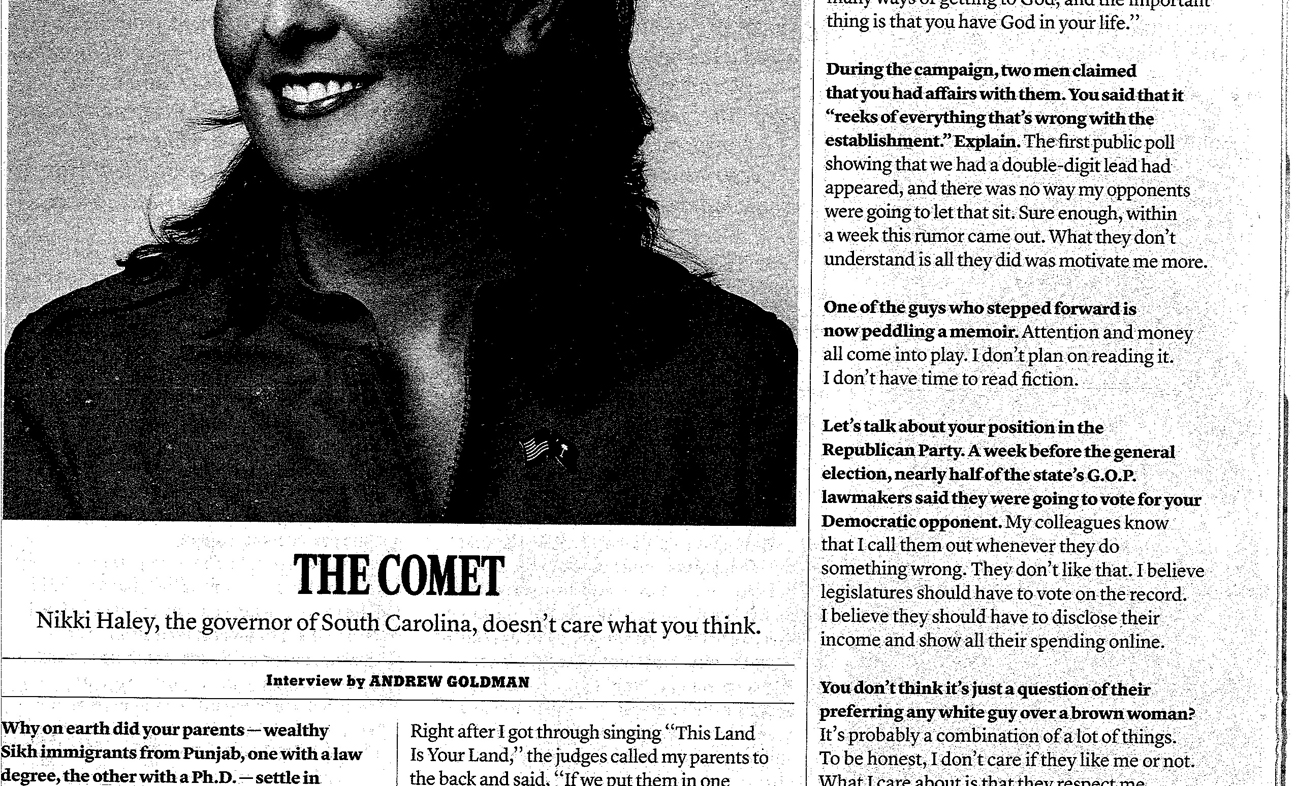
The State took note of the New York Times Magazine article several weeks back. They saw the “Comet” headline, and noted her wildly hubristic statement that “I don’t lose.”
But they apparently missed the subhead — probably because whoever was doing The Buzz for that edition looked at the piece online, rather than in print.
And that was the best part.
Above is a shot from a PDF of the print edition, which an alert reader shared.
By the way, that little pun — Haley the Comet — reminds me of something I saw in Oxford during my recent visit.
It seems that when Edmond Halley, famous for having first charted the path of the comet, was at Oxford (The Queen’s College), he decided to knock a hole in the roof of his top-floor flat so that he could watch the stars from there. The landlord was VERY accommodating — even though he wasn’t yet the famous Halley of the Comet — and a little observatory structure was built onto the roof.
At least, that’s the way our guide on the walking tour told it. The story may be apocryphal (a few minutes on Google just now failed to confirm it).
But if it’s true, it occurs to me that Halley didn’t care what people thought, either. With him, it turned out all right in the end. With our own Haley, the Comet… that definitely remains to be seen.
Below is the picture I took on Jan. 4 of the building where Halley lived:
And the thing is, this one is one of Eleanor Kitzman‘s bosses — House Ways and Means Chairman Dan Cooper, 50.
This came in over the transom yesterday, and I suppose it’s the letter that John O’Connor (oh, and happy birthday today, John) referred to in this story.
As accustomed as I am to the familiar tone of these appeals from the parties — you know, the ones that are all about whipping you up and making you really, REALLY hate the opposition, so that you’ll be angry enough to give money — I was still taken aback when I looked at my Blackberry and saw that I had an e-mail from Nancy Pelosi beginning, “Brad, I’ve had enough…”
First, I didn’t know we were such intimates. Second, whatever did I do to upset her? That concerns me, seeing as how we’re so close. Apparently.
Anyway, here’s the message:
Brad —
Do you know what House Republicans have done to create jobs since claiming the Majority three months ago? Nothing.
However, they’ve found time for votes to restrict access to reproductive health care, take teachers out of our classrooms, nurses out of our hospitals, and even to defund NPR. All told, Republican cuts would destroy 700,000 jobs.
I’ve had enough of the Republicans’ extremist anti-jobs agenda and I think you have too.
On March 31st, we’ll hit the first FEC quarterly filing deadline since the outrageous GOP power play in Wisconsin and Republicans took the reins in the House. The eyes of the nation will be on our fundraising numbers to judge our grassroots determination to fight back against the radical Republican agenda. We must have a strong showing.
An extreme Republican majority has launched an all out assault on middle class America. It began in Wisconsin, but has spread to Congress and state houses across the country.
Secretive groups like Karl Rove’s Crossroads GPS are already up on the air running vicious attack ads against House Democrats who are standing up against the Republican assault and fighting for middle class working families.
I’ve set a goal of $1 million before the March FEC deadline to show the world that we have the grassroots strength to fight radical Republican budget cuts and to stand up for middle class American families.
The DCCC counts on individual donors like you for 75% of their funding. Together, we can turn back this Republican attack on the middle class and move America forward. Please contribute today.
Thank you.
Nancy Pelosi
Democratic Leader
P.S. The first FEC quarterly deadline of the year is just 10 days from now. We must exceed our $1 Million grassroots goal to show the world that Democrats are strong, united and determined to fight back against the radical Republican agenda. Contribute Now.
The radical Republicans? What! Reconstruction is back? Has anyone told Wade Hampton?
These messages leave me really torn. On the one hand, I want to get off the mailing list, because I don’t want them thinking I’m the kind of sap to whom all this nasty partisan stuff would appeal (and really, is there anything more inimical to civil discourse in a free society than deliberately trying to get people angry so that they’ll give you money?). I’ve written about this before, quoting the sage Bugs Bunny. (“He don’t know me very well, do he?”)
But on the other hand, it’s kind of nice to know that Nancy thinks we’re such good friends.
“I don’t know how many people have died as we wait to do something. Thank God for strong women in the Obama administration.”
— Sen. Lindsey Graham (R-SC), quoted by NBC News, on how it was President Obama’s female advisers that prevailed in arguments to take military action in Libya.
NBC’s Andrea Mitchell reported Saturday night on the internal debate about the decision to go into Libya. “In the end, it became the women foreign policy advisers against the men. Although Hillary Clinton initially resisted the idea of a no-fly zone, she was persuaded at the beginning of this week by the Arab League’s endorsement of military action, and she had intense meetings with the Arab League leaders and a Libyan opposition leader this week. She actually joined U.N. ambassador Susan Rice and two other women in the National Security Council, who had been arguing for some time for more aggressive action in persuading the president on Tuesday. This is a rare instance, by the way, of Clinton going up against Defense Secretary Bob Gates and the National Security Adviser Tom Donilon among other men in the White House who were much more cautious about this.”
To that point, here was more Lindsey Graham on FOX: “I don’t know how many people have died as we wait to do something. Thank God for strong women in the Obama administration.”
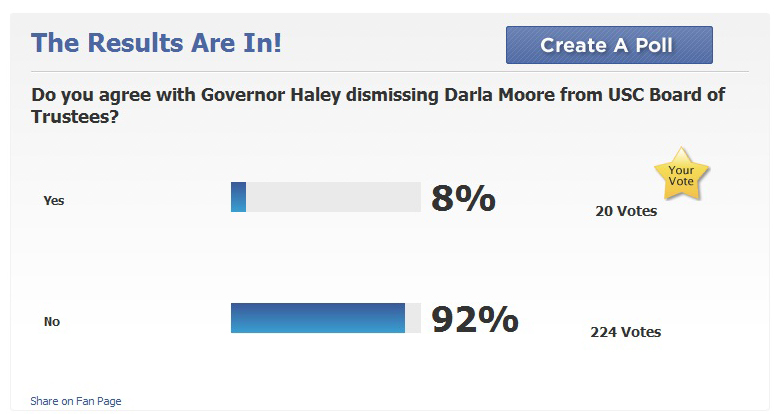
First and foremost, a thing where you go online and click “yes” or “no” to a current-events question is not a POLL, in any meaningful sense. It has no statistical significance. If you don’t have a properly constructed sample, with the right elements of randomness and screening questions (“are you the head of household, etc.”), you cannot extrapolate that the result you obtain indicates what you would get if the entire population, or electorate, answered the question.
A self-selected sample doesn’t cut it, not by a long shot. It’s a great way to invite readers/viewers to sound off — they like that — but it doesn’t generally give you much, if anything, to base conclusions on.
Yeah, I know — 244 respondents, which makes a self-selected survey even MORE meaningless. But it still surprised me. Because for the last few days, any time someone says “This is going to cost her,” I say they are totally wrong, that Nikki made the calculation that her base wouldn’t care (or would even applaud, being so anti-elitist), and therefore she’s fine — from her perspective (certainly not from South Carolina’s).
It’s one thing for all the folks I run into at the Capital City Club to be shocked and appalled. One expects that, and Nikki Haley couldn’t care less. But this kind of populist thing should draw out the Haley fan club. For that matter, particularly with such low participation, it would be so easy to stack (which is the biggest reason you don’t regard self-selected “polls” as serious).
This result has NO statistical significance, but it’s SO lopsided. At the very least, it indicates a lack of eagerness on the part of her peeps to jump out and defend her. (I mean, did even ardent fan Eleanor Kitzman vote?) The way they rushed to back her on the WACH-Fox thing. What happened to that default mode of “If the elites and the media say it about our gal, it’s WRONG! And we’re gonna run out and shout it!”?
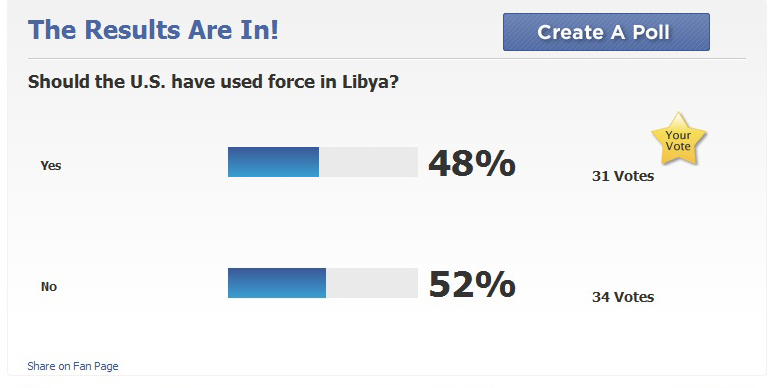
By the way, for what it’s worth… the latest WLTX nonpoll asked, “Should the U.S. have used force in Libya?” So far, this is how it’s going:
Yep, a dead heat. So far. And I figured that would be a blowout on the “yes” side. Because, you know, that’s something it looked like we had some consensus on before we went in. Of course, that consensus was among elites — including leading liberals who might otherwise oppose military action — and this is far from that. But that’s the factor that I thought would help Nikki on such a “poll” — at least to even things out for her. And it didn’t.
Once again, you can throw all of this out and you will have lost nothing of value — no methodology, tiny numbers. But it DID strike me as interesting, because it was such a blowout. And that’s all it is — interesting.
Gov. Nikki Haley made a grave misstep by removing philanthropist Darla Moore from the University of South Carolina’s board of trustees, said a vast majority of the people who responded to a two-day poll on the Daily Report.
Haley had few supporters of her move with only 7.1% saying they approve of her decision to replace Moore with Lexington attorney Tommy Cofield, who financially supported Haley’s campaign.
However, 78.8% want Moore back on the board; 44.2% of the respondents said Haley needs to admit her mistake and reinstate Moore, while 34.6% said the General Assembly should rectify the situation and by electing Moore to the board.
The remaining 14.1% asked who Tommy Cofield is.
Comments were fairly consistent, with the majority saying the move was “idiotic.”…
There was no methodology mentioned, so I figured this was an informal survey. I double-checked with CRBR Publisher Bob Bouyea, and he confirmed, “Informal poll.” Of course. No one in SC media has money to run real polls on the spur of the moment these days.
But I did find some of the comments interesting. Of course, they were fairly typical of what I’ve been hearing among the business movers and shakers, which is the same circle CRBR moves in.
As I say, interesting. Thought you might find it all interesting, too.
Busy day — speaking this morning, speaking tonight. Yakkety-yak. In fact, if you’re the last-minute type, you might want to attend the Politics and Media Conference at The Riley Institute at Furman tonight. I’m on a panel with some media types, followed by another panel with Bob Inglis and Vincent Sheheen. In fact, I’d better run if I’m going to get up there (no Virtual Front Page today, I’m afraid). They’ll feed me if I get there in time. But before I go, about this morning’s appearance…
Kelly Payne, the former state superintendent of education candidate who teaches a “Current Issues” class at Dutch Fork High School, is one of those… intense kinds of teachers you may remember from your own schooldays. A teacher with certain expectations. I remember them, because slackers like me tended to run afoul of them sometimes.
Anyway, Kelly asked me to come out today for a second time to speak to her class, so I guess it went OK the first time. I wanted to go straight to questions and answers, knowing the kids would have questions (I prefer that as a speaker; I don’t have to think as hard), but she asked me to talk for a few minutes first about “SC Politics,” so I started speaking nonstop about why we’re so different, why people say “there’s the South, there’s the Deep South, and there’s South Carolina,” starting with Lord Anthony Ashley Cooper and John Locke and the colonial period an The War and what followed, generally explaining to them in FAR more detail than they want to know why we have some of the problems we have, and why we are SO resistant to changing that fact, and…
… once they were good and glassy-eyed, I asked them to throw their questions at me. Because I knew they had some. In most high school classes I’ve spoken to (admittedly, I don’t do it often; I generally shy away from anything earlier than post-grad, because there’s only so much of that bored-kids look you can take), you can wait awhile for a question.
But not Kelly Payne’s class — because of what I said about intensity, and expectations and such.
I knew there were questions because they were printed out on the lectern in front of me, pages of them, with kids’ names attached. They were to ask them in order. So we got started. Unfortunately, the 90-minute class was over before we could get to all of them. In fact, we only got to the first eight. I like to give thorough answers. Anyway, here are ALL the questions, since they bothered to compile them:
Hailey
1. Explain the difficulties you’ve experienced in transitioning from being a full-time journalist to your current activities.
Horace
2. Since you were last here the media hasn’t made much progress in gaining the public trust. What will it take for it to improve at doing so?
Venisha
3. When you were an editor at the paper, did you have other editors to check your grammar and spelling to keep you from making mistakes?
Hannah Jane
4. How significant a factor are your feelings about a topic when you write a story? If you’re really angry or really happy about a topic do those emotions impair your objectivity?
Jaquarius
5. How can social media be an effective tool in reporting? What social media platforms do you use (e.g., texting, Twitter, Facebook) to deliver news content?
Ruby
6. What do you miss most about your old job at the paper?
Eric
7. Do blogs really move public opinion or do they just provide “some fun” for people in the Echo Chamber to take anonymous shots? Is there any way to assure a little more fairness in blogs?
Taylor
8. What do you think about requiring public officials who hire bloggers to shill for them to disclose those relationships in order to improve transparency and increase public trust?
Katherine
9. If elected officials make blog comments hiding behind assumed names, wouldn’t the publics’ interest in transparency and its desire for more civil conversation be better met by calling on those public officials to “man-up,” take ownership of their comments, and stop hiding behind assumed names?
Kelsi
10. How do you rationalize disagreements between your religious convictions and
your political beliefs? (i.e., gay rights)
Marshall
11. What should the response of the United States be to Gadahfi’s suppression of his own people?
Taylor
12. You’ve criticized the Governor for her appointment on the USC Board of Trustees. Please explain why you don’t believe that election outcomes matter.
Katherine
13. You seem very focused on the need for the Governor and her team to guard against “gender politics” yet your profession admonishes society on the need to be “gender sensitive.” Please explain this dichotomy.
Kelsi
14. Eleanor Kitzman recently spoke to our class and we loved her. Why do you criticize her for defending the Governor’s honor and performance given the Governor selected her for that position?
Lexie
15. Why do you think being loyal to the Governor makes Eleanor Kitzman disloyal to the other four Budget & Control Board members?
Shaun
16. The Governor has talked about more transparency with legislative votes and the Treasurer has talked about “calendar transparency.” Which of these ideas do you think is the most sophomoric?
Christian
17. Given that Senator Sheheen and the Governor are about the same age, why is he more appealing to young people?
Kenneth
18. What do you think should be done to keep deep pockets from having an excessive influence on election outcomes? (i.e., Bloomberg, Schumer, candidates supported by Howard Rich, etc.)
Christie
19. How soon do you think it will be before we see meaningful restructuring in state government?
Ben
20. Which of our Constitutional Officers would it make more sense to appoint? Explain your reasons.
Hailey
21. What’s your opinion of eliminating the Budget & Control Board and replacing it with a Department of Administration reporting to the Governor?
Andrew
22. Give the best reason to support and the best reason to oppose the Voter ID Bill?
Kenneth
23. Please explain the post you recently wrote on daylight savings time.
Evan
24. What is the legacy you hope to leave?
25. What do you think about paying teachers based on classroom outcomes?
26. Why are the two major political parties so segregated along racial lines?
27. How can South Carolina Republicans be so diverse as to have elected two Republican Senators that are so different in their ideology? (Lindsey Graham, Jim DeMint….earmarks)
28. I’m optimistic about the next generation of public servants — my fellow classmates and me– who will soon by making decisions that impact our daily lives. What advice can you give us as we move in this direction?
Frankly, with that many questions, I could have talked for a month. But it was great. Been pressed for time, I was really antsy this morning about all I had to do, and ran late and got lost (turns out that Kelly Payne doesn’t teach at Dutch Fork Middle School, which I went to first — they have a nice office — even though I’d been to the right place previously), and I was rattled.
But driving away, I felt nice and relaxed. Ninety minutes of high-speed, non-stop, stream-of-consciousness talking does that for me. It probably doesn’t do all that much for the people listening (so it’s nice when they HAVE to sit there and listen, or get a flunking grade), but I find it… calming. Probably why Freud was such a hit back in the day.
If I don’t hit the road, they won’t feed me in Greenville. As Vincent Sheheen’s Uncle Bob always used to say to bring interviews to a sudden stop: Gottagobye.
And yes, that IS a picture of me, speaking to the class last year, in the upper left-hand corner. Kelly's like that. Very thorough.
Graham Presses Obama Administration to Establish Libyan No-Fly Zone
WASHINGTON – U.S. Senator Lindsey Graham (R-South Carolina) today made this statement on the establishment of a No-Fly zone over Libya and what United States inaction means for our own national security. Graham is a member of the Senate Armed Services Committee.
“One test in foreign policy – at least be as bold as the French. Unfortunately, when it comes to Libya we’re failing that test.
“The French and British are right to call for a no-fly zone over Libya, and they are correct to recognize the forces opposing Gaddafi. I’m very disappointed by the indecisiveness of the Administration in the face of tyranny. They are allowing the cries of the Libyan people to fall on deaf ears.
“Allowing Gaddafi to regain control over Libya through force – without any meaningful effort to support the Libyan people – will create grave consequences for our own national security.
“The biggest winner of an indecisive America refusing to stand up to dictators who kill their own people, will be the Iranian regime. The Iranian regime has already used force against their own people when they demanded freedom. If we allow Gaddafi to regain power through force of arms, it is inconceivable to me that the Iranians will ever take our efforts to control their nuclear desires seriously.
“The world is watching, and time is beginning to run short. The Obama Administration should join with the international community to form a no-fly zone while it still matters.
“Then-Senator Obama relished the opportunity to label Iraq as President Bush’s war. If he does not act decisively in Libya, I believe history will show that the Obama Administration owned the results of the Gaddafi regime from 2011 forward.
“Their refusal to act will go down as one of the great mistakes in American foreign policy history, and will have dire consequences for our own national security in the years to come. I truly fear the decisions they are making today will come back to haunt us.”
#####
Yeah, that’s kind of what I thought the other day, when I saw that the French and the Brits were taking the lead on trying to coordinate an international response to try to stop Qaddafi from continuing to kick the stuffing out of the Libyan people who have risked their lives to fight our enemy for us (and, of course, for themselves and their country).
I don’t know what the right thing to do is — such things are complex — but the no-fly zone certainly seems like a measured response that would carry some likelihood of doing good. Unlike, say, boots on the ground, which Sen. Graham draws the line at.
Let’s get our money down, now: Who will be the first to criticize the senator’s common-sense assertion? An antiwar liberal Democrat, or one of those extremists in his own party who are pleased to trash the “RINO” at every opportunity. Cue the Jeopardy music…
It’s really hard to keep up with all the petty outrages (both “petty” and “outrageous” — yes, that seems about right) that our new young governor keeps pumping out.
I’m a busy guy — working, blogging, trying to grab a little sleep at night — and sometimes find myself momentarily out of the loop. Particularly when there are so many far more important things going on in the world. Let’s see, the Japan earthquake, Qaddafi (I’ve gotten to where I just spell his name with the first combination of letters that my fingers hit, so I hope that suits) moving to crush the rebellion while the world is distracted with Japan, Saudis intervening in Bahrain and people getting killed… And sometimes you have to put even that aside, and do other stuff…
So when I finish my Virtual Front Page and close the laptop, I sometimes don’t see any new developments until 7ish the next morning. Which is why I was taken aback at the very first Tweet I saw this morning:
I replied, “Well, she’s this rich lady from South Carolina who tries to give back to her home state. That’s the Twitter version, I guess…” And I went on to breakfast. There, the grill room at the Capital City Club was buzzing with what I didn’t know about, since I hadn’t sat down to read the paper yet (don’t ask me why it wasn’t on thestate.com when I was doing the Virtual Front Page yesterday; maybe it was and I just missed it). The state and community leaders weren’t going, “Did you hear about Darla?” It was more like, “What do you think of the news?” Period.
Yep, this stuff happens to me, too. Not often, but sometimes.
So I sat down, and I read the paper. And I Tweeted this out:
Nikki Haley dumping Darla Moore is classic case of naked, arbitrary exercise of patronage power….http://tinyurl.com/4nu4of8
You can congratulate me later for having gotten a link, an editorial point, “Nikki Haley,” “Darla Moore,” and “naked” into the Twitter format (with 14 characters of room left!). Let’s move on to the substance.
And the substance is… well, what I just said. It just doesn’t get any more blatant, plain, slap-in-the-face, I-don’t-care-what-you’ve-done-for-our-state-or-this-institution-I’ve-got-my-own-guy than this. Just bald, plain, take-it-for-what-it-is. Although I do have to hand it to Haley staffer Rob Godfrey for managing to twist the knife a bit with this bit of sarcastic insouciance:
Asked why the appointment was not announced, he said: “Given that there are over 1,000 appointments to boards and commissions the governor can make, we never intended to have a press conference for each one.”
Because, you know, Darla Moore isn’t any more important than that.
At the Cap City Club this morning, one of the regular movers and shakers made a rather naive and innocent remark (sometimes movers and shakers can surprise you that way), honestly asking, “How do you just brush aside someone who’s given $100 million to South Carolina?” (Yeah, I know she’s only pledged $70 million to USC and $10 million to Clemson, according to the story, but I guess he was rounding.)
I replied, patiently, here’s what Nikki Haley would say to that (were she brutally honest, of course): “She didn’t give ME a hundred million dollars. Tommy over here gave me $3,500. I don’t understand the question.” That’s Tommy Cofield, by the way, a Lexington attorney.
People who are not movers and shakers (and who in fact have a sort of visceral aversion to movers and shakers) can say some naive things, too. Over in a previous comment, our own Doug said “Are we assuming that Sheheen wouldn’t have replaced anyone he didn’t like?”
To that, I responded once again with the painfully obvious: “No, Vincent would not have replaced Darla Moore with an unknown, minor campaign contributor in such a prestigious post. If that’s what you’re asking.” Of course, I should have added, “without a reason.” By that, I would mean a valid reason, one that takes South Carolina’s and USC’s legitimate interests into account, one that is not just arbitrary.
Oh she GAVE what I suppose some folks (probably including Doug, believing as he does that there is nothing so deleterious to society as experience and commitment to the public weal) will regard as a reason: “As is the case with many of our appointees, the governor looked for a fresh set of eyes to put in a critical leadership position…”
That’s it.
And if you are one of the people who takes Nikki Haley at face value, as her supporters tend to do, and you don’t know or care about Darla Moore or the University of South Carolina — you just like to cheer on your Nikki — that will suffice. In with the new, out with the old. She will feel in no way obligated to explain what was wrong with Darla Moore’s service on the board, or to cite any of the exciting new ideas that her appointee brings to the table that were previously missing. No one will expect that of her; it probably wouldn’t even occur to her to think about it. The governor will skate on this with these people — this is something that is core to her whole approach to politics ever since she transformed herself into the darling of the Tea Party in preparation for her run for this office for which she was so unprepared.
This WORKS for her. She skates on this, just as — with the voters she cares about — she will skate on apparently having told a prospective employer in 2007 that she was making $125,000 a year when she was telling the IRS that she made $22,000. This will matter not. People are just picking at her. The nasty, powerful, status quo people — those people who hang out at the Capital City Club! — are picking at Nikki because they’re mean, you see. (By the way, on the “petty” vs. “outrageous” spectrum, the thing on the job application is more the typical “petty” violation of her alleged principles that we have come to expect; the Darla Moore thing, dealing as it does with the leadership of such an important state institution, is more of an “outrage.” If you’re keeping score.)
She will not only skate, but her supporters — or at least, this is what the governor banks on — will continue, in spite of all evidence, to see her as a champion of transparency, a reformer, a nemesis of “politics as usual” and patron saint of Good Government. Which just, you know, boggles the mind if you’re the sensible sort who thinks about things.
That’s the plan, anyway. And that’s why she did this, and really doesn’t care if you, or the university, or the business community, or Darla Moore don’t like it.
The quixotic demonstration at the State House yesterday by citizens sick of seeing our state’s infrastructure rapidly eroding under the stewardship of shortsighted politicians was of course an exercise in futility.
But I’m no stranger to that. A few minutes ago, looking for a link for a previous post that needed one, I went back to the last week of posts on my old blog I had at the paper, and ran across this forgotten item — which, as it happens, was day after the post in which I announced that I had been laid off:
Good job rejecting the tuition caps
This might sound strange coming from a guy who was already counting pennies (or quarters, anyway — I miscounted how many I had this morning in my truck, and ended up with a parking ticket because I didn’t have enough for the meter), with my two youngest daughters still in college. And now I’m about to be unemployed.
But I’m glad the House rejected tuition caps at S.C. colleges and universities. I have an anecdote to share about that.
Remember the recent day when college students wandered the State House lobbying lawmakers on behalf of their institutions. They wanted the state to invest in higher education the way North Carolina and Georgia have. Either that day, or the day after, I had lunch with Clemson President James Barker, and he told me an anecdote he had witnessed: He said the students were pressing a lawmaker NOT to support the tuition caps, because they were worried about their institutions being even more underfunded — they hardly get anything from the state — some are down below 20 percent funding by the state, and the rest has to come from such sources as tuition, federal research grants and private gifts. Eliminate the ability to raise tuition, and the institution’s ability to provide an excellent education is significantly curtailed. If we want lower tuitions, the state should go back to funding higher percentages of the schools’ budgets, the way our neighboring states with better higher ed systems do.
The lawmaker listened to the kids, and then said with great condescension, maybe you kids don’t care if tuition goes up, but I’ll bet your parents would like a cap. He thought he had them there, but the kids set him straight: None of their parents were paying the bills. These kids were working their way through schools and paying for it all themselves. And they didn’t want to see the quality of what they were working so hard to pay for be degraded by an artificial cap on tuition. The lawmaker had not counted on getting that answer.
I wish I had been there to see it, because I’ve been in a similar place before. Back in 95 or 96, Speaker Wilkins had brought his committee chairs to see us, and I started challenging the wisdom of their massive rollback of property taxes paid for school.One of them allowed as how he bet I was glad to get that couple of hundred dollars I didn’t have to pay. And I answered him that I was ashamed that I was paying so little through my property tax to support schools that I knew needed more resources. He said smugly that he was sure I wouldn’t want to give it back. I told him I didn’t see as how there was any channel for doing that, but if he could point me to the right person who would take my money and see it gets to the right place, I would pay the difference. He didn’t have a good answer for that.
It would be great if our lawmakers would stop assuming that all of us in South Carolina are so greedily shortsighted that we can’t see past our personal desire to pay less money, and that we are corruptible by a scheme to starve colleges of reasonable support.
Reading that now, with all that’s happened since — the rise of the Tea Party, the eagerness of Republicans, demoralized after their 2008 defeat, to embrace destructive extremism (and of course, what happens to the Republican Party as happens to South Carolina, which it dominates), the election of Nikki Haley over more experienced, less extreme candidates of both parties — it reads like thoughts from another century. And, of course, another place.
Imagine, even dreaming of our state caring enough about education to invest in it the way our neighboring states have, much less suggesting that we do so. How anachronistic can one get? All that’s happened since then is that South Carolina has run, faster every day, in the opposite direction — with out elected leaders firmly convinced that that is not only the right direction in which to run, but the only one.
The president at this afternoon's presser. (Official White House Photo by Lawrence Jackson)
Well, gasoline prices are rising toward levels that might, just might, cause some of us to face reality and acknowledge that it’s not a good idea at all to be so desperately dependent on cheap oil from crazy-dangerous parts of the world, and what are our elected leaders — Democrats and Republicans — doing?
Why, what they always do — pandering. But there’s pandering, and then there’s pandering.
The GOP is busily blaming Barack “Root of All Evil” Obama. The president himself is responding by saying, at a press conference today, that he’s prepared to tap the strategic oil reserve, if needed.
But that last part is key, and his way out as a rational man. It’s like his promise to “start” withdrawing troops from Afghanistan by a certain date, which in no way commits him to draw down dangerously before it’s wise to do so. Obama’s smart; he’s not going to pander so far that he commits himself to something irresponsible. This is a quality that he has demonstrated time and again, and which has greatly reassured me ever since he beat my (slightly) preferred candidate for the presidency. This is the quality — or one of them — that made me glad to say so often, back in 2008, that for the first time in my editorial career, both major-party candidates for president were ones I felt good about (and both of whom we endorsed, in their respective primaries).
It’s certainly more defensible than Mr. Boehner’s reflexive partisan bashing. And it’s WAY more defensible than Al “Friend of the Earth” Gore asking Bill Clinton to tap the reserve to help him win the 2000 election.
Obama said he’s prepared to tap the U.S. emergency oil reserve if needed. But as gas prices climbed toward $4 a gallon, the president said the U.S. must adopt a long-term strategy of conservation and domestic production to wean itself off foreign oil.
“We’ve been having this conversation for nearly four decades now. Every few years gas prices go up, politicians pull out the same political playbook, and nothing changes,” Obama said.
“I don’t want to leave this to the next president,” he said.
Some in Congress have been calling on Obama to tap the Strategic Petroleum Reserve. And the president made clear Friday that that was an option, although he indicated he wasn’t yet prepared to exercise it. He declined to specify the conditions that would trigger the step, but said it was teed up and could happen quickly if he chooses to call for it….
His threshold, based on what he said, is a Hurricane Katrina, or worse. Personally, I’d raise the bar a bit higher than that, but he’s on the right track, trying to set a high standard. (You make a disruption like Katrina the standard, then next thing you know, you’re tempted to lower it to, say, a BP oil spill — and that’s not the direction you want to go in.)
The key word here is “strategic,” a threshold that I would think wouldn’t be crossed until we have a sustained inability to GET oil to power our economy — something we came close to, in spots, in recent crises. But it seems to me one only turns to such “strategic” options as a last resort. The president should be “prepared to tap the U.S. emergency oil reserve if needed” in the same sense he is expected to be prepared to crack open the “football” and activate the codes for going nuclear. OK, maybe that’s a bit extreme, but you get where I’m going with this. It’s something we hope and pray never happens, and we do our best to pursue policies that avoid such an eventuality.
“They’ve canceled new leases for exploration, jeopardized our nuclear energy industry, and imposed a de facto moratorium on future drilling in our country. They’ve even pushed a cap-and-trade energy tax that the president himself admitted would cause the price of energy to skyrocket,” Boehner said.
Republicans have repeatedly criticized the administration and congressional Democrats for what they perceive to be a lackluster response to the rapidly rising cost of oil.
… but half a point, in the hands of partisan ideologues, is a very dangerous thing.
I say “half a point” because the president is no more an Energy Party man than the speaker is. Both of them only see the half that their respective ideologies allow. Boehner is for drilling, domestic exploration, nuclear energy and the like. Obama is for alternative energy sources, conservation, and other “green” initiatives. When the truth is, we need to do ALL of those things, and more, to achieve the critically important (economically and strategically) goal of energy independence.
Yet another way that our two-party system prevents our leaders from even considering real, comprehensive solutions to compelling national problems. Which is another reason we MUST not allow them to further strengthen their death grip on our electoral system.
One other thing: I allowed this comment from our persistent gadfly Steven/Michael/Fred/Luke/etc. earlier today:
GREENVILLE, SC (AP) – South Carolina Republicans hope a federal judge will set the stage for closed primaries that require voters to register by party.
The Greenville Republican Party and state GOP are pushing for the legal ruling at a Thursday hearing in a Greenville federal courtroom.
A ruling there could change South Carolina’s taxpayer-funded presidential, state and local primaries.
South Carolina’s attorney general has asked that the case be dismissed.
It is also opposed by the Columbia Tea Party, members of the state Legislative Black Caucus, the Independence Party of South Carolina and IndependentVoting.org.
Oh, and before my liberal friends counter that Once again, you’re forcing a false nonpartisan parity by refusing to recognize that only those awful Republicans would do such a thing, and Democrats never would, allow me to remind you that leading Democrats tried to do this very thing (although a different way) in 2006, by requiring that anyone voting in the presidential primary here had to swear to being a Democrat. (Then-chairman Joe Erwin heroically stepped in at the very last minute to stop it, to his everlasting credit.)
At least with the Republicans, it sort of makes a twisted kind of sense for them to try to close primaries, since they see it to their advantage as the majority party. For the Democrats, with their dwindling ranks, it made NO sense to bar independents such as myself from voting in a Democratic primary. Golly, who knows — they might get into the habit!
Anyway… I haven’t seen yet what happened in court today. But this is one time that I’m rooting for the Tea Party (if I understand it rightly and they are opposing the GOP on this — it was a little hard to tell from that brief item; the wording was sketchy.)
You know what I think? I think we ought to do like Louisiana, and let everybody vote in a single primary that candidates of all parties (and nonparties) vote in. That way the citizens, rather than parties, get to decide which two candidates they’ll be choosing from in the fall. When the UnParty takes over, that’s the way it will be here.
UPDATE:
Arguments were heard today, but the judge apparently hasn’t decided the case yet. The update was as sketchy as the original item, unfortunately. I’m hoping to see something more complete, because this deserves a MUCH wider airing.
I think I have it straight, now: if you disagree with Brad’s position, you are guilty of being over-emotional. If you agree, you are being rational. Brad, you really need to let this one go. You like to talk about “left and right” and position yourself as someone in a calm, unemotional, rational center, but the truth that you have opinions on various issues just like anybody else. They tend not to divide in a partisanly-predictable way, which indicates that you think for yourself on each issue, and that’s certainly admirable. But we are all human, and every considered opinion by every truly thinking citizen (and you certainly are that, as are almost all the commenters here) is a combination of emotion and reason, at least as that individual sees it. You’re not immune from that combination of factors, and it’s argumentatively lazy to just dismiss someone’s disagreement as saying, in effect, “well you’re just emotional and I’m rational, so the argument’s over.” You were off base on the other thread on jfx’s comment, which was no less a combination of emotion and reason than your own reasons for endorsing our invasion of Iraq. Most conservatives who criticize Obama are NOT nutty “birthers” and practitioners of Obama-Derangement-Syndrome; and most who think Blair was a slick prevaricator on the war can’t be dismissed as purely emotional BDS-ers. (That would be at least half the planet in that case.)
I certainly don’t pretend that my opinions are devoid of an emotional basis: and for the record, going back to Mr. Schiller, my point was not that the right wing or the left wing is more prone to emotionalism or even rhetorical over-the-top-ness; but that anti-intellectualism per se is (at least at this moment in American history) a cudgel wielded in particular by the right. It’s inexact for you to say that Mr. Schiller was equally guilty of “the worst kind of anti-intellectualism”: that would mean he would be doing such things as criticizing Tea Party leaders for “sounding like a professor,” just one of the gibes (meant to be an insult, I guess) directed at our current President. Schiller was guilty of a lot of things, stereotyping and overgeneralization among them, but anti-intellectualism is a very different and very specific thing.
I’ve been running from meeting to meeting today, which is why I hadn’t posted anything until a few minutes ago. But I was here for about 15 minutes right after Phillip posted that, so I wrote a medium-length reply, and just as I was about to save it and run out… Google Chrome shut down. Then Firefox shut down. Then EVERYTHING ELSE I had open shut down, spontaneously. And my laptop started restarted itself, and just as I ran out the door screaming, I saw it was adding insult to injury by running CHKDSK.
When I get back, ol’ Hal calmly informed me that he had taken it upon himself to download the following::
– Update for Windows 7 for x64-based Systems
– Security Update for Windows 7 for x64-based Systems
– Update for Microsoft Office Outlook 2003 Junk Email Filter
– Security Update for Windows 7 for x64-based Systems
I’m betting none of it was necessary. And I don’t see why the blasted machine couldn’t give me heads-up first.
Of course, everyone here at ADCO will tell me that’s what I get for insisting upon being the only person in the office who doesn’t use a Mac. On that subject, and having just mentioned HAL, you might enjoy this Apple ad.
Anyway… if I can remember, here’s what I was going to say to Phillip… But first, I’m going to “Save Draft”…
OK, here goes…
Phillip, your initial observation — “if you disagree with Brad’s position, you are guilty of being over-emotional. If you agree, you are being rational” — is slightly off the mark. That’s not a hard-and-fast law of the universe. It’s more like a useful rule of thumb.
Insert smiley-face emoticon.
But you were dead-on when you said, “you have opinions on various issues just like anybody else. They tend not to divide in a partisanly-predictable way, which indicates that you think for yourself on each issue, and that’s certainly admirable.”
Absolutely! Thank you for getting that! Of COURSE I have opinions! This is an opinion blog!
And thanks particularly for the “admirable” thing.
But to elaborate… as I try over and over to explain here, I am repulsed by the left and the right, Democratic and Republican, as they are currently constituted — because I DO think hard about each issue, which means I don’t accept the pat, off-the-shelf packages that the two predominant ideologies offer.
It’s like cable TV. The thing I’ve always hated about cable TV is that they won’t let me choose, and pay for, only the channels I want. Not because it’s technologically difficult, but because it doesn’t fit the cable companies’, or the networks’ and channels’, business model. They force me to take channels I don’t want in order to get the channels I DO want, because they make more money that way (I think; if that’s not the motivation, someone please explain it to me).
Same deal with the political parties, or the two main competing ideologies. Both Column A and Column B offer some ideas I like. But each of them also offers ideas I utterly reject. There’s no way I can buy either package and be honest with you, or with myself.
The problem is, our shared marketplace of ideas lacks a vocabulary for speaking of the way I think. I try hard to come up with a vocabulary of my own, using ordinary English words, but they so often run up against the problem that certain definitions and delineations are now assumed to be true by everyone, and my ideas don’t connect, even with very smart people. That’s because 24/7 we are bombarded with the political equivalent of Newspeak. If you’ll recall, the way Orwell conceived it, the goal was to reduce language so that it was impossible to express (and therefore, to a great extent, impossible to think of) ideas that were incompatible with IngSoc.
Well, today, the terms that most of us use for expressing political ideas are very limited terms handed to us by the two parties, their attendant interest groups, and increasingly simplistic news media, led by 24/7 TV “news” and the Blogosphere — all of whom find it in their interests to boil everything down to two choices — actually, two SETS of predetermined choices, so that once you pick one, everyone else knows what you think about everything.
I find this appalling. And I continue to resist it. And even though I’m not bad with words, I find it hard, like Winston trying to write half-formed heretical concepts into his diary, just out of sight of the telescreen. Only I’m publishing mine.
But it’s sometimes hard to express. And even when my friends and regular readers UNDERSTAND it, it’s hard for them to describe, because of our lack of that common vocabulary. So when Phillip says I “position yourself as someone in a calm, unemotional, rational center,” I know what he means, and he’s right to say it. But the fact is, I’m not in the center at all, although you’ll occasionally see me acquiesce to being called a “centrist,” just as a convenient shorthand.
But the problem with that term is that it implies that one MUST be on that one-dimensional line between left and right, and that if you ARE neither left nor right, you must be in the “center.” But I’m not. Sometimes I agree more or less with the left, and sometimes with the right. And sometimes neither the left nor the right is far enough out on its own wing to suit me. To paraphrase Billy Ray Valentine, when it comes to the political spectrum, I’m all over that place, baby.
I’m made this point before, such as on this post, and even back in my initial UnParty column. And in a variation on that theme, the Energy Party is all about taking the best ideas from left and right to do all we can to attain energy independence.
OK, I just went on at far greater length than I did on my failed comment earlier — perhaps out of frustration. And as I’ve written every word, I’ve been cognizant that if anyone is patient enough to read it all, he or she is likely to say, That Brad Warthen just thinks his thoughts are so far above everyone else’s that no one else is smart enough to understand him.
But that’s not it. If I were smart enough, I’d be able to explain it better, I suppose. I just get frustrated, because our common vocabulary HAS been reduced by people who have found it to their political advantage to do so, just like Big Brother, so I struggle to express what I truly think. Most people who are as uncomfortable as I am with the either-or paradigm just give up, curse politics, and walk away from it all. I don’t feel like I can do that as a citizen. I have to keep trying, whether I succeed or not. (And whether I get paid a salary to do it or not.) Which is why I’ve written all these millions of words over the years.
Did y’all see the followup this morning in The State about Nikki Haley’s dollar-a-year guy?
An efficiency adviser for Gov. Nikki Haley has set up a nonprofit group to research and advocate the best ways for government to operate.
Christian Soura, a former secretary of administration for the Democratic governor of Pennsylvania, quietly agreed to work for Haley for $1 a year in January. Soura said Thursday he was living off his Pennsylvania pension and the sale of his Harrisburg home while making that $1 salary.
However, Soura, 32, said Friday that he also plans to raise money for — and be paid by — the newly minted South Carolina Center for Transforming Government.
Critics of the governor responded by charging her with yet more hypocrisy, saying she wants to know where legislators earn their money but is not forthcoming about her own staff’s income and its sources.
Soura said his organization has no donors or commitments yet. It would act as a think tank for ideas about reducing state government’s administrative and operating costs. The paperwork creating the non-profit was filed with the S.C. secretary of state on Feb. 24…
So it turns out I was right in my initial guess, that this guy was actually going to be paid by some sort of ideological advocacy group allied with the Mark Sanfords of the world (a category that includes our current governor).
And OK, so it wasn’t a national group (so far as we know — it will still be interesting to see where its money comes from), which makes me only half right. And it wasn’t an existing group, as he had to set it up himself. (Enterprising young man — very New Normal.)
But half right isn’t bad for total conjecture.
Also, you’ll note that this guy being a 32-year-old who had been living on a PA state pension (plus money from selling his house in Harrisburg) is still the operative story. So the weirdest part of the tale is still the official version.
As you know, I strenuously resist any attempt to place me along America’s left-right political spectrum, even to the extent of being in the middle. Personally, I just don’t feel comfortable anywhere on that line, and “middle” suggests always being somewhere between the two extremes (or, to use another paradigm I reject, between the two parties), which I most certainly am not. Depending on the issue, sometimes I’m in the middle, sometimes I agree with Democrats, sometimes with Republicans, and sometimes I’m out beyond either of them on their respective “wings.”
That’s because I think about each issue and the various factors bearing upon it, rather than buying a prefab set of values selected by someone else to appeal to some variation on the lowest common denominator. I passionately believe that that’s an inadequate, and intellectually dishonest, way to approach important public issues.
Considering all of that, I was intrigued by a chart Herb Brasher shared with me, which was compiled by his son, a teaching fellow in political science at Indiana University.
Here’s the description. The chart itself is above:
I’ve been thinking about messing around with a 3-dimensional model of partisan ideology for a while. Usually we only talk of right vs. left, although some political science literature works with two dimensions. While somewhat difficult to display for an artistically challenged person like me, I make a rough shot at placing European, Canadian, and American parties in a more complex political spectrum. Any thoughts, suggestions?
1) Parties / Party Families
a) SOC: European socialists
b) SOD: European Social Democrats and some socialists; British labour; Canadian NDP;
c) Green: Greens/environmental parties
d) CD: European Christian Democrats
e) DEM: American Democrats
f) CON: European and Canadian conservatives
g) LIB: European liberals
h) CLIB: Canadian Liberals
i) REP: American Republicans
j) TEA: American Tea-party
2) Partisan Ideology Dimensions:
a) Some assumptions:
i. Instead of the common left-right model, or even two-dimensional one in some political science literature, a three-dimensional one; added complexity, but also better representation of reality?
ii. Note: all parties fit within the liberal democratic framework – I’m not including parties that want to get rid of democratic regime form
b) Dimensions
i. Free vs. social market – degree to which party advocates government involvement in the economy, and social welfare policies
ii. Environment vs. Growth – degree to which party advocates environmental protection, quality of life vs. growth of economy (particularly jobs) – this is separate from the
above issue – strong interventionist parties, like the social democrats, are not traditionally known as pro-environment (blue-collar jobs, etc.)
iii. Secular-Religious – degree to which party/party family either rhetorically or programmatically promotes traditional vs. progressive values; or situates itself as a secularizing force, or protective of religion, etc.
3) Interpreting Party Position
a) Position: I place the parties in the figure based on a quick and dirty assessment of its ideological positioning vis-à-vis each of these dimensions
b) Size: I’m assuming that each party ‘box’ is the same size; however, in order to get a 3D effect, the bigger the box appears in the figure (and the bigger the font), the closer it is to the front, and the smaller, the further back it is. In this case, since the secular-religious dimension is the third dimension, the more secular a given party/party family is, the further up front it is, the further back, the more religious.
Unfortunately, this did not help place me, really — except, if you assume that these are the three axes that must be considered, to put me right in the middle, even in three dimensions. Here’s why:
Free vs. Social Market — This just doesn’t cause a flutter in my heart either way. The libertarians on the blog will cry, “He’s a statist!,” but I’m not. I sound like it sometime because the prevailing wind in South Carolina is radically libertarian, libertarian to a harmful degree, and I resist it strenuously in an effort to pull the conversation toward a neutral middle ground. I believe there is nothing inherently superior about either the public or the private sector (which is why I’m always arguing with people who believe, ideologically, that the private is inherently better — I never run into anyone on the opposite side of that equation to argue with). There are simply issues that are better solved one way, and others that are better solved another.
Environment vs. Growth — I’ve cared deeply about the Earth since before the first Earth Day, when I was in high school. But I think some people take some really ridiculous, harmful positions in the name of love of the Earth. I reject those who reflexively reject nuclear power, for instance. And of course we should drill in the ANWR and offshore — taking care to do so safely. In fact, my whole Energy Party Manifesto sits squarely along the center of this axis. Or perhaps I should say, borrows from various points along it. And one of the reasons why is that I think the country’s strategic position in the world is tied up with, and just as important as, the two issues on this axis. That affects the way I look at both.
Secular-Religious — No question that I endorse the First Amendment and the liberal democracy it makes possible. I also think secularists are off their trolleys with their oversensitivity about religion in public life, seeing every small expression — a nativity, a blue law, a public prayer — as some sort of establishment of a theocracy. So again, I can’t be comfortable in either camp.
The thing is, I think a lot more than those three factors are involved, and I try to take all the other factors into account as well. So does the UnParty, bless them.
Catching up on my e-mail, I ran across this release from our friend Wesley over with the Senate Republicans:
Senate passes bill giving DHHS budget flexibility
The state Department of Health and Human Services needs to crawl out of a $228 million hole for this fiscal year, alone. Next year, deficit estimates top $500 million. But, it doesn’t have to stay this way. That’s why Senate Republicans led the fight today to pass S. 434 — it removes budgetary constraints on the actions of agency director Tony Keck and gives him and his department more flexibility as it comes to this fiscal crisis.
The legislation, chief sponsored by Senate Majority Leader Harvey Peeler and cosponsored by Senators Kevin Bryant and Lee Bright, requires the ability to purchase generic drugs instead of more expensive name brands. Most importantly, it repeals part of a proviso that stopped any DHHS director from modifying the schedule by which doctors and hospitals were paid through the state’s administration of Medicaid.
“This bill is all about untying Mr. Keck’s hands and allowing him to do his job as effectively as he can,” Peeler said following the vote. “That doesn’t mean he has to cut programs, it means he can cut. With such a huge deficit, we need Keck to be running his own agency, not micromanaged by the legislature.”
The bill’s passage is also seen as a win for Gov. Nikki Haley. It both invests more power to an executive branch agency and hands those reigns over to one of her recent appointments. The budgetary problems within DHHS — and Medicaid in particular — have been high on issues to address for both the governor and the legislature as they entered this session.
Keck has said that he’s looking at making health care providers modify their staffing ratios, increasing patient co-pays and taking a hard line in favor medical tort reform. Senate Republicans are ready to help him in any way possible fix the agency’s financial problems.
“Flexibility.” I like that. It reminds me of when people who want to increase taxes call what they’re doing “revenue enhancements.” When conservatives in SC want to cut spending on life-and-death essentials, they call it “flexibility.” As euphemisms go, it’s sort of breathtaking.
I especially liked this part, so I’ll repeat it:
“This bill is all about untying Mr. Keck’s hands and allowing him to do his job as effectively as he can,” Peeler said following the vote. “That doesn’t mean he has to cut programs, it means he can cut. With such a huge deficit, we need Keck to be running his own agency, not micromanaged by the legislature.”
Translation: We’re going to flat make these cuts, but we are not going to take the responsibility. That’s what the governor hired Mr. Keck to do. Interesting how sometimes, the Senate sees granting power to the executive as a good thing. Take note, boys and girls. Take pictures, and remember so you can tell your own children, because this doesn’t happen often. Normally, as Cindi wrote on Wednesday, or Legislature is “fixated… on micromanaging the most mundane minutiae of state government…”
But flexibility — that’s a good thing, right? Sounds good, anyway.
Here’s the way what the Senate did was described by a neutral party (which is why we have the MSM):
The S.C. Senate gave key approval Thursday to a bill allowing immediate cuts in state payments to doctors and hospitals that treat patients in the state-run health care program for the poor and disabled.
Gov. Nikki Haley and the Department of Health and Human Services have sought to cut those payments in order to make up part of a $225 million deficit at the state’s Medicaid agency. Agency director Tony Keck said the state could save $2.4 million between now and June 30 for every percentage point that it cuts those payments.
The bill also requires HIV, AIDS, cancer and mental-health patients to use generic drugs or get prior approval from the state’s health agency to use more expensive, non-generic drugs.
So you’ve seen it described two ways — by the perpetrators and by the news media. Now, here’s the assessment of someone at the other end of the spectrum. Samuel Tenenbaum, the head of Palmetto Health Foundation, came to my table at breakfast to make sure I knew what was going on from the perspective of health care providers. He said it’s not a fiscal issue, but a moral issue, for this reason: Cut back on payments for care, and “people will die.”
This, of course, will be dismissed by folks at the first end of the spectrum who will describe Samuel as a bleeding-heart liberal Democrat whose ox is being gored. They’ll tell him to get out there and work harder raising money for the hospital, if he’s so concerned. But you know, I don’t distrust the judgments of people who are actually involved in the complex business of paying for health care. I tend to think that they, the involved parties, more than anyone else, may actually understand the situation. Call me crazy.
Later in the day, Samuel sent me this set of more formal talking points, elaborating on his stark assessment at breakfast:
• The Problem
Former Governor Mark Sanford originally requested $659 million to fund the Medicaid program for fiscal year 2011-12. Governor Nikki Haley and her Medicaid director Tony Keck reduced that request by over $200 million. More than half of that reduction would be made up by reducing Medicaid payments to hospitals, physicians and other healthcare
providers.
• South Carolina Hospital Association Proposal
SCHA member hospitals support a temporary increase in the $264 million hospital contribution to the state’s Medicaid fund as opposed to a cut in hospital provider rates.
• Why contribute rather than cut?
• A 10 percent reduction in the rate paid to hospitals will “save” $47 million in state funds but “cost” the state almost $170 million in federal matching funds. As Mr. Beaman has stated, a 10 percent cut for Palmetto Health will result in a $22 million loss to our system.
• Over 2600 South Carolina hospital jobs will be put in jeopardy.
So there you have it, a sort of Three Bears approach — perspectives on the issue from both ends and the middle. See what you think.
Sometimes my readers spend time thinking about an issue at some length, and write me a note about it, and suggest I write about it on the blog — and I realize it will be days before I find time to think about it as much as they have (if I ever do), so… why not just post that reader’s thoughts? Sort of what I did with Kathryn’s contribution the other day… although I solicited that; this one just came in over the transom.
Anyway, here’s what Mark Stewart thought yesterday after reading an editorial on the subject in The State:
Brad,
I read The State editorial this morning and thought that they came close but missed the boat on a few key points that might make for an interesting discussion on your blog.
After education, I believe that the Port of Charleston is perhaps the most important driver for economic prosperity across the state over the next fifty years. I don’t normally grandstand on words like this, but I would argue that this issue may be one of EPIC proportions for South Carolina. As happened with airline hubs, the emergence of a new shipping paradigm, the 50’ depth for super-container ships, will render obsolescent most of the remaining American ports as far as international trade goes. Only a few of the ports will be viable in this new world. This will lead to an even greater consolidation of economic activity.
The clear winners will be Los Angeles/Long Beach; New York/NJ; Norfolk, VA and Seattle. But there will likely be a few others. One of those might be a Southeastern port. At present Savannah is the nation’s fourth-largest container port. But it has a serious issue – it is 35 miles up a river which is now only 42 feet deep. As Charleston did in the 1830’s when it drove the first Southern railroad to Augusta, The Port of Charleston has the opportunity now to seize back the economy of North Georgia from Savannah. With a mega port, South Carolina would have the opportunity to become the hub of the Southeast and parts of the Midwest, funneling the economies of Atlanta and Charlotte along the way – and possibly also of Florida.
Georgia recognizes this need/opportunity in a way that South Carolina does not. And yet, the Obama administration did not support Savannah’s request to begin the dredging process just as it did not provide funds to Charleston. I believe this is because, unlike with New York and Norfolk, it is not clear who the winner will or should be in the Southeast.
That’s an opportunity.
But here is where The State’s editorial missed the entire picture. Simply dredging Charleston is not the answer. The real problem is on the land. The thing that will hobble South Carolina’s future is the current lack of a robust port to railroad connection. What is the point of dredging the harbor channels to a depth of 50 feet if the intermodel connections to move freight throughout the state and region efficiently are not there? Now trucks clog I-26 and the local roadways in North Charleston and yet that city continues to fight more complete rail access to the Port terminals. Worse still, the largest container terminal is on Mt. Pleasant and not even near a rail line. So the issue really isn’t whether all politicians support the allocation of federal funds for dredging, it’s does the State of South Carolina support the creation of the landside infrastructure that would make the decision to dredge deeper a rational one?
The second point that the editorial touched on, but did not hammer home is this: Sen. DeMint wants to promote legislation to have the Corps of Engineers be the party ultimately responsible for selecting which of America’s ports are dredged to the new trade standard. What he seems not to understand is that this is not a scientific process of comparing variables. It is instead a political knife-fight. Yes, items such as channel depths, distances to open water, intermodel connections, and port terminals are critically important in advocating one’s position. But what we are really talking about is the economic future of our state. It’s not just that there will be winners and losers; it is that the winners will see compounding economic growth. If Sen. DeMint does not understand that this is an issue of politics and that the U.S. Congress will be the ultimate battleground, then maybe national politics isn’t the right place for him. We are not talking about philosophical viewpoints on the issue of earmarks; we are talking about representing the State of South Carolina in the most important battle for our long-term economic vitality and growth. Senator DeMint is not showing any sort of leadership on this issue – in fact, it appears that he does not even realize what the issue is or that the fight is already on.
Do I agree with Mark on this (as I do on most thing, although not all)? Well, really, I agree with him and The State both. And I’ll add that, like The State, I’m a little more sympathetic than Mark seems to be toward Sen. DeMint’s desire to have the Corps decide. I think that’s a solid, Good Government 101 approach, and I hesitate to endorse Mark’s approach of saying we just need to squeeze all the political advantage for SC that we can out of this situation.
Again, I like The State‘s approach — concede the rightness of the senator’s original intent, but point out in no uncertain terms that such laudable original intents do NOT excuse his subsequent boneheaded behavior on the issue. Here’s what I mean:
Mr. DeMint says he’s focused on convincing the Congress to change the law so that the U.S. Army Corps of Engineers can use its own judgment to decide which projects to pursue, rather than abiding by the political dictates of the president and the Congress. It’s a wonderful idea, and not just because any honest evaluation of our nation’s ports needs would conclude that the Charleston harbor is a better investment of federal dollars than other ports whose deepening is being funded. But there is no realistic chance that it’s going to pass, which means that he has an obligation to work on Plans B and C as well. (If Mr. Wilson or any of our four new members of Congress have any plans for getting the port deepened absent a presidential request or a congressional earmark, they’re keeping them to themselves.)
Would their signatures have guaranteed that President Obama included the funding in his budget? No. In fact, Mr. DeMint might well be correct when he says that it would have made no difference. But he might not be, and the need is so great, and the cost to him and Mr. Wilson so low that it is simply incomprehensible that they would refuse to lend their names to a letter. Their refusal is akin to a mother whose child needs a life-saving operation she can’t afford refusing to sign a letter that her husband wrote to a charity asking for help simply because the charity’s director roots for a different ball team than she does.
One more thought, on one facet of this issue: At some point, South Carolina has to make a decision which it’s going to respect more: the desires of the rich Yankees who move to Charleston (and rich neoConfederates allied with them) and don’t want any nasty commerce spoiling the quaintness they paid for, or the desperate need of this whole state for economic development. Or maybe South Carolina has already decided, and decided wrong. In which case, it’s time to think again.
And finally, I want to thank Mark for getting me to address this important issue. And I addressed it in the best possible way, in the mind of an old assigning editor: I got somebody else to do all the work. Cindi Scoppe and many others who worked for me as reporters will recognize my modus operandi.